
Mulberry (Morus nigra / Morus alba)
OriginThe Silk Road Tree
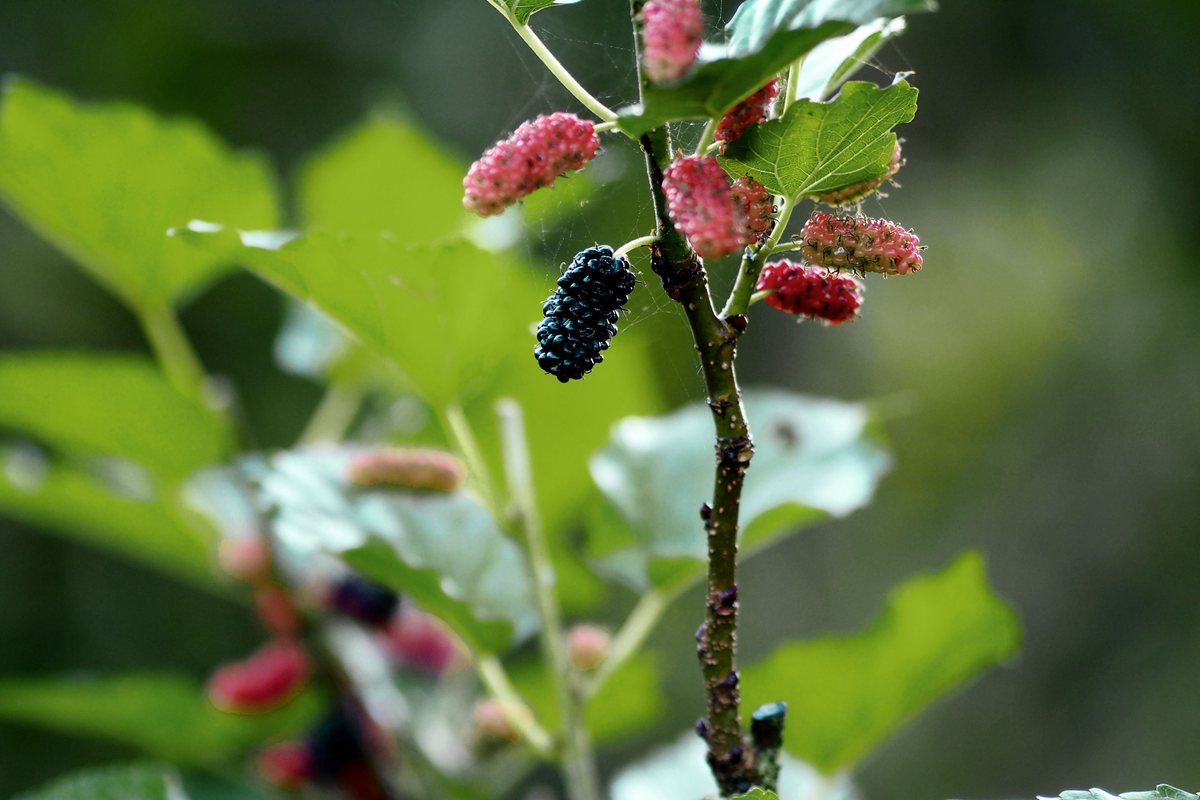
Without the white mulberry, there would be no silk: The silkworm caterpillar eats almost exclusively its leaves.
The white mulberry originates from China, where its leaves have been used to feed silkworms for millennia. With the knowledge of silk production, the tree spread westward along the Silk Road. The black mulberry comes from Persia and Western Asia and was cultivated by the Greeks and Romans for its fruit. Ovid recounts that its berries were darkened by the blood of the lovers Pyramus and Thisbe.
In 18th-century Germany, Frederick the Great had thousands of mulberry trees planted to establish a domestic silk production. These plans failed due to the climate, but some old trees still stand today in parks and village churchyards. Dried mulberries sold commercially come predominantly from Turkey, where the white variety is cultivated on a large scale.
To useWhat mulberries can do for you
Fresh mulberries contain only about 43 kcal per 100 g and provide about 36 mg of vitamin D. Vitamin C as well as just under 2 mg iron - a high value for fruit Anthocyanins, especially cyanidin-3-glucoside, which gives the berries their deep color. White mulberries contain hardly any anthocyanins and therefore taste particularly sweet.
When dried, everything becomes concentrated: The berries turn into a sweet, slightly crunchy treat. snack High in fructose, but also containing fiber, iron, and calcium. As with all dried fruits, a handful is best, not the whole bag.
The leaves the white mulberry contains 1-Deoxynojirimycin (DNJ). This substance inhibits enzymes in the intestine that break down starch and sugar—similar to the diabetes medication acarbose. In small studies, mulberry leaf extract lowered the rise in blood sugar and insulin levels after a meal. Long-term studies are rare and inconsistent; the US National Centre for Clinical Immunology and Health (NCCIH) rates the data as mixed. The berries contain only small amounts of DNJ.
IngredientsThis is what's in mulberries
The fruits contain water, fructose and glucose, some acid, fiber, vitamin C, vitamin K, potassium, iron, and calcium. They also contain anthocyanins (in darker varieties), flavonols such as quercetin and rutin, phenolic acids such as chlorogenic acid, and small amounts of resveratrol.
The leaves contain 1-deoxynojirimycin and other imino sugars, flavonoids, chlorogenic acid, and a high protein content – which is why they are so nutritious for silkworms. Unripe fruits, bark, and leaves contain a white milky sap that can irritate the skin and stomach.
Enhanced combinationsWhat makes mulberries stronger
Mulberries are sweet and soft - they need some acidity, bite or creaminess alongside them.
Enhances the aroma of the sweet white variety.
As a snack mix.
Dried in muesli instead of sugar.
Fresh berries as a topping.
Fruit brings both with it.
Similar look, different aroma.
What contradicts itselfIt's best to avoid these combinations.
Milky sap can irritate the stomach and intestines.
Lots of fructose.
Risk of hypoglycemia - only after consultation.
They become mushy within hours.
The juice stains strongly.
The available research is insufficient to support this.
In the kitchenWhere they belong
- Fresh from the treeIdeally, they should be picked fresh.
- MuesliDried instead of raisins.
- trail mixWith nuts and seeds.
- mulberry jamWith lemon and gelling sugar.
- Yogurt toppingFresh black berries.
- SmoothieWith banana and oats.
- CakeLike a crumb cake with blackberries.
- syrupTurkish style, cooked as Dut Pekmezi.
- lettuceWith arugula and feta cheese.
- Mulberry leaf teaKnown as Kuwacha in Japan.
As a home remedyMulberry leaf tea
Mulberry leaf tea
- Add 1 to 2 teaspoons of dried white mulberry leaves to a cup.
- Pour over 200 ml of hot, but no longer boiling, water.
- Let it steep for 5 to 10 minutes and then strain.
- Drink with or shortly before a starchy meal.
As a mild beverage to accompany carbohydrate-rich meals. The leaves can slightly dampen the rise in blood sugar after eating – however, the extent to which this is achieved with a simple tea has hardly been studied.
One to two cups daily. Those taking diabetes medication or insulin should consult their doctor or pharmacist beforehand, as the effects may be additive. Bloating and loose stools are possible.
Ayurveda & TCMWhat the old systems say
Ayurveda
In Ayurveda, the mulberry is considered Tuta It is well-known. The ripe fruits are considered sweet, cooling, and nourishing – balancing Vata and Pitta. Unripe fruits are considered heavy and sour.
Traditional Chinese Medicine
In Traditional Chinese Medicine (TCM), the mulberry tree is a whole pharmacy: The leaves (Sang Ye) are said to dispel wind-heat and clear the eyes, the fruits (Sang ShenThese are considered sweet and cold and are said to nourish yin and blood. Root bark and twigs are also used.
Warning noticesWhen you should be careful
Please note
- Unripe fruit: and the white milky sap from leaves and bark can irritate the stomach, intestines and skin.
- Diabetes: Mulberry leaf extracts can cause hypoglycemia when used with blood sugar-lowering medications - only use after consulting a doctor.
- Digestion: Leaf extracts often cause bloating or loose stools.
- Allergy: Mulberry pollen and fruit can trigger allergies; cross-reactions with figs are possible.
- Dried fruits: high in fructose - enjoy in moderation.
This page provides information and does not replace medical advice. If symptoms persist, please consult a doctor.
Related to the topicRead on and cook along!
Shop links lead to our product pages; it is indicated there if a partner is involved.
SourcesWhat is this based on?
- USDA FoodData Central: Mulberries, raw.
- Thaipitakwong T, Numhom S, Aramwit P. Mulberry leaves and their potential effects against cardiometabolic risks: a review of chemical compositions, biological properties and clinical efficacy. Pharmaceutical Biology 2018; 56(1): 109–118.
- Lown M et al. Mulberry-extract improves glucose tolerance and decreases insulin concentrations in normoglycaemic adults: Results of a randomized double-blind placebo-controlled study. PLoS One 2017; 12(2): e0172239.
- Yuan Q, Zhao L. The Mulberry (Morus alba L.) Fruit - A Review of Characteristic Components and Health Benefits. Journal of Agricultural and Food Chemistry 2017; 65(48): 10383–10394.
- National Center for Complementary and Integrative Health (NCCIH): White Mulberry Leaf: Usefulness and Safety.


