
Durian (Durio zibethinus)
OriginThe king with the house ban
In Singapore, carrying durian on public transport is prohibited - a special sign shows the fruit with a red line.
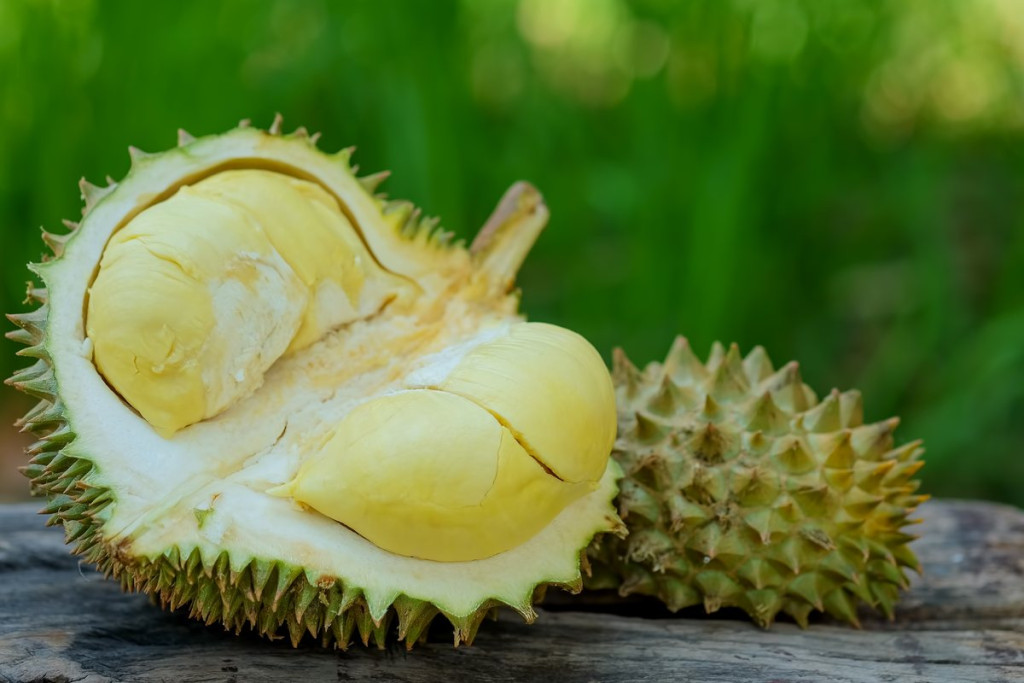
The durian tree originates from the rainforests of Borneo and Sumatra and grows up to 50 meters tall. Its spiky fruits weigh one to three kilograms and fall from the tree when ripe – anyone standing underneath is in danger. Thailand alone has over 300 named varieties; the most well-known is Monthong With thick, mild flesh and small seeds - the best choice for beginners.
The durian fruit has a mixed reputation. In Southeast Asia, it's a status symbol and a gift; entire families gather around a freshly opened durian. At the same time, hotels and public transport companies from Singapore to Bangkok have banned bringing it into the country because the smell lingers in carpets and air conditioning systems for days. In Germany, durian is usually found frozen in Asian grocery stores – its scent is considerably less pronounced when frozen.
To useWhat Durian does for you
100g of fruit pulp provides approximately 147 kcal and about 5.3g of carbohydrates. Fat - exceptionally high for a fruit; most tropical fruits contain less than 1 g. In addition, there are approximately 27 g of carbohydrates and 3.8 g of... Dietary fiber, approximately 436 mg potassium, 20 mg vitamin C, 36 µg folate, and plenty of vitamins B1 and B6. Two to three segments are equivalent to a small meal.
The smell is caused by volatile substances. Sulfur compounds. A German research group has measured the aroma compounds of the Monthong durian variety: A combination of sulfur-containing thiols and fruity esters is responsible – hence the impression of onion, cheese, and honey all at once. A 2017 genetic analysis found many active genes for sulfur metabolism in the durian genome.
In Southeast Asia, the rule is not to combine durian with alcohol – and there's more to this than superstition: In laboratory tests, durian extract inhibits the enzyme. Aldehyde dehydrogenase, The enzyme that breaks down alcohol further metabolizes the toxic acetaldehyde. Whether this plays a role in humans is unknown. To be on the safe side, it's best to abstain from alcohol on an evening when eating durian.
IngredientsThis is what's in the durian
Durian contains sugars from sucrose, glucose, and fructose, an unusually high amount of fat including oleic and palmitic acid, fiber, protein, potassium, magnesium, copper, manganese, vitamin C, folate, as well as vitamins B1, B2, and B6. It also contains carotenoids for its yellow color and polyphenols.
The smell is due to sulfur-containing compounds, including ethanethiol, di- and trisulfides, and fruity esters. The kernels are not edible raw; roasted, they are eaten like chestnuts.
Enhanced combinationsWhat makes durian stronger
Durian is loud and sweet - it tolerates coolness, salt and bitterness better than even more sweetness.
The smell remains more subtle.
Thai classic.
It catches the sweetness.
It enhances the aroma remarkably.
In Asia, it's the cooling opposite.
Fat and sugar add up quickly.
What contradicts itselfIt's best to avoid these combinations.
Possibly inhibited alcohol breakdown.
That's equivalent to several meals.
The smell lingers for weeks.
Everything else absorbs the smell.
Only digestible after cooking or roasting.
Lots of sugar and fat at once.
In the kitchenWhere she belongs
- Durian with sticky riceWith coconut milk, like mango sticky rice.
- Durian ice creamThe gentlest introduction.
- Durian shakeWith milk or coconut milk.
- Durian pancakesThin pastry, cold cream.
- TempoyakFermented durian from Sumatra.
- MooncakesSweet filling for pastries.
- Roasted kernelsLike chestnuts, common in Southeast Asia.
- Durian cheesecakeStirred cold, no baking required.
- Curry with TempoyakSavory and fermented.
- Freeze-dried chipsThe snack for the cautious.
As a home remedyDurian shake when appetite and weight are lacking
Durian shake
- Remove the seeds from 80 to 100 g of thawed durian fruit flesh.
- Blend until smooth in a mixer with 200 ml of milk or coconut milk and a pinch of salt.
- Add half a banana and some lime juice to taste.
- Drink well chilled in small portions throughout the day.
As a calorie-dense recovery shake, it can be used when appetite is reduced and weight has been lost after illness. In Southeast Asia, durian is known precisely for this: high energy in a small volume. It does not replace medically supervised nutritional therapy.
One glass a day is sufficient. Consult a doctor beforehand if you have diabetes, kidney problems, or are on a prescribed diet.
Ayurveda & TCMWhat the old systems say
Ayurveda
Durian is not described in classical Ayurveda. According to modern classification, it would be sweet, heavy, oily, and distinctly heating – beneficial for Vata, but only in small quantities for Pitta and Kapha.
Traditional Chinese Medicine
In Southeast Asian folk medicine and Western Traditional Chinese Medicine (TCM) nutrition, durian is considered strongly warming and restorative. Traditionally, mangosteen is eaten alongside it as a cooling counterpoint – the „queen“ to the „king“.
Warning noticesWhen you should be careful
Please note
- Alcohol: It's best not to mix durian and alcohol - laboratory tests suggest an inhibition of alcohol breakdown, although human data is lacking.
- Calories: Very high in fat and sugar; only small portions for diabetics.
- Potassium: The high potassium content should be taken into account in cases of impaired kidney function.
- Cores: Do not eat raw, only cooked or roasted.
- Odor: Carrying them is expressly forbidden in many hotels, airplanes and public transport in Southeast Asia.
- Maturity: Eat or freeze any broken fruit quickly.
This page provides information and does not replace medical advice. If symptoms persist, please consult a doctor.
Related to the topicRead on and cook along!
Shop links lead to our product pages; it is indicated there if a partner is involved.
SourcesWhat is this based on?
- USDA FoodData Central: Durian, raw or frozen.
- Li JX, Schieberle P, Steinhaus M. Characterization of the major odor-active compounds in Thai durian (Durio zibethinus L. „Monthong“) by aroma extract dilution analysis and headspace gas chromatography-olfactometry. Journal of Agricultural and Food Chemistry 2012; 60(45): 11253–11262.
- Maninang JS, Lizada MCC, Gemma H. Inhibition of aldehyde dehydrogenase enzyme by durian (Durio zibethinus Murray) fruit extract. Food Chemistry 2009; 117(2): 352–355.
- Teh BT et al. The draft genome of tropical fruit durian (Durio zibethinus). Nature Genetics 2017; 49(11): 1633–1641.
- Aziz NAA, Mhd Jalil AM. Bioactive compounds, nutritional value, and potential health benefits of indigenous durian (Durio zibethinus Murr.): a review. Foods 2019; 8(3): 96.


