
Chervil (Anthriscus cerefolium)
OriginThe leaf of joy
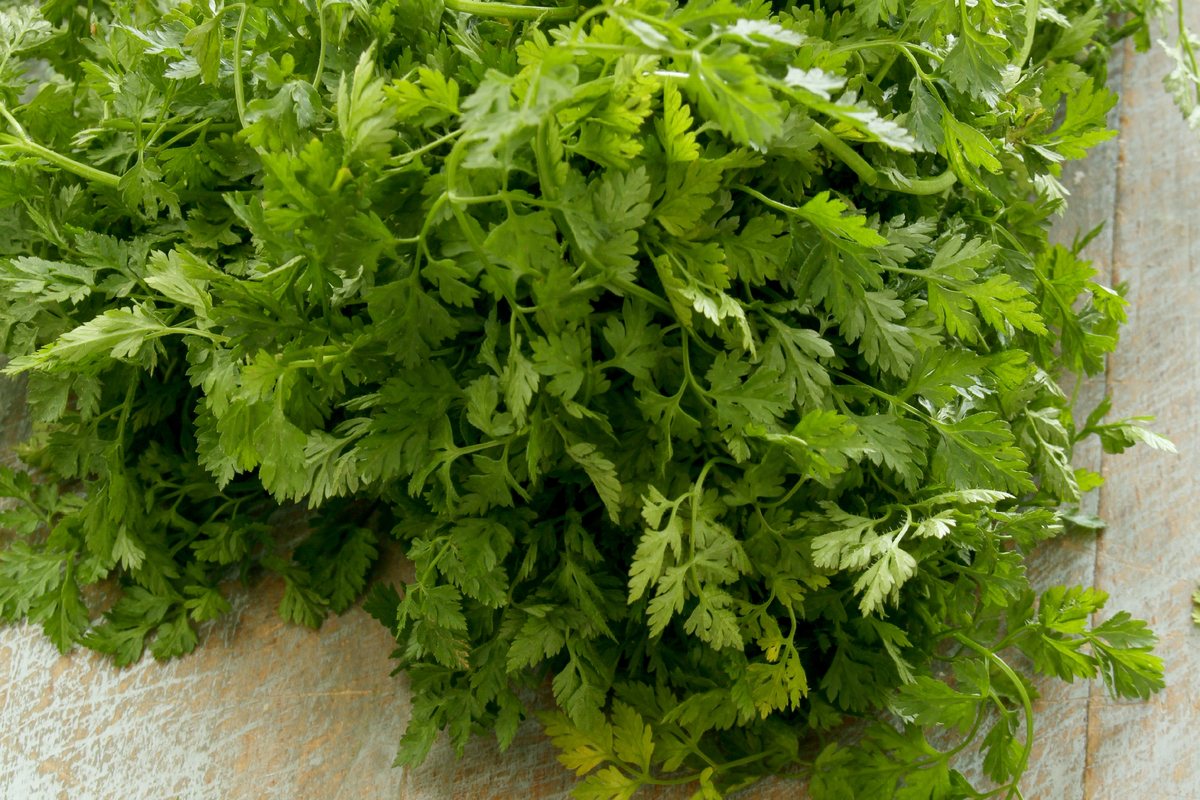
The Latin name cerefolium goes back to the Greek chairephyllon back - usually translated as "leaf of joy".
Chervil likely originated in the Caucasus and the adjacent regions of Southeast Europe and West Asia. Its exact origin is difficult to pinpoint, as the Romans cultivated it early on and spread it throughout Europe with their legions and gardens. In the Middle Ages, it grew in almost every monastery and farm garden.
In Germany, chervil is closely associated with Easter. Maundy Thursday soup, often simply called chervil soup, is eaten on the Thursday before Easter – green herbs symbolizing spring and the end of Lent. In France, chervil is considered one of the fine herbs, along with parsley, chives and tarragon. And in Hesse, it is one of the seven herbs in Frankfurt Green Sauce.
To useWhat chervil does for you
Dried chervil is, on paper, a nutrient concentrate: according to the USDA, 100 g provides around 1,350 mg. Calcium, 32 mg iron, lots of potassium and plenty Provitamin A. However, you only eat pinches of it, and fresh chervil consists mostly of water. A handful of fresh leaves primarily provides some vitamin C, carotenoids, and folate – a small but welcome contribution in spring.
Chervil owes its aroma to the essential oil. It is dominated by Estragole (Methylchavicol), plus 1-allyl-2,4-dimethoxybenzene – hence the anise and tarragon notes. Also included are... Polyphenols such as chlorogenic acid and luteolin glycosides. In the laboratory, chervil extracts have antioxidant and antimicrobial effects, but there are no studies on humans.
Folk medicine used chervil as a diuretic and digestive spring herb, and also as a remedy for hiccups – though there is little evidence to support these claims. Its more practical use lies in the kitchen: chervil adds flavor to soups, eggs, and spring vegetables without the need for much salt.
IngredientsThat's what's in chervil
Chervil contains essential oil with estragole (methylchavicol) and 1-allyl-2,4-dimethoxybenzene as its main components, as well as phenolic acids such as chlorogenic acid, caffeic acid and ferulic acid, flavonoids such as rutin, luteolin-7-glucoside (cynaroside) and apigenin glycosides, and carotenoids, vitamin C, folate, calcium, iron and potassium.
The essential oil is volatile and heat-sensitive. Even brief cooking and drying cause a large part of the aroma to be lost – dried chervil therefore has only a faint flavor.
Enhanced combinationsWhat makes chervil stronger
Chervil is quiet. It needs mild partners and should never be cooked.
The classic of French cuisine.
Delicate with delicate.
As fine herbs.
It carries the delicate aroma.
For dips and green sauce.
Anise flavor goes well with fish.
What contradicts itselfIt's best to avoid these combinations.
Remove from the stove first, then put in.
Poisonous doppelgangers.
They completely cover him up.
It loses almost all its aroma.
It wilts quickly, best eaten fresh.
Concentrated estragole.
In the kitchenWhere he belongs
- Maundy Thursday soupChervil soup for Easter.
- Frankfurt Green SauceOne of the seven herbs.
- scrambled eggsWith chervil and chives.
- Herb omeletFrench with fine herbs.
- asparagusWith chervil butter.
- herb quarkServe with boiled potatoes.
- Spring saladLeaves completely plucked underneath.
- troutWith chervil and cream sauce.
- Carrots and peasSprinkled on top at the end.
- VinaigretteWith lemon and mustard.
As a home remedyChervil soup for Maundy Thursday
Chervil soup
- Dice 1 onion and 2 floury potatoes and sauté them in 1 tablespoon of butter or oil until translucent.
- Pour in 750 ml of vegetable stock and simmer gently for about 15 minutes until soft.
- Remove the pot from the heat, roughly tear a large bunch of chervil (about 50 g) and add it.
- Puree everything finely, season with a splash of cream or plant-based cream, salt, pepper and a little nutmeg.
- Sprinkle with a few fresh chervil leaves and serve immediately.
A light, green spring meal after winter and for Easter. Potatoes provide potassium and are filling, while chervil adds aroma, carotenoids, and some vitamin C.
A portion can be served as a starter or light dinner. Eat fresh and do not keep warm for long or reheat, otherwise the chervil will lose its flavor.
Ayurveda & TCMWhat the old systems say
Ayurveda
Chervil is not described in classical Ayurveda. According to modern classification, it is considered light, mildly warming, and sweet-aromatic – balancing Vata and Kapha, and well-tolerated by Pitta in culinary quantities.
Traditional Chinese Medicine
Chervil is not traditionally used in Traditional Chinese Medicine (TCM). Western TCM dietary theory classifies it, like other umbelliferous herbs, as slightly pungent and warming, stimulating the digestive system and the middle.
Warning noticesWhen you should be careful
Please note
- Confusion: Chervil looks similar to poisonous umbellifers such as hemlock and fool's parsley. Never collect wild chervil – only use garden chervil from a store or from your own seeds.
- Fool's parsley: It grows as a weed in gardens and can mix into herb beds. When crushed, it has an unpleasant smell, while chervil has a distinct anise scent.
- Estragole: Typical kitchen quantities are considered safe. Avoid concentrated extracts or essential oils, especially during pregnancy, breastfeeding, and with children.
- Allergy: Cross-reactions with celery, carrot, fennel and mugwort are possible.
- Skin: The sap of umbellifers can irritate the skin when combined with sunlight. Wear gloves when doing a lot of gardening.
This page provides information and does not replace medical advice. If symptoms persist, please consult a doctor.
Related to the topicRead on and cook along!
Shop links lead to our product pages; it is indicated there if a partner is involved.
SourcesWhat is this based on?
- USDA FoodData Central: Spices, chervil, dried.
- Stojković D et al. Extract of Herba Anthrisci cerefolii: chemical profiling and insights into its anti-glioblastoma and antimicrobial mechanism of actions. Pharmaceuticals 2021; 14(1): 55.
- Chizzola R. Composition of the essential oils from Anthriscus cerefolium var. trichocarpa and A. caucalis growing wild in the urban area of Vienna (Austria). Natural Product Communications 2011; 6(8).
- Federal Institute for Consumer Health Protection and Veterinary Medicine (BgVV, now BfR): Minimizing estragole and methyleugenol levels in food. 2002.
- WWF Germany: Wild herbs and poisonous look-alikes.
- Chamber of Agriculture North Rhine-Westphalia (Landservice): Chervil.


