
OriginThe thistle with the milk drops
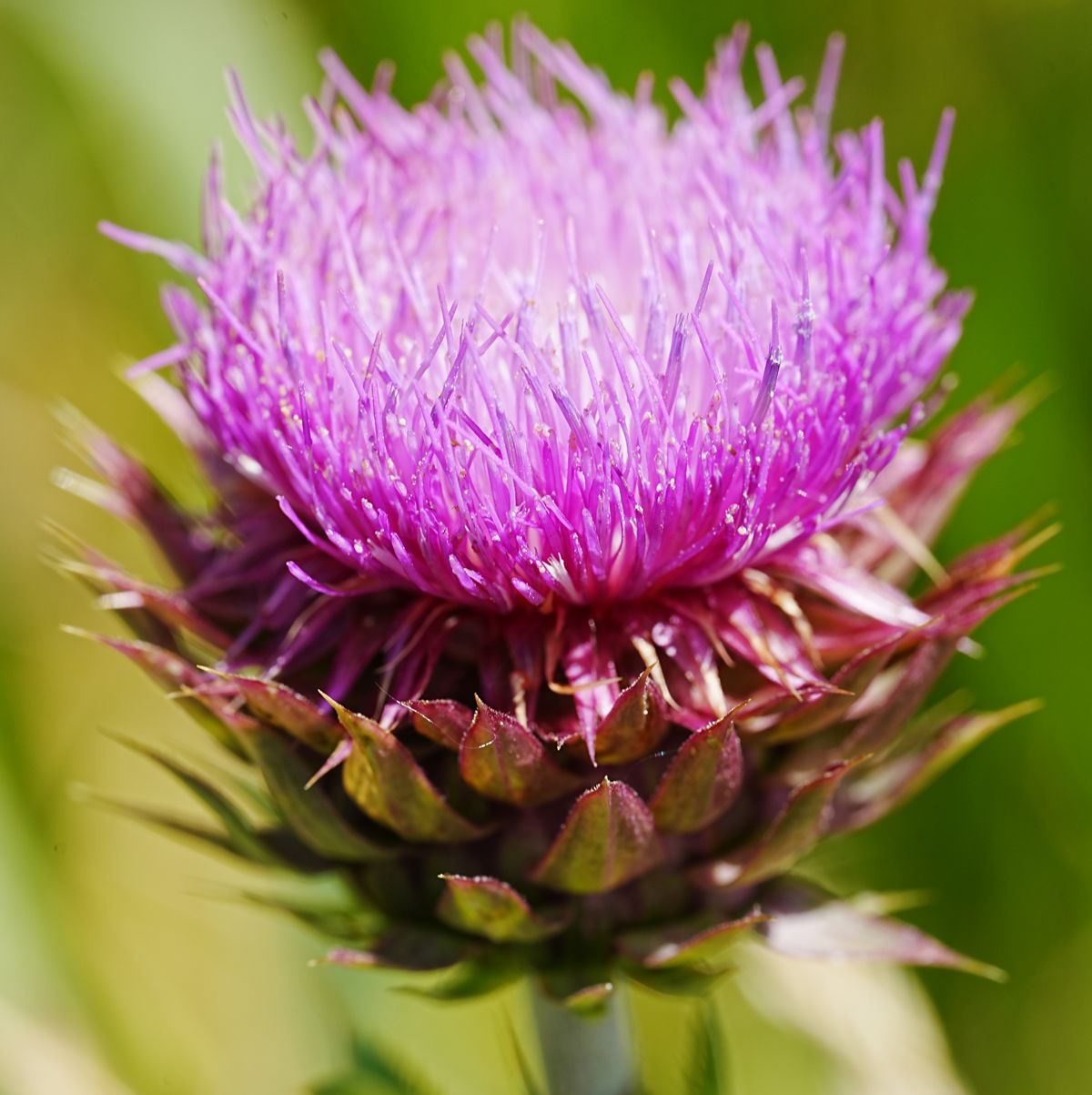
The white veins on the leaves are said to have come from the milk of Mary - hence the name milk thistle.
Silybum marianum is an annual or biennial thistle from the Mediterranean region that grows up to one and a half meters tall and bears large, purple flower heads. Its leaves are striking: dark green, spiny, and crisscrossed with white veins, as if milk had spilled over them. This is precisely how Christian legend explains the name – that the Virgin Mary's milk dripped onto the leaves while she was breastfeeding. The species name Marianum This interpretation is confirmed.
Its use is ancient. Dioscorides describes it, Pliny mentions it in connection with liver ailments, and in medieval medicine it was a standard treatment for liver and gallbladder problems—a remarkably stable association that has hardly changed for over two thousand years. In the 19th century, eclectic medicine in America also employed it for liver and gallbladder diseases.
The modern history of milk thistle began in Munich in 1968. A research group isolated an active ingredient complex from the fruits and named it silymarin. This led to the development of a standardized preparation, which in the following decades became one of the few herbal remedies to have a firm place in clinical practice. In 1990, milk thistle was chosen as the medicinal plant of the year. In Central Europe, it can now also be found growing wild – on rubble heaps, roadsides, and in vineyards.
To useWhere the evidence is strong - and where it isn't.
The European Medicines Agency distinguishes between two categories for milk thistle, and this distinction is key to understanding it. For standardized silymarin preparations, it specifies... well-established use as a supportive treatment for toxic liver damage and as an adjunct therapy for chronic inflammatory liver diseases and liver cirrhosis. She also recommends simple preparations, such as tea made from crushed fruit. traditional use For dyspeptic complaints – bloating and indigestion. These are two completely different products with two different levels of preparation.
The strongest evidence for silibinin lies in emergency medicine. In cases of poisoning by the death cap mushroom, intravenous silibinin is part of the standard therapy in Germany and many other countries. The mechanism of action is well described: Amanitin, the mushroom toxin, is absorbed into liver cells via a specific transporter, and silibinin competitively blocks this transporter. Registry data show lower mortality rates with this treatment. This is no longer herbal medicine, but intensive care medicine using a plant compound.
The picture is considerably more mixed when it comes to chronic liver diseases. A Cochrane review of milk thistle for alcoholic and viral liver disease found no convincing reduction in mortality or complications; the included studies were predominantly of low quality. More recent meta-analyses find moderate reductions in the liver enzymes ALT and AST, especially in non-alcoholic fatty liver disease. Decreased liver enzyme levels are a laboratory finding, not proof that the liver is ultimately healthier – we state this because this distinction is regularly blurred in advertising.
The underlying cause has been well-researched in the lab: silymarin scavenges free radicals, stabilizes cell membranes, and stimulates the regeneration of liver cells in animal models. However, its practical limitations are clear. Milk thistle is a complementary treatment for diagnosed liver disease. It is not a detox cure, a protective shield for the night before drinking, or a remedy that compensates for continued alcohol consumption. For those with fatty liver disease, weight loss and exercise are orders of magnitude more beneficial.
IngredientsSilymarin is not a single substance, but a mixture.
„"Silymarin" does not refer to a single substance, but rather a mixture of closely related flavonolignans: silibinin (in two forms, A and B), isosilibinin, silychristin, and silydianin, along with the flavonoid taxifolin. Silibinin usually makes up about half of the mixture and is the best-studied component. The exact composition varies depending on the origin and variety of the fruit, which is one reason why study results are difficult to compare across different preparations.
A key pharmaceutical problem is solubility. Silymarin is very poorly soluble in water, and its absorption from the intestines is correspondingly low. This directly explains why milk thistle tea does not achieve its medicinal effect: what doesn't dissolve cannot reach the body. The tea is a mild bitter tonic for digestion – the EMA-approved traditional use-Application - and nothing beyond that. Standardized extracts are needed for liver application, and some modern preparations use phospholipid complexes to improve absorption.
Therefore, two pieces of information are crucial when buying milk thistle: the silymarin content in milligrams and the type of extract. A product that simply states "milk thistle powder 500 mg" says nothing about the amount of active ingredient it contains. Studies usually use 200 to 400 milligrams of silymarin daily, divided into several doses – this is the benchmark against which a product must be measured.
Besides silymarin, the fruits contain 20 to 30 percent fatty oil with a high linoleic acid content and about 25 to 30 percent protein. The young leaves, stems, and flower heads are edible—milk thistle was once a vegetable, and the flower heads were prepared like artichokes, to which it is closely related. This is almost forgotten today, but it still works.
Enhanced combinationsWhat goes together with milk thistle
When it comes to liver-supporting plants, it's less about combinations and more about the right environment. The most important partners are not plants.
For non-alcoholic fatty liver disease, weight loss and exercise are by far the most effective measures – orders of magnitude more effective than any medication. Silymarin can be used as a complementary treatment.
In cases of alcohol-related liver damage, abstinence is the treatment. Taking a supplement alongside alcohol changes nothing – and using one to replace it is self-deception.
The artichoke is the plant for the gallbladder and for bloating after fatty meals, while the milk thistle is for liver cells. Both are members of the daisy family and are often sold together – which actually makes sense in this case.
For the traditional use-Application for bloating: crushed fruit in tea, together with gentian or wormwood.
Only preparations that specify the silymarin content can be evaluated. The studies have used a daily dosage range of 200 to 400 mg.
The flower heads can be cooked and eaten like artichokes, the young leaves, after removing the thorns, like chard. A forgotten vegetable.
What contradicts itselfIt's best to avoid these combinations.
The liver detoxifies itself naturally, every single day. There is no substance that meaningfully accelerates this process, and no study that proves a "liver cleanse." Anyone who buys a milk thistle detox program is buying into a false promise.
There is no evidence that silymarin protects against the effects of alcohol. Its use as a hangover preventative has not been studied, and the idea that it allows you to drink more is simply wrong.
Those who react to mugwort, chamomile, arnica or chrysanthemums may also react to milk thistle.
Silymarin can affect liver enzymes and transporters. Its use should be discussed with any patient taking immunosuppressants, HIV medication, cytostatic drugs, or anticoagulants.
Silymarin is barely water-soluble. The tea is a bitter tonic for digestion, not a liver treatment – that's not an opinion, it's chemistry.
Elevated liver enzyme levels should be investigated, not treated. They can be caused by hepatitis, medications, alcohol, metabolic disorders, or autoimmune processes.
ApplicationFrom plant to preparation - and back to the vegetable garden
- Standard extractCapsules with a declared silymarin content, 200 to 400 mg daily - the form used in studies.
- Phospholipid complexNewer preparations designed to improve poor solubility.
- tea1 teaspoon of freshly crushed fruit per cup, let it steep for ten minutes - as a bitter tonic for bloating.
- Grind fresh in a mortarThe fruit peel is hard; unground fruit yields almost nothing.
- tinctureAlcoholic extracts dissolve silymarin better than water, but are not standardized.
- Flower receptaclesHow to cook artichokes - a forgotten use of vegetables.
- Young leavesThorns removed and prepared like chard.
- StemsPeeled and steamed, with a flavor similar to salsify.
- GardenA striking, biennial structural plant; self-seeds readily.
- Check the label„Milk thistle powder“ without a silymarin indication says nothing about the amount of active ingredient.
As a home remedyTea - and what it can do
Milk thistle fruit as a bitter tea
- First, some context: This tea is classified by the EMA as traditional use It is a recognized remedy for bloating and indigestion. For liver use, a standardized extract is required – silymarin is poorly water-soluble.
- Crush a teaspoon of milk thistle seeds in a mortar. The hard shell must be broken open, otherwise the seed will release almost nothing.
- Pour over a cup of boiling water and let it steep, covered, for ten minutes.
- Strain and drink lukewarm - ideally twenty minutes before meals if it's about appetite and digestion, or afterwards if you feel full.
- Two to three cups daily. The taste is mild, nutty, and slightly bitter, significantly more pleasant than most bitter herbs.
- For liver use: a preparation with a declared silymarin content, 200 to 400 mg daily - and only under medical supervision in the case of existing liver disease.
This tea is for dyspeptic complaints, bloating, and loss of appetite. Standardized extracts can be used as a complementary treatment for diagnosed liver diseases – not as a detoxification therapy, nor as a preventative measure against alcohol.
Tea: 12 to 15 g of fruit daily according to Commission E, divided into two to three cups. Extract: 200 to 400 mg silymarin daily. Not suitable for those with a daisy allergy. Consult a doctor beforehand if taking immunosuppressants, HIV medication, cytostatic drugs, or anticoagulants.
Ayurveda & TCMWhat the old systems say
Ayurveda
Milk thistle is a Mediterranean plant and not included in classical Ayurveda. However, the liver is considered a central organ in Ayurveda – as the seat of… pitta and as a place of transformation - and the supporting plants for this area are Bhumyamalaki (Phyllanthus niruri), Kutki (Picrorhiza kurroa) and Kalmegh (Andrographis paniculataIn modern Indian phytotherapy, milk thistle is now also used, but with Western justification.
Traditional Chinese Medicine
Even in Chinese medicine, there is a lack of Silybum marianum in classical sources; in modern Chinese sources it appears as Shui Fei Ji and is marketed according to Western indications. Traditional drugs for the liver are different. Yin Chen Hao, the mugwort relative, against jaundice, and Chai Hu for what TCM calls "liver Qi stagnation". The concept of the "liver" in TCM only partially corresponds to the anatomical organ, which makes comparisons difficult.
Warning noticesWhen you should be careful
Please note
- No detoxification treatment: The liver detoxifies itself naturally. There is no evidence for a "liver cleanse" and no reason to buy a detox program.
- No protection against alcohol: Silymarin has not been studied as a preventative measure against alcohol poisoning. Anyone who believes it will allow them to drink more is mistaken.
- Elevated liver enzyme levels should be investigated: The underlying cause could be hepatitis, medication, metabolic disorders, or autoimmune diseases. Self-treatment only delays the diagnosis.
- Interactions: Silymarin can affect drug transporters and liver enzymes. Do not use without consulting a doctor if you are taking immunosuppressants, HIV medication, cytostatic drugs, or anticoagulants.
- Asteraceae allergy: Cross-reactions with mugwort, chamomile, arnica and chrysanthemums are possible.
- Tea is not a liver treatment: Silymarin is practically insoluble in water. For liver use, standardized extracts with a declared content are required.
This page provides information and does not replace medical advice. If symptoms persist, please consult a doctor.
Related to the topicRead on and cook along!
Shop links lead to our product pages; it is indicated there if a partner is involved.
SourcesWhat is this based on?
- European Medicines Agency, HMPC: European Union herbal monograph on Silybum marianum (L.) Gaertn., fructus - well-established and traditional use.
- Rambaldi A. et al.: Milk thistle for alcoholic and/or hepatitis B or C liver diseases. Cochrane Database of Systematic Reviews 2007.
- Mengs U. et al.: Legalon SIL: the antidote of choice in patients with acute hepatotoxicity from amatoxin poisoning. Current Pharmaceutical Biotechnology 2012.
- Zhong S. et al.: The therapeutic effect of silymarin in the treatment of nonalcoholic fatty liver disease - a meta-analysis. Medicine 2017.
- Commission E, monograph „Cardui mariae fructus“, BAnz No. 50 from March 13, 1986.


