
Medlar (Mespilus germanica)
OriginThe fruit from the monastery gardens
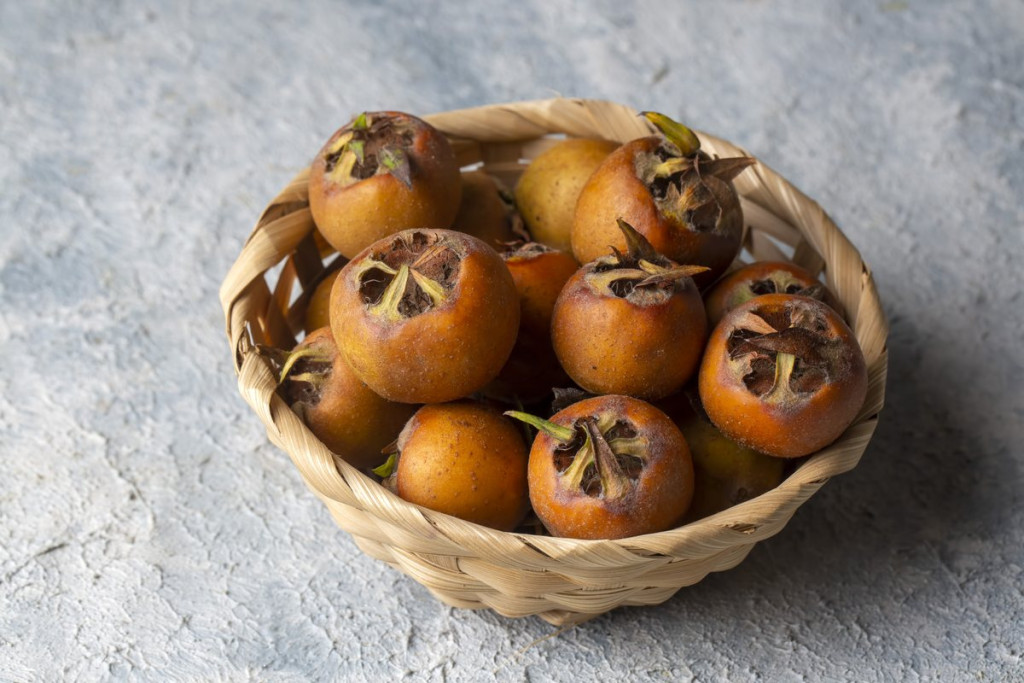
The name germanica This is misleading: The medlar does not originate from Germania, but from the Caucasus and northern Iran.
The common medlar grows wild from the Balkans through Asia Minor and Crimea to the Caucasus and northern Iran. Greeks and Romans cultivated it. In the Middle Ages, it was found in almost every monastery and farm garden because it ripens in winter when hardly any other fruit is available. The nun and naturalist Hildegard von Bingen wrote that its fruit was "good for healthy and sick people.".
From the 17th century onward, apples, pears, and other citrus fruits displaced the medlar. Chaucer and Shakespeare used it as a metaphor for overripeness. A medlar blossom even adorns the coats of arms of Lower Rhine cities like Geldern and Viersen.
To useWhat the medlar can do for you
The ripe, soft medlar is primarily a Fiber-rich fruit: Its meat is rich in pectin and insoluble fibers that form the stool, provide long-lasting satiety, and are fermented by the intestinal flora. In addition, there are... potassium, some calcium, magnesium and iron, organic acids such as malic acid and plenty Polyphenols - Tannins, phenolic acids and flavonoids.
What's special about this is that Becoming doughy, in English "bletting": After frost or several weeks of cool storage, enzymes break down the hard cell walls and part of the tannins The starch and acid are converted into sugar. The fruit loses its astringent taste and becomes mild. In folk medicine, it was considered a remedy for diarrhea due to its tannins.
Laboratory studies show antioxidant, antibacterial, and blood sugar-lowering effects for medlar extracts. However, there are virtually no studies on humans. And contrary to what is often stated, the medlar is not a source of vitamin COnly about 8 mg per 100 g were measured in ripe fruit, less than in an apple. It is a valuable winter fruit – nothing more.
IngredientsThis is what's inside the medlar
The medlar contains fructose, glucose and sucrose, organic acids (especially malic acid, as well as citric and quinic acid), pectin and other dietary fiber, tannins, phenolic acids such as chlorogenic acid, flavonoids such as catechin, epicatechin and quercetin glycosides, carotenoids as well as potassium, calcium, phosphorus, magnesium and iron.
Hard fruits are rich in tannins and acid, while softer, more doughy ones are sweeter and milder. Like many members of the rose family, the large, hard seeds contain cyanogenic glycosides – these are not eaten.
Enhanced combinationsWhat makes the medlar stronger
The medlar brings pectin and bitterness - it needs partners with fragrance and acidity.
The pectin in the medlar makes everything gel well.
Enhances the earthy aroma.
A classic for medlar jam in winter.
The soft fruit pulp as a topping.
Medlar paste like quince bread.
For a tart winter jelly.
What contradicts itselfIt's best to avoid these combinations.
Very bitter, difficult to digest.
Contains cyanogenic glycosides.
Tannins have a constipating effect.
Doughy is brown and firm - not mushy, moldy or fermenting.
The loquat is a completely different fruit.
The cornelian cherry is far stronger.
In the kitchenWhere she belongs
- Medlar jellyWith apples and a little lemon.
- Medlar jamStrained through a sieve, with cinnamon.
- Eaten straight from the spoonBreak open the doughy fruit and suck out the pulp.
- Medlar chutneyWith onion, ginger, and vinegar.
- Medlar breadFruit paste like quince paste.
- Wild fruit jamWith pear or quince.
- with the cheeseJelly with mountain cheese or goat cheese.
- Fruit breadMedlar pulp instead of dried fruit.
- Medlar liqueurTraditionally made with grain.
- Wild sauceA spoonful of jelly with venison or mushrooms.
As a home remedyMedlar puree for a calm stomach
Medlar jam
- Wash 500g of doughy medlars, cut off the stem and calyx remnants.
- Simmer gently in a pot with 100 ml of water for about 10 minutes until soft.
- Pass through a sieve or food mill so that the peel and kernels remain.
- Season to taste with a pinch of cinnamon and a little apple juice, let cool and store in the refrigerator.
As a mild, pectin-rich puree for mild diarrhea or a sensitive stomach, similar to grated apple. This is not a substitute for medical attention in cases of severe, persistent, or bloody diarrhea.
2 to 4 tablespoons, up to three times a day, with plenty of fluids. Keeps for about 3 to 4 days when refrigerated.
Ayurveda & TCMWhat the old systems say
Ayurveda
The medlar is not described in classical Ayurveda. According to current classification, the tart fruit is considered astringent (kashaya) and cooling, while the doughy fruit is considered sweet and heavy – balancing for Pitta, and better suited to Vata when cooked and spiced.
Traditional Chinese Medicine
In Traditional Chinese Medicine (TCM), the European medlar plays no role. The "Pipa" used there refers to the loquat, whose leaves are used for coughs. As an astringent fruit, the medlar would be considered a remedy for strengthening the intestines.
Warning noticesWhen you should be careful
Please note
- Cores: Do not eat, chew or grind them - like many rose plants, they contain cyanogenic glycosides.
- Constipation: The tannins have a constipating effect - in cases of sluggish bowels, only in small amounts and with plenty of fluids.
- Quality: Use only brown, soft, but intact fruit; discard any that are moldy or smell of alcohol.
- Confusion: The Japanese loquat is a separate species; its kernels are also not suitable for consumption - kernel powder can release a lot of hydrocyanic acid.
- Allergy: Cross-reactions are possible in cases of allergy to pome fruits such as apples or pears.
This page provides information and does not replace medical advice. If symptoms persist, please consult a doctor.
Related to the topicRead on and cook along!
Shop links lead to our product pages; it is indicated there if a partner is involved.
SourcesWhat is this based on?
- Popović-Djordjević JB et al. Chemical composition, nutritional and health related properties of the medlar (Mespilus germanica L.): from medieval glory to underutilized fruit. Phytochemistry Reviews 2023; 22(6).
- Nistor DI, Marc RA, Mureșan CC. Phytochemistry, nutritional composition, health benefits and future prospects of Mespilus germanica L. (Medlar): A review. Food Chemistry: X 2024; 22:101334.
- Glew RH et al. Changes in sugars, organic acids and amino acids in medlar (Mespilus germanica L.) during fruit development and maturation. Food Chemistry 2003; 83(3): 363–369.
- Federal Centre for Nutrition (BZfE): A comeback for the medlar.
- Ministry of Agriculture, Forestry and Fisheries (MAFF), Japan: Cyanogenic glycosides in loquat seeds.


