OriginBetween Heaven and Earth
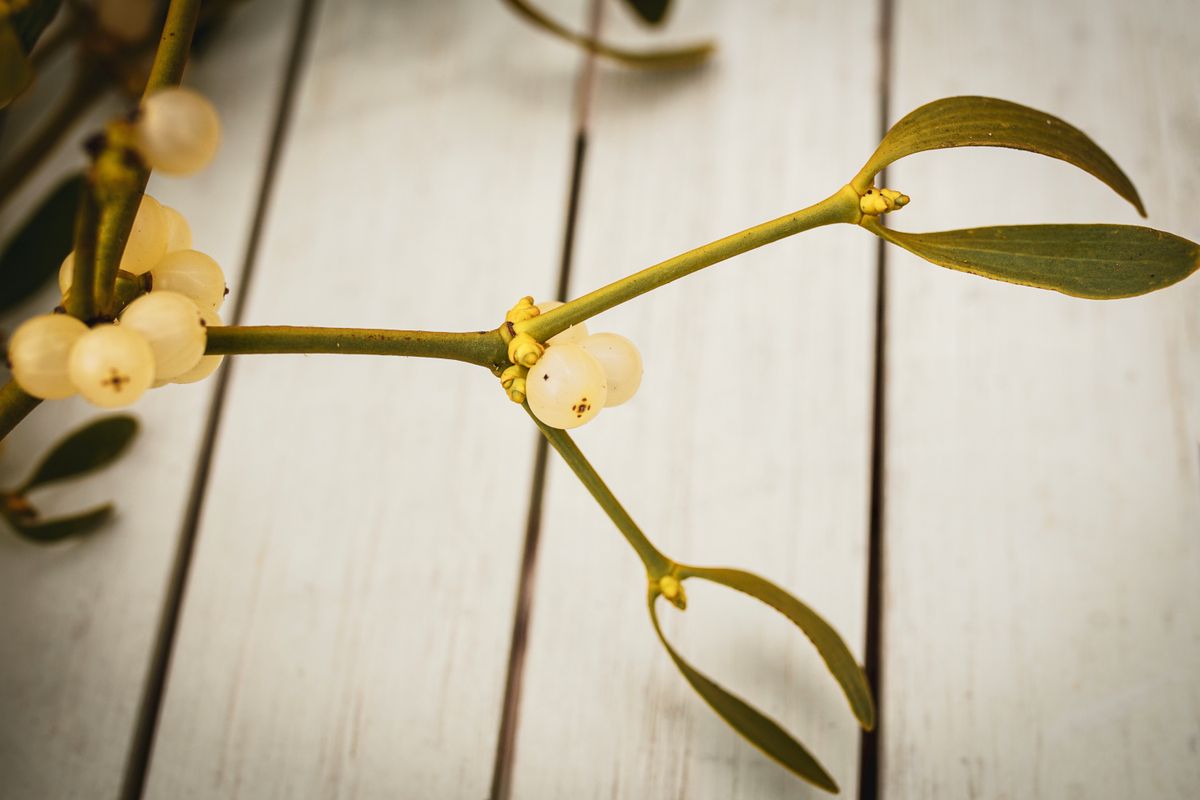
A plant that hangs rootless in the crown, remains green in winter and bears white berries - for ancient cultures it must have been something special, and for biology it truly is.
The mistletoe is a half-parasiteIt has green leaves and performs its own photosynthesis, but cannot draw water or minerals from the soil. Instead, it uses so-called sinkers to penetrate the vascular system of its host tree and tap into its water supply. Therefore, it always grows high in the crown where the water pressure is high enough, and therefore it depends on a living tree – if the tree dies, it dies with it.
Birds take care of their spread. Mistle thrush It even gets its name from this; waxwings and blackcaps also eat the berries. The pulp is exceptionally sticky – the substance is called viscin, hence the genus name. Viscum This explains the old use of mistletoe glue as bird glue. The seeds either remain on the beak or pass through undigested and then stick to the branch, where they germinate. A single seed takes years to develop into a visible bush.
Botanically, three subspecies are distinguished, each with its own host range: the Hardwood mistletoe on apple, poplar, willow, birch, linden and black locust; the Fir mistletoe on silver fir; the Pine mistletoe on pine and larch. They are not interchangeable – a deciduous mistletoe will not germinate on a fir tree. On the oak The European mistletoe practically never grows, which is what makes the Druid story in Pliny so significant: an oak mistletoe was a real rarity.
Culturally, it is present in almost every European tradition – as protection against lightning and misfortune, in Norse mythology as a weapon against Baldr, and among the Celts as a sacred plant. The best-known custom is of English origin: the kiss under the mistletoe, which spread worldwide through Victorian Christmas traditions.
To useWhat mistletoe means for trees and gardens
This page covers the The plant itself. Everything about the medicinal use – the herbal tea and its limited evidence base for high blood pressure, mistletoe therapy in oncology with its differentiated and controversial study results, the ingredients lectins and viscotoxins – is explained in detail on the page about mistletoe. It is the same plant, and a second depiction would only create confusion.
What belongs here is the ecological and practical aspect – and that has become important in recent decades. Common mistletoe is spreading rapidly in Central Europe. Milder winters, longer growing seasons, and increased bird activity near settlements have led to an increase in populations of species that were previously rare. Orchards This is a serious problem: A heavily infested apple tree loses significant amounts of water through the mistletoe, becomes susceptible to drought stress, produces poor new growth, and can die over the course of years. In some regions, entire orchards are threatened.
Anyone wanting to save an infested tree must act early and correctly: Mistletoe cannot simply be cut off, because the root is deeply embedded in the wood and will sprout again. One must... Saw off the branch about 30 to 50 centimeters below the mistletoe., This ensures that the ingrown tissue is completely removed. The best time is winter, when the mistletoe is clearly visible in the bare canopies – precisely when it's being cut for Christmas decorations anyway.
For animals, however, it is valuable: the berries ripen in winter when little other food is available and are an important food source for several bird species. As is so often the case in ecology, the assessment is therefore not clear-cut – the same plant is a burden on fruit growing and winter food for birds.
IngredientsHow the mistletoe is structured
The most noticeable anatomical difference to normal plants is that sinker system. Instead of a root, mistletoe forms a primary sinker that penetrates the bark, and from this, bark sinkers develop that spread through the wood of the host branch for years. The tree continues to grow around them, so that the mistletoe tissue is effectively incorporated – this is why simply cutting it off is ineffective.
Also noteworthy is the Growth formMistletoe branches in a strictly forked pattern, with each fork corresponding to one year. Therefore, the age of a mistletoe bush can be determined by its branching levels. Leaves and branches remain for several years and then fall off irregularly; the plant is evergreen, but not in the sense that it never renews its leaves.
The Ingredients Mistletoe lectins, viscotoxins, flavonoids, amines – and their evaluation are described on the mistletoe herb page. Two points, however, belong here because they relate to the plant itself. First: The composition depends heavily on the Host tree This is why the host is always specified for medicinal preparations. Secondly: The white berries They contain the cell-damaging viscotoxins in higher concentrations and are the most common cause of poisoning - a point that becomes practical at Christmas time when mistletoe branches hang in homes and berries fall down.
Enhanced combinationsWhat you can do with mistletoe
Customs, fruit tree care, and a clear reference to the page that deals with the application.
The most beautiful and uncomplicated use - with a view of falling berries.
Only in this way will the ingrown sinker be completely removed.
The mistletoe is clearly visible in the bare crown - the ideal moment for both.
Everything about herbal tea, mistletoe therapy and the current state of research can be found there.
The recognized plant when it comes to the heart and circulatory system.
Where fruit growing is not affected, mistletoe is a valuable winter food source.
What contradicts itselfIt's best to avoid these combinations.
The white berries are the most common cause of mistletoe poisoning.
The sinker is deeply embedded in the wood and sprouts again - part of the branch has to be removed along with it.
Severe infestation can cause apple trees to die over several years.
The berries are also problematic for them.
There is no evidence for this - the classification is on the mistletoe page.
The active ingredient content and composition vary depending on the host tree and the season.
ApplicationHow to deal with this
- Christmas decorationsThe branch above the door - the most well-known custom, of English origin.
- Remove berriesRemove the pinch-off strip before hanging if there are children or pets in the house.
- Fruit tree careCut off infested branches 30 to 50 cm below the mistletoe in winter.
- OrchardRegular inspection – remove infestations early, before the tree suffers.
- BirdwatchingMistle thrush and waxwing on mistletoe bushes in winter.
- Age determinationThe forks count - each branching level represents a year.
- Identify host treeWhether it's a hardwood, fir or pine mistletoe - they are not interchangeable.
- Medicinal useDetailed information can be found on the page about mistletoe.
- No mistletoe teaNeither for high blood pressure nor for self-treatment of cancer.
- Know the poison control centerIf you have swallowed berries, don't wait, call now.
As a home remedyTree pruning
Remove mistletoe infestation from fruit trees
- In winter, when the crown is bare, look at the tree from all sides - mistletoe is then unmistakable as green balls.
- Locate the point of origin for each affected branch. The mistletoe's root continues to grow within the wood, often for more than half a meter – therefore, do not cut at the mistletoe itself.
- The branch 30 to 50 centimeters below Cut off the mistletoe base cleanly, ideally at the nearest branch collar. If this isn't possible with thick main branches, the mistletoe will need to be removed repeatedly, and regrowth will be expected.
- Don't leave the cuttings lying on the property; remove them – ripe berries can be propagated further. And repeat the check annually: new seedlings are tiny in the first few years.
For fruit trees and orchard trees, especially apple trees, which are increasingly suffering from mistletoe infestation. A heavily infested tree loses large amounts of water through the mistletoe, becomes more susceptible to drought, produces weaker new growth, and can die after a few years. This isn't a matter of herbs, but simply tree care – however, it's the most common practical reason why people concern themselves with this plant.
Annual inspections in winter, removal of infested branches each time. For old, valuable trees with heavy infestations, it's worth consulting a specialist company or the local fruit and gardening association – overly radical pruning will harm the tree more than the mistletoe itself. And when handling the pruned material, remember that the berries are poisonous, especially for children and pets.
Ayurveda & TCMWhat the old systems say
Ayurveda
See the page on mistletoe. In short: European mistletoe is not used in Ayurveda, and with a plant that has this safety profile, we deliberately refrain from assigning it to a specific dosha – it would send the wrong message.
Traditional Chinese Medicine
Here too, the reference is made, with the important addition: In the Chinese Materia Medica, a different type of mistletoe is firmly established - Sang Ji Sheng, the mulberry mistletoe (Taxillus chinensisIts bitter, sweet, and neutral taste is associated with the liver and kidneys, and it is used for rheumatic complaints, back pain, and to stabilize pregnancy. Another species on a different host tree with a different application – the similarity in name is irrelevant here.
Warning noticesWhen you should be careful
Please note
- Berries are poisonous: The white berries are the most common cause of poisoning, especially in children - pick them off before hanging.
- Pets: Dogs and cats are also sensitive – do not leave clippings lying around.
- Do not use on your own: For medicinal evaluation, see the page on mistletoe herb; tea preparations are not recommended.
- Fruit trees: Severe infestation can damage trees for years – prune early and correctly.
- Tree care: Excessive pruning is more harmful than mistletoe – consult experts about old trees.
- Emergency: If berries are swallowed, call the poison control hotline and do not wait.
This page provides information and does not replace medical advice. If symptoms persist, please consult a doctor.
Related to the topicRead on and cook along!
Shop links lead to our product pages; it is indicated there if a partner is involved.
SourcesWhat is this based on?
- Blaschek W (ed.): Wichtl - Herbal drugs and phytopharmaceuticals. 6th edition 2016, monograph Visci herba.
- Roth L, Daunderer M, Kormann K: Poisonous plants - plant toxins. 6th edition - Viscum album, Viscotoxins and symptoms of poisoning.
- Julius Kühn Institute and Chambers of Agriculture: Information on mistletoe infestation on fruit trees and on proper removal.
- Zuber D. Biological flora of Central Europe: Viscum album L. Flora 2004; 199(3): 181–203.
- Federal Agency for Nature Conservation: Information on the spread of the European mistletoe in Central Europe.