
Parsley root (Petroselinum crispum var. tuberosum)
OriginThe forgotten sister of parsley
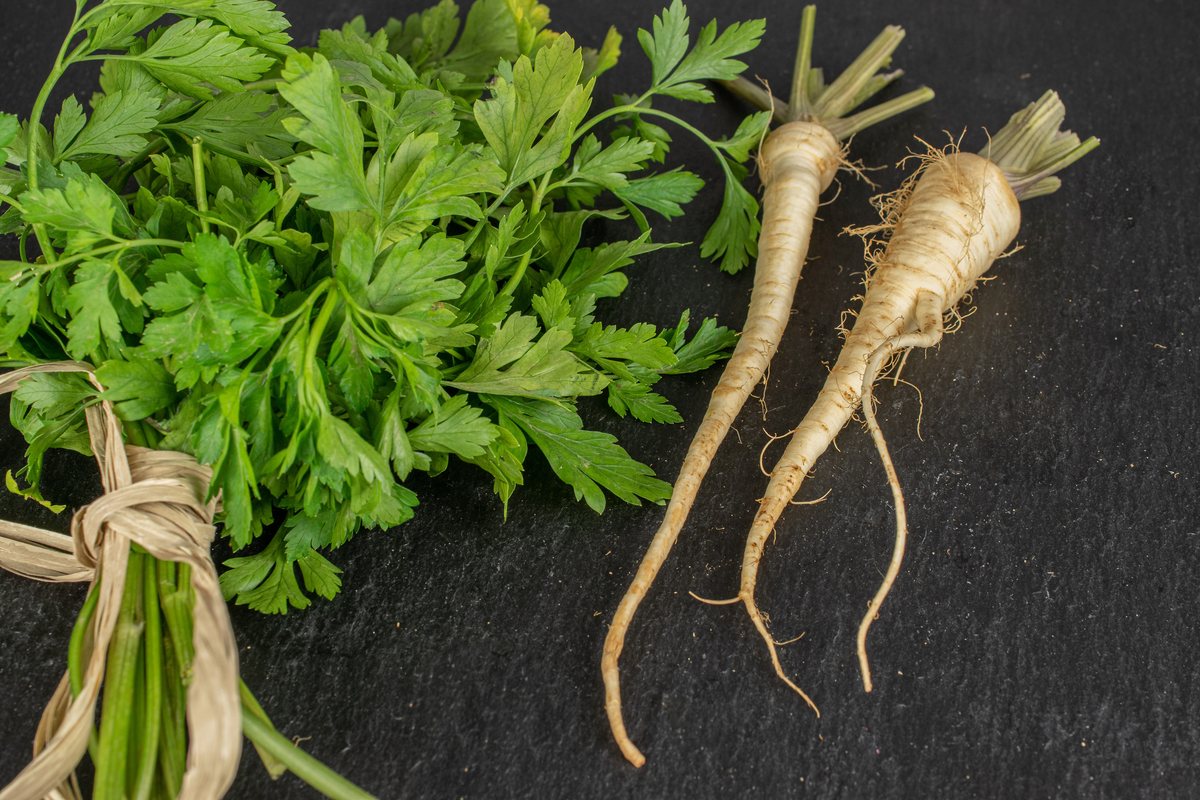
Parsley root and parsnip look deceptively similar - but they are two different plants.
Parsley originates from the Mediterranean region and came to Central Europe with the Romans and later via monastery gardens. Varieties were selected that develop a thick, turnip-like root instead of curly leaves. This root parsley became a staple ingredient in winter soup, particularly in Germany, Poland, Austria, and the Netherlands.
In the store, it's often located right next to the parsnip. The differences: Parsley root is smaller (usually around 20 cm), slimmer, and has a distinct parsley aroma. Parsnips grow larger, have a broad, sunken leaf base, and taste sweeter and nuttier. If you're unsure, just rub the skin briefly – your nose will tell you immediately.
To useWhat parsley root does for you
100 g of parsley root provide approximately 40 to 55 kcal, about 4 g. Dietary fiber, approximately 40 mg Vitamin C and 400 to 560 mg potassium - depending on the nutritional information table. Also when... Folate It's in good shape; the figures vary considerably, but are usually higher than those for carrots and celery. It also contains magnesium, calcium, iron, and flavonoids such as apigenin.
Commission E has given a positive assessment to dried parsley root (together with the herb): to Flushing For diseases of the urinary tract and for the prevention of kidney stones. Drinking plenty of fluids is always important. The diuretic effect is attributed to the essential oil and flavonoids; however, good clinical studies in humans are largely lacking.
The essential oil also contains Apiol and Myristicin. They are present in the root only in very small quantities, but highly concentrated in parsley seeds and oil. In high doses, they irritate the kidneys and uterus; apiol was formerly misused for abortions, sometimes with fatal consequences. This is irrelevant when the parsley is eaten as a vegetable in soup, but it is a concern when it is consumed in teas, juices, and extracts.
IngredientsThis is what's in the parsley root
Parsley root contains carbohydrates, fiber, some protein, vitamin C, folate, B vitamins, potassium, calcium, magnesium, and iron. It also contains flavonoids (apigenin and its glycoside apiin), a small amount of essential oil with apiol, myristicin, and terpenes, as well as furocoumarins, phthalides, and polyynes.
Furocoumarins can make the skin more sensitive to light - this is particularly relevant when peeling large quantities or extracts, not when eating normally.
Enhanced combinationsWhat makes parsley root stronger
Parsley root is a team player - spicy on its own, well-rounded when combined with other roots.
The classic basis of every broth.
It carries the aroma and helps with carotenoids.
Keeps them bright and fresh.
The herb on top provides more vitamin C.
Turn the soup into a meal.
Winter root plate.
What contradicts itselfIt's best to avoid these combinations.
Avoid concentrates; vegetables are fine.
Highly concentrated apiol.
It can be irritating.
Flushing is the wrong approach here.
Softens quickly - damp cloth or bag.
Hemlock looks similar - only purchased or definitively identified.
In the kitchenWhere she belongs
- vegetable brothWith carrot, celery and leek.
- Cream soupWith potato and a splash of cream.
- pureeWith fish or lentils.
- Oven rootsWith olive oil and thyme.
- raw foodFinely grated with apple and lemon.
- stewWith beef or beans.
- ChipsPaper-thin straight from the oven.
- RisottoDiced and braised along with the other ingredients.
- GratinAlternating with potatoes.
- parsley pestoFrom the leaves with nuts.
As a home remedyParsley root tea for flushing out the bladder
parsley root tea
- Put 2 g of dried, finely chopped parsley root (about 1 teaspoon) into a cup.
- Pour 150 ml of boiling water over it.
- Cover and let steep for 10 to 15 minutes, then strain.
- Drink a cup three times a day and also drink plenty of water or herbal tea throughout the day.
According to Commission E, this tea is used for flushing out the urinary tract in cases of urinary tract infections and for preventing kidney stones. It does not replace treatment for cystitis with fever, blood in the urine, or flank pain.
Daily dose approximately 6 g of the drug, divided into three cups. Do not use during pregnancy, in cases of inflammatory kidney disease, or if you have fluid retention due to heart or kidney failure. If symptoms do not improve after a few days, consult a doctor.
Ayurveda & TCMWhat the old systems say
Ayurveda
Parsley root is not described in classical Ayurveda. According to modern classification, it is considered warming, slightly spicy, and diuretic – balancing Kapha and Vata, and used in moderation for Pitta.
Traditional Chinese Medicine
Parsley root plays no role in classical Traditional Chinese Medicine (TCM). In Western TCM dietary theory, parsley is classified as warming and slightly pungent, and is said to promote water circulation and support bladder function.
Warning noticesWhen you should be careful
Please note
- Pregnancy: Avoid teas, juices, extracts and especially parsley fruit or oil; normal amounts as a vegetable are safe.
- Kidney: Flushing therapy is not recommended for inflammatory kidney diseases and edema due to heart or kidney failure.
- Light: Furocoumarins can cause phototoxic skin reactions in fair-skinned people, especially with high-dose preparations.
- Allergy: Cross-reactions with celery, carrot and mugwort pollen are possible.
- Urinary tract infection: If you experience fever, blood in your urine, or pain in the kidney area, consult a doctor.
This page provides information and does not replace medical advice. If symptoms persist, please consult a doctor.
Related to the topicRead on and cook along!
Shop links lead to our product pages; it is indicated there if a partner is involved.
SourcesWhat is this based on?
- Commission E: Monograph Petroselini herba/radix (parsley herb/root). Federal Gazette.
- Farzaei MH et al. Parsley: a review of ethnopharmacology, phytochemistry and biological activities. Journal of Traditional Chinese Medicine 2013; 33(6): 815–826.
- Encyclopedia of medicinal plants and drugs: Petroselinum crispum. Spektrum Akademischer Verlag, 1999.
- Austrian Health Portal (gesundheit.gv.at): Parsley root. Seasonal calendar.


