
Açaí (Euterpe oleracea)
OriginThe staple food of the Amazon
In Belém, açaí is as much a part of lunch as potatoes are to us - thickly cooked, with cassava flour and fish.
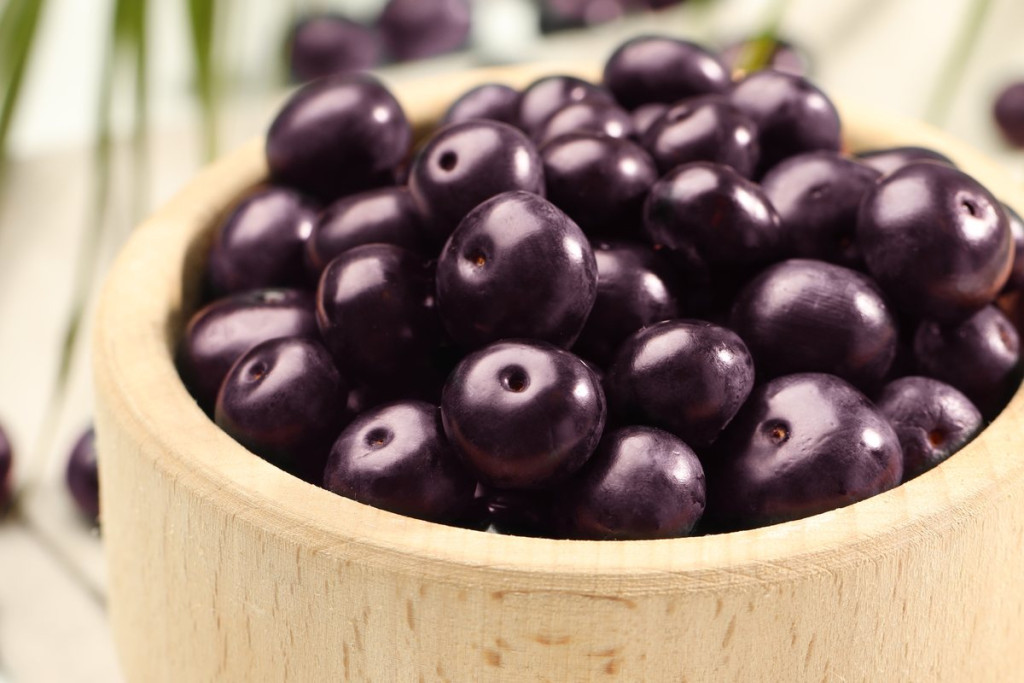
The açaí palm grows in the floodplain forests at the mouth of the Amazon River and reaches heights of over 20 meters. It forms multiple trunks, from which hang heavy panicles bearing hundreds of small, bluish-black fruits. A large part of each fruit is the hard seed – only a thin layer of pulp is rubbed with water to form a thick paste.
For the people of the Amazon, açaí has been a staple food for centuries, eaten in savory dishes. The fruit only became world-famous in the 2000s as a sweet "acaí bowl" and as a "superfood." Because the pulp spoils within a day, it is pasteurized and deep-frozen or freeze-dried locally – this is how it arrives in Europe, along with juices, powders, and capsules.
To useWhat Açaí does for you
Açaí is different from most fruits: freeze-dried powder contains approximately 33g per 100g. Fat, 44 g Dietary fiber, 8g of protein and hardly any sugar. Roughly half of the fat consists of... oleic acid - like olive oil. Unsweetened frozen mashed potatoes provide, depending on the manufacturer, approximately 60 to 80 kcal, around 5 g of fat and 3 g of fiber per 100 g.
The dark color comes from Anthocyanins, Açaí contains primarily cyanidin glycosides, along with other polyphenols. In test tubes, these have a strong antioxidant effect. However, consumer protection agencies point out that local fruits such as elderberries, blackcurrants, and red cabbage contain significantly more anthocyanins. Açaí provides very little vitamin C.
Human studies are small and short. In a pilot study with ten overweight adults, fasting blood sugar, insulin, and cholesterol levels decreased slightly after one month of consuming 200g of açaí puree daily. body weight The results remained unchanged; there was no control group. The US National Center for Disease Control and Prevention (NCCIH) states that no reliable studies have proven a weight-loss effect. In the EU, advertising claims related to weight loss with açaí are not permitted.
IngredientsThis is what's in Açaí
Açaí fruit pulp contains fat (primarily oleic acid, palmitic acid and linoleic acid), fiber, some protein, phytosterols, anthocyanins such as cyanidin-3-glucoside and cyanidin-3-rutinoside, other flavonoids such as orientin and homoorientin, proanthocyanidins, and minerals such as potassium, calcium, magnesium and a remarkably high amount of manganese.
Anthocyanins are sensitive to heat, light, and long storage. Capsules and highly processed powders often contain very little of them – and the labels rarely mention this.
Enhanced combinationsWhat makes Açaí stronger
Açaí tastes rather earthy on its own - good partners make it a breakfast without a sugar bomb.
Equally many or more anthocyanins.
Beta-glucan and saturation as well.
Turn the bowl into a meal.
Instead of sugar or syrup.
Açaí itself provides hardly any vitamin C.
Omega-3 and even more fiber.
What contradicts itselfIt's best to avoid these combinations.
No evidence of a weight loss effect.
Expensive, often with little active ingredient.
With syrup and granola, you can quickly get 500 kcal.
Transmission of Chagas disease is possible.
Frequently hidden subscription traps.
It can affect imaging.
In the kitchenWhere she belongs
- Açaí BowlPuree with banana, berries and oatmeal.
- SmoothieWith yogurt and blueberries.
- Açaí na TigelaBrazilian food with granola - rare, because it's sweet.
- Açaí with FarinhaHearty like in Belém, with cassava flour.
- With fishFried fish on the Amazon.
- Overnight OatsStir in one spoonful of powder.
- Yogurt dessertMarbled with açaí puree.
- SorbetPuree frozen with a little banana.
- PorridgeStir in the powder at the end.
- Energy ballsWith dates, nuts and powder.
As a home remedyBerry bowl without the sugar bomb
Açaí berry bowl
- Allow 100 g of unsweetened açaí frozen puree to thaw slightly.
- Blend half a banana, a handful of blueberries and 100g of natural or plant-based yogurt until creamy.
- Pour into a bowl and sprinkle with 2 tablespoons of rolled oats and a teaspoon of ground flaxseed.
- If desired, add fresh berries or kiwi on top - without syrup.
A colorful and satisfying breakfast packed with anthocyanins, fiber, and protein. If you can't find açaí or want to save money, simply double the amount of blueberries or aronia berries.
One bowl a day is enough. Store-bought bowls often contain 40 to 70g of sugar – it's worth making your own.
Ayurveda & TCMWhat the old systems say
Ayurveda
Açai is not described in classical Ayurveda. According to current understanding, the fatty fruit is considered heavy, cooling, and nourishing – balancing Vata and Pitta, but only in small quantities and not ice-cold for Kapha.
Traditional Chinese Medicine
In Traditional Chinese Medicine (TCM), açaí traditionally plays no role. Due to its dark color, it would be classified in Western TCM nutritional theory, like blueberries and mulberries, as nourishing to blood and yin, cooling, and sweet-tart.
Warning noticesWhen you should be careful
Please note
- Chagas disease: Outbreaks have been reported in Brazil where fresh, unpasteurized açaí juice was contaminated with assassin bugs or their feces. When traveling, only drink pasteurized products; locally available frozen açaí juice is generally pasteurized.
- Advertising: Claims regarding weight loss, detoxification, or anti-aging are unsubstantiated and not permitted in the EU.
- Stresses: Studies have found pesticide residues, chlorate, mineral oil components and high levels of manganese in açaí powders and dietary supplements - frozen puree is preferable to capsules.
- Blood sugar: Anyone taking diabetes medication should discuss dietary supplements containing açaí with their doctor.
- MRI: Before undergoing an abdominal magnetic resonance imaging scan, mention Açaí products - they can affect the images.
This page provides information and does not replace medical advice. If symptoms persist, please consult a doctor.
Related to the topicRead on and cook along!
Shop links lead to our product pages; it is indicated there if a partner is involved.
SourcesWhat is this based on?
- Schauss AG et al. Phytochemical and nutrient composition of the freeze-dried Amazonian palm berry, Euterpe oleraceae Mart. (acai). Journal of Agricultural and Food Chemistry 2006; 54(22): 8598–8603.
- Udani JK, Singh BB, Singh VJ, Barrett ML. Effects of Açai (Euterpe oleracea Mart.) berry preparation on metabolic parameters in a healthy overweight population: a pilot study. Nutrition Journal 2011; 10:45.
- Nóbrega AA et al. Oral transmission of Chagas disease by consumption of açaí palm fruit, Brazil. Emerging Infectious Diseases 2009; 15(4): 653–655.
- Consumer Advice Center: Acai - the Brazilian miracle berry?
- National Center for Complementary and Integrative Health (NCCIH): Acai: Usefulness and Safety.


