
Sweet chestnut (Castanea sativa)
OriginThe Bread of the Mountains
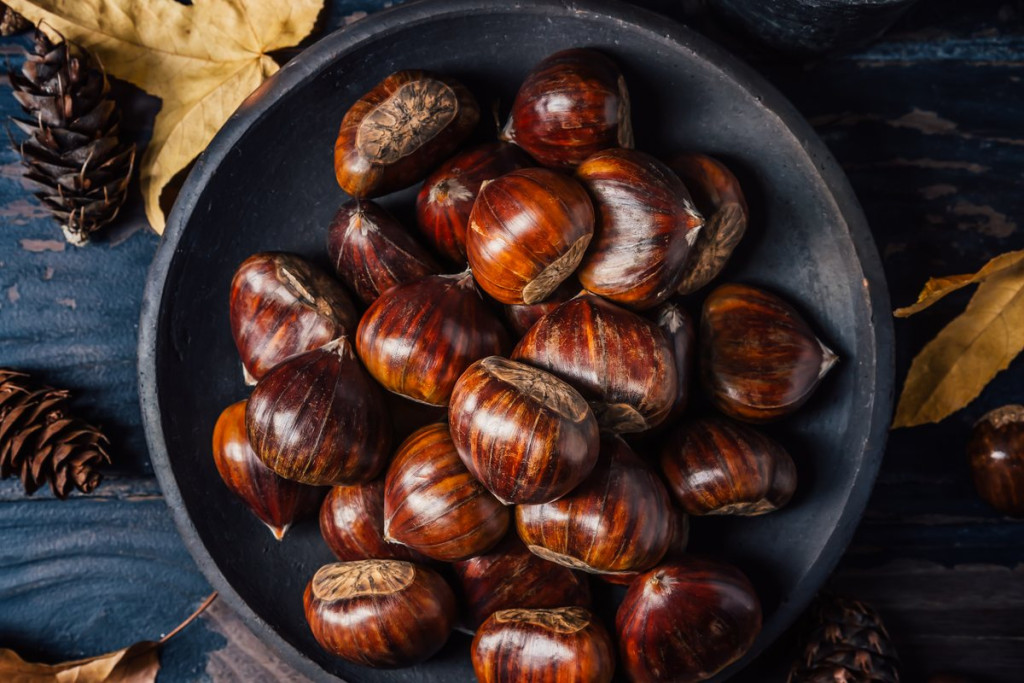
In poor mountain regions of southern Europe, the chestnut tree was called "bread tree" - its flour replaced grain there for centuries.
The sweet chestnut originates from Asia Minor and the Caucasus. Greeks and Romans planted it throughout the Mediterranean; it also came to the Rhine, the Moselle, and the Palatinate with the Romans. In Ticino, South Tyrol, Corsica, and the Apennines, dried chestnut flour ensured people's survival through the winter.
In Germany, most sweet chestnuts grow on the warm slopes of the Palatinate along the Wine Route, where the fruits are called "Keschde," as well as along the Upper Rhine and the Moselle. In Ticino, "Marroni" are part of the autumn culture, while in South Tyrol they are part of the Törggelen tradition. In the trade, the term "Marone" usually refers to particularly large, easily peeled varieties where only one fruit is contained in the shell.
To useWhat chestnuts can do for you
Unlike hazelnuts or walnuts, chestnuts are hardly fatty: 100 g of roasted chestnuts provide around 245 kcal, only about 2 g of fat, about 3 g of protein, but around 50 g carbohydrates, especially starch. In addition, there are about 5 g. Dietary fiber, approximately 590 mg potassium, magnesium, B vitamins and - unusually for a nut - noticeably Vitamin C, after roasting, approximately 25 mg remain.
Because sweet chestnuts gluten-free Chestnut flour is suitable for people with celiac disease, provided it has been produced without contamination from wheat. It doesn't bind well on its own when baking and is therefore usually mixed with other flours. Due to the starch breakdown during roasting and cooking, chestnuts naturally taste sweet.
Review articles describe chestnuts as a good source of starch, fiber, minerals, and polyphenols such as gallic acid and ellagic acid; however, there are hardly any direct studies on human health effects. Therefore, chestnuts are primarily a filling, low-fat alternative to potatoes, pasta, or bread during the colder months—not a medicinal remedy.
IngredientsThis is what's in sweet chestnuts
Chestnuts contain starch, sugar (especially sucrose), fiber, some protein and very little fat, as well as potassium, magnesium, phosphorus, copper and manganese, vitamins B1, B2, B6 and folate, and vitamin C and vitamin E.
The fruit, and especially the thin brown inner skin (pellicle), contains tannins such as gallic acid, ellagic acid, and ellagitannins. Therefore, the bitter inner skin is removed as completely as possible after roasting or cooking.
Enhanced combinationsWhat makes chestnuts stronger
Chestnuts love autumn vegetables, wild herbs and a little fat - and always need heat.
The classic choice for a festive meal.
For soups and roasted vegetables.
Forest aromas in autumn.
It rounds off the sweetness.
Sweet or savory.
Gluten-free and spicy.
What contradicts itselfIt's best to avoid these combinations.
Horse chestnuts are poisonous.
Difficult to digest, high in tannins.
The fruit bursts explosively.
Bitter and astringent.
Discard any damage caused by worms or mold.
Store in the refrigerator for up to two weeks.
In the kitchenWhere they belong
- Hot chestnutsRoasted in the oven.
- Chestnut soupWith celery and onion.
- Brussels sprouts with chestnutsThe festive supplement.
- Red cabbage with chestnutsWith roast meat or lentil roast.
- Chestnut pureeInstead of mashed potatoes.
- fillingFor goose or pumpkin.
- CastagnaccioTuscan chestnut cake.
- VermicelliSwiss chestnut puree dessert.
- Chestnut flour pancakesGluten-free and sweetish.
- Chestnut risottoWith sage.
As a home remedyRoast chestnuts in the oven
Chestnuts from the oven
- Wash the chestnuts and check them in a water bath; discard any floating, soft, or moldy fruits.
- Cut a cross into the shell on the curved side with a sharp knife - this is essential, otherwise they will burst.
- Roast on a baking sheet at 180 to 200 °C for about 20 minutes, until the skin cracks open; an ovenproof dish with water in the oven will keep them moist.
- Wrap in a damp cloth, let rest for 5 minutes and peel while still warm, removing the brown inner skin as well.
A warm, satisfying snack during the cold season – low in fat, high in starch and containing some vitamin C. Chestnuts are a good alternative to pastries or chips.
A serving is about 100 to 150 g of peeled chestnuts. Freshly roasted, they are best eaten immediately; peeled, they will keep in the refrigerator for 2 to 3 days.
Ayurveda & TCMWhat the old systems say
Ayurveda
In Ayurveda, the European chestnut is not classically described. According to current classification, it is considered sweet, heavy, and nourishing – calming for Vata and Pitta, and for Kapha in small quantities and well-seasoned.
Traditional Chinese Medicine
In Chinese nutritional theory, the related Chinese chestnut (Ban LiIt is classified as sweet and warming. It is said to strengthen the spleen and stomach and support the kidneys; it is eaten cooked, not raw.
Warning noticesWhen you should be careful
Please note
- Buckeye: The shiny chestnuts in parks and avenues come from the horse chestnut tree (Aesculus hippocastanumTheir seeds contain saponins and can cause nausea, abdominal pain, and vomiting. Sweet chestnuts have a densely spiny husk, usually with several pointed fruits, and lanceolate, coarsely serrated leaves; horse chestnuts have palmate leaves.
- Roast: Always cut into the chestnuts - uncut chestnuts can burst in the oven or pan and cause burns.
- Mold and worms: Do not eat fruit with holes, soft spots, mold or musty smell; moldy nuts may contain mycotoxins.
- Flatulence: Larger quantities can cause bloating due to starch and fiber, especially raw.
- Celiac disease: Use only chestnut flour that is labelled gluten-free.
This page provides information and does not replace medical advice. If symptoms persist, please consult a doctor.
Related to the topicRead on and cook along!
Shop links lead to our product pages; it is indicated there if a partner is involved.
SourcesWhat is this based on?
- De Vasconcelos MCBM, Bennett RN, Rosa EAS, Ferreira-Cardoso JV. Composition of European chestnut (Castanea sativa Mill.) and association with health effects: fresh and processed products. Journal of the Science of Food and Agriculture 2010; 90(10): 1578–1589.
- USDA FoodData Central: Nuts, chestnuts, European, roasted.
- Federal Centre for Nutrition (BZfE): Chestnuts for autumn cooking. Press release 2025.
- Information Centre against Poisoning Bonn (GIZ Bonn): Horse chestnut (Aesculus hippocastanum).


