Pomegranate (Punica granatum)
OriginThe Fruit of Myths
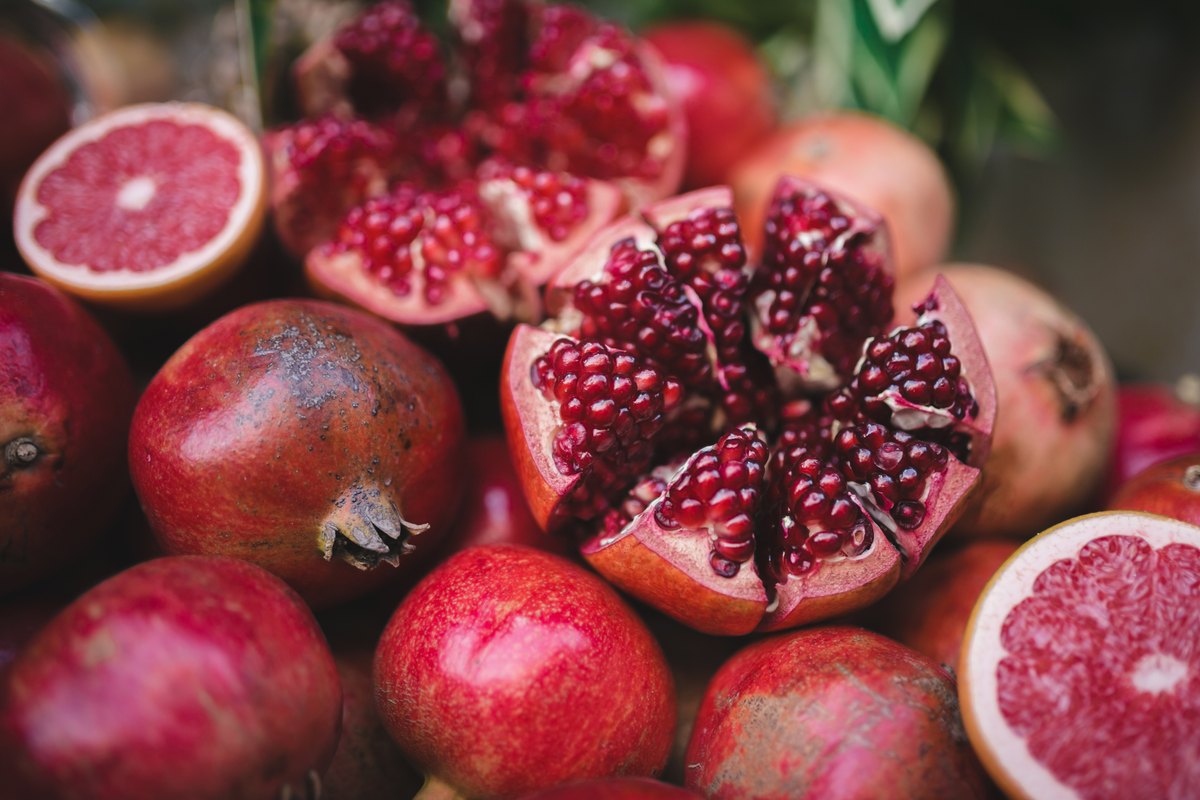
Persephone ate six pomegranate seeds and therefore had to stay in the underworld for half a year - that's how the Greeks explained winter.
Punica granatum It is a shrub or small tree from the region between Iran and northern India, cultivated for at least five thousand years. Botanically, it belongs to the loosestrife family – meaning it is related to purple loosestrife, not apples. Its fruit is a berry with a leathery skin, inside which the seeds are enclosed in white membranes. What we eat are the arils: fleshy, juice-filled seed coats that enclose each kernel.
Few fruits are as deeply rooted in myths and religions. In Greek myth, Persephone binds herself to the underworld with six pomegranate seeds and must spend half the year there – the mythical explanation for winter. In Judaism, it is a symbol of fertility and is traditionally eaten on Rosh Hashanah. In Christianity, it represents resurrection, and in Islam, it is considered a fruit of paradise. The name comes from the Latin... granatum, rich in kernels; the Spanish Granada and the hand grenade is also derived from it.
The Latin genus name Punica It refers to the Carthaginians – the Romans knew the fruit as the „Punic apple“ because it came to them via Carthage. Today, Iran, India, Turkey, and the USA are the largest producers.
To useUroliths – and why they don't develop in everyone
The pomegranate is a food that provides vitamin C, potassium, fiber, and above all, an unusual class of polyphenols: ellagitannins, especially the punicalagins. These are responsible for the tart, astringent flavor of the juice and are the focus of all the research.
The interesting thing is that punicalagins themselves are hardly absorbed. They reach the large intestine, where intestinal bacteria break them down into smaller molecules – the urolithins. These are absorbed and are what end up in the bloodstream. Urolithin A has received the most attention, as studies have described an effect on mitophagy – the cellular breakdown of damaged mitochondria – with reference to muscle function and aging processes.
And here's the crux of the matter. Whether a person can produce urolithin A depends on the bacteria present in their gut. Studies differentiate between urolithin metabotypes: some of the people studied produce urolithin A, others only urolithin B or isourolithin A, and a small percentage produce practically nothing. The figures vary, but roughly half to two-thirds of people can produce urolithin A. This is one of the clearest illustrations of why nutritional studies so often yield contradictory results: the same fruit has different chemical effects on different people.
Clinically, there are studies on blood pressure with some positive results, studies on PSA levels in prostate cancer with inconsistent findings, and studies on inflammatory markers. Systematic reviews conclude that the evidence is insufficient for specific recommendations. The pomegranate is a good, interesting food – not a medicine.
IngredientsJuice, fruit - and a grapefruit-like problem
A significant portion of punicalagins is not located in the arils, but in the peel and membranes. Industrially pressed juice, which uses the whole fruit, therefore often contains more ellagitannins than freshly squeezed seeds. This is one of the few instances where a juice can be richer in polyphenols than the fruit itself—though it also concentrates the sugar and reduces the fiber content.
Now to the practically most important point of this page: drug interactions. Studies have shown that pomegranate juice inhibits the enzyme CYP3A4 in the gut – the same enzyme involved in the well-known grapefruit interaction. The data is less conclusive than with grapefruit: some studies found relevant effects, others did not. For warfarin, there are case reports of an increased risk of bleeding.
Our assessment: The risk is lower than with grapefruit, but it's not zero, and it affects a large number of medications – statins, certain blood pressure medications, immunosuppressants, and some heart medications. Anyone who regularly drinks large amounts of pomegranate juice and takes medication long-term should discuss this with their pharmacist or doctor. For the occasional fruit, this isn't a concern.
There's a method for opening them that works much better than the usual cutting. Cut off the flower head like a cap, score the peel along the white membranes – which appear as light stripes – and then break the fruit apart like a flower. The arils can then be easily removed with your fingers without being crushed. The juice permanently stains fabrics; an apron is a good idea.
Enhanced combinationsPomegranate in the kitchen
It brings acidity, sweetness and bite at the same time - a rare combination that has proven itself in many kitchens.
The acidity and crunch of the arils liven up any salad. A classic with feta, walnuts and mint.
Firmly rooted in Persian and Levantine cuisine - served with rice, lamb and poultry.
The reduced juice is a central seasoning in Levantine cuisine, sweet and sour, and deep dark in color.
As breakfast or dessert - the acidity is well incorporated into dairy products.
Cut off the flower crown, score along the lighter stripes, and break it apart. Much cleaner than cutting it open.
The seeds inside the aril are edible and provide fiber.
What contradicts itselfIt's best to avoid these combinations.
Statins, certain blood pressure medications, immunosuppressants, and others. Consult your pharmacist or doctor if you regularly consume larger quantities.
There are case reports of increased bleeding tendency. Be cautious when using Marcumar.
It concentrates sugar and loses fiber. The whole fruit is the better choice.
Systematic reviews consider the evidence for specific applications to be insufficient.
Whether urolithin A is produced depends on the individual's gut flora. A significant proportion of people do not produce it.
It stains permanently. Wear an apron when opening and work over the sink.
In the kitchenWhere he belongs
- lettuceWith feta, walnuts, mint and leafy salad.
- FattoushIn the Levantine bread salad - with pomegranate molasses in the dressing.
- MuhammadSyrian paprika and walnut paste with pomegranate molasses.
- Rice dishesAbout Persian rice with barberries and saffron.
- lambAs a marinade with molasses, garlic and cumin.
- yogurtWith honey and pistachios for breakfast.
- HummusAs a topping - color, acidity and bite.
- dessertOver panna cotta or rice pudding.
- JuiceFreshly squeezed or as mother juice, diluted.
- OpenCut off the flower crown, break it along the septa.
As a home remedyMake your own pomegranate molasses
Reduced pomegranate juice
- Open four to five large pomegranates and remove the arils. Work over the sink – the juice stains permanently.
- Briefly pulse the arils in a blender, do not puree; the kernels should remain whole, otherwise it will be bitter.
- Pass through a fine sieve or a cloth. Four to five fruits yield approximately 800 to 1000 ml of juice.
- Reduce the juice uncovered in a wide pot over medium heat. If desired, add two tablespoons of sugar and the juice of half a lemon – traditionally, it is often made without sugar.
- Simmer for about an hour, until about a quarter of the original volume remains and the liquid runs off the spoon like syrup. It will thicken further as it cools – it's better to remove it from the heat when it's slightly too thin.
- Pour into a clean bottle and store in the refrigerator; it will keep for several months. Use in dressings, marinades, and over hummus or yogurt.
As a versatile sweet and sour condiment in Levantine cuisine – the most sensible use for a larger quantity of pomegranates. The pomegranate is a food; there is insufficient evidence for specific medicinal effects.
Enjoy as a foodstuff if desired. If you are taking long-term medication and regularly consume larger quantities of juice, discuss potential interactions with your pharmacist or doctor.
Ayurveda & TCMWhat the old systems say
Ayurveda
In Ayurveda, the pomegranate is considered Dadima A prized fruit, it is considered sweet, sour, and astringent, balancing all three doshas – a classification few foods receive. It is associated with digestion and used for diarrhea and to strengthen the body after illness. The peel is also used, traditionally as a vermifuge – an application for which the peel contains alkaloids and is therefore not suitable for self-medication.
Traditional Chinese Medicine
In Chinese materia medica, the pomegranate is described as Shi Liu guided; mainly shells are used (Shi Liu PiThe fruit contains the husk and root bark. It is considered sour, astringent, and warming, with a connection to the large intestine and stomach, and is used for chronic diarrhea and as a vermifuge. The fruit itself is considered nourishing and thirst-quenching in dietetics. However, the peel contains alkaloids and is not suitable for home medicine cabinets.
Warning noticesWhen you should be careful
Please note
- Interaction via CYP3A4: Pomegranate juice, like grapefruit juice, can inhibit the breakdown of certain medications – statins, blood pressure medications, immunosuppressants. This may be noticeable with long-term medication use and regular consumption.
- Warfarin: There are case reports of increased bleeding tendency. Be cautious when using Marcumar.
- Do not use the peel and root bark yourself: They contain alkaloids; traditional use of vermifuge medication does not belong in the home medicine cabinet.
- Uroliths are not present in everyone: Whether urolithin A is produced depends on the intestinal flora. A significant proportion of people do not produce it.
- Juice is not a health drink: It concentrates sugar and loses fiber. The whole fruit is the better choice.
- Limited evidence: Systematic reviews conclude that the data situation is insufficient for specific applications.
This page provides information and does not replace medical advice. If symptoms persist, please consult a doctor.
Related to the topicRead on and cook along!
Shop links lead to our product pages; it is indicated there if a partner is involved.
SourcesWhat is this based on?
- Tomás-Barberán FA et al.: Urolithins, the rescue of „old“ metabolites to understand a „new“ concept - Metabotypes. Molecular Nutrition & Food Research 2017.
- Andreux PA et al.: The mitophagy activator urolithin A is safe and induces a molecular signature of improved mitochondrial health. Nature Metabolism 2019.
- Sahebkar A. et al.: Effects of pomegranate juice on blood pressure - a systematic review and meta-analysis. Pharmacological Research 2017.
- Hidaka M. et al.: Effects of pomegranate juice on human cytochrome P450 3A and carbamazepine pharmacokinetics. Drug Metabolism and Disposition 2005.
- Federal Institute for Risk Assessment: Information on interactions between fruit juices and medicinal products.