
OriginThe root behind the marshmallow
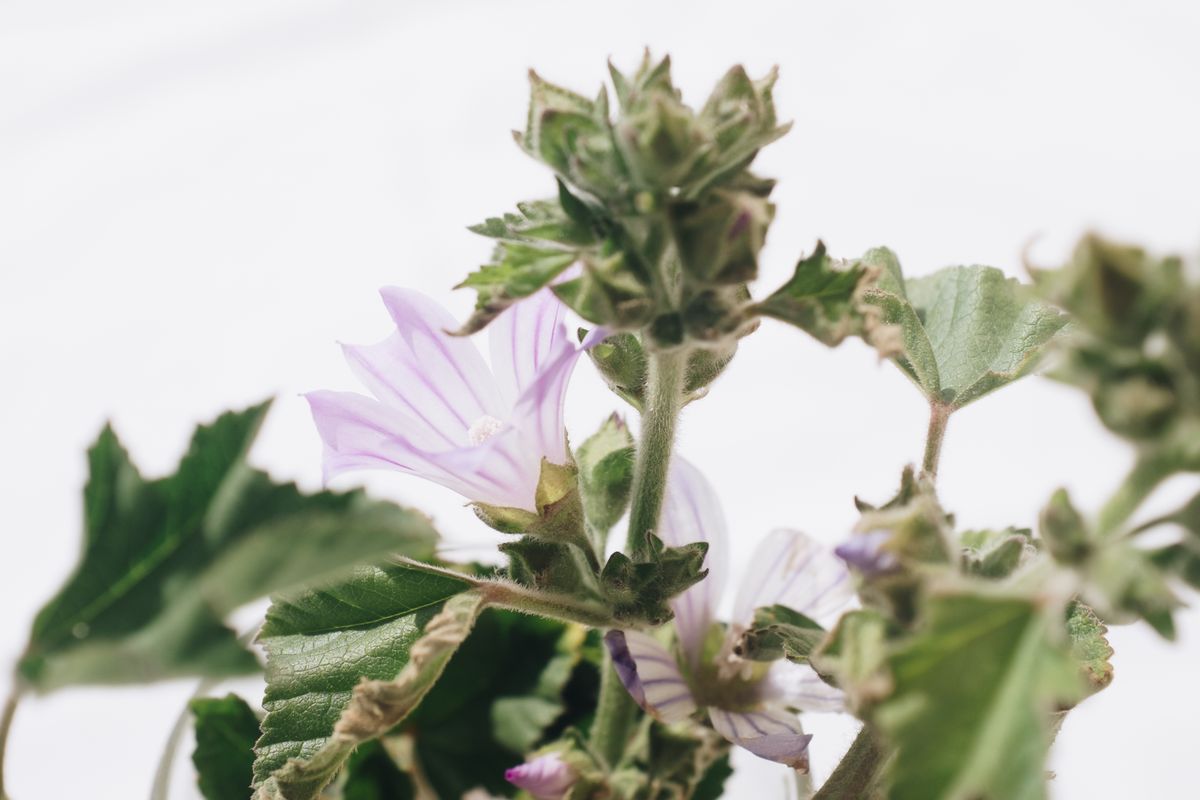
The English name marshmallow This is no coincidence: The white sweet was originally made from the mucilage of the marshmallow root, whipped with sugar and egg white - it has nothing to do with today's gelatin mass.
Marshmallow (Heliotropa) originates from Eastern Europe and Western Asia and grows wild in damp, sometimes saline habitats – salt marshes, ditches, and riverbanks. In Central Europe, it is rare and in some areas protected; what is used medicinally comes from cultivation, primarily from Eastern Europe. The plant grows up to 1.5 meters tall, has velvety, gray-green leaves, and pale pink flowers that resemble those of mallows – no wonder, they belong to the same family.
The botanical name already indicates its rank: Althaea comes from Greek althaino, heal. It is mentioned by Theophrast and Dioscorides, it is a required plant in Charlemagne's Capitulary, and it was commonplace in monastery gardens. For over two thousand years, the marshmallow the Remedies for irritated mucous membranes – both internal and external – and little has changed in that regard to this day.
The connection to marshmallows is historically documented: French confectioners introduced them in the 19th century. pâte de guimauve It originated from a confection made by whipping the mucilage of marshmallow root with sugar and egg white – a sweet that was actually intended as a cough remedy for children. When industrial production arrived, the laborious root mucilage was replaced with gelatin and starch. What remained was the name, which today recalls a plant that is no longer part of the sweet.
To useWhat the marshmallow root can do for you
The marshmallow is the The most mucilage-rich medicinal plant in our flora The root contains up to twenty percent mucilage, which is more than mallow, ribwort plantain, or coltsfoot. The European Medicines Agency lists it for traditional uses in dry, irritating cough and at mild inflammation of the oral and pharyngeal mucosa, Commission E has given it a correspondingly positive assessment. Additionally, it has a recognized use for mild irritation of the gastric mucosa.
The mechanism of action is the most honest a medicinal plant can have because it is purely physical: The mucilage consists of long-chain polysaccharides that swell in water, forming a viscous, slippery solution. When drunk, this solution coats the pharyngeal mucosa as a thin film, covering the irritated cough receptors. This soothes the irritation, and the dry, self-perpetuating cough subsides. There is no debate about the active ingredient here, and no unclear study results—it works like a protective film because that's what it is.
That's precisely why marshmallow is the plant to turn to for a tickly cough, instead of resorting to more problematic herbs: It contains no pyrrolizidine alkaloids like coltsfoot, has no significant interactions, and boasts a very good safety profile. It's suitable for children, pregnant women, and the elderly. The only practical limitation stems from its mechanism of action itself: A film over the mucous membrane can also delay the absorption of other medications. - therefore, keep a one to two hour interval between taking tablets.
IngredientsIt's in the root.
The Mucus They make up ten to twenty percent of the root's composition and about six to ten percent of the leaves'. Chemically, they are polysaccharides—mainly galacturonorhamnans, arabinogalactans, and glucans—long chains of sugar molecules that can bind enormous amounts of water. They are not "active ingredients" in the classical sense because they are not absorbed and do not bind to any specific parts of the body; their effects are felt wherever they remain.
In addition, the root contains approximately 35 percent Strength, Marshmallow contains approximately 10 percent pectin, sucrose, free amino acids such as asparagine, and traces of flavonoids and coumarins. The starch is responsible for the slightly sweet, mealy taste. Essential oil is practically nonexistent – marshmallow has almost no scent.
From all this follows one rule that decides everything for this plant: Cold infusion instead of infusion. While boiling water does dissolve mucilage, it destroys some of it and extracts a lot of starch, which makes the tea cloudy and slimy. The correct method is as follows: Let the cut root stand in cold water for one to two hours, stirring occasionally, strain, and then warm it only to drinking temperature – never boil it. The finished extract is slightly viscous, mild, and almost tasteless.
Enhanced combinationsWhat makes the marshmallow stronger
Almost everything here depends on the temperature. Cold and patient is better than hot and fast.
Start with cold water, let it steep, strain, warm until lukewarm - this is how you get all the mucilage.
Three mucilage drugs in one mixture - all three are harmless, even for children.
Well-researched for nighttime tickly coughs in children from one year of age - one spoonful before bedtime.
For sore oral mucosa and after dental treatments - the film protects the irritated area.
For irritated stomach lining: Marshmallow forms a protective film, chamomile relieves cramps and has an anti-inflammatory effect.
Marshmallow syrup stays in the throat longer than tea - therefore, the syrup form is often more effective for coughs.
What contradicts itselfIt's best to avoid these combinations.
Boiling water destroys some of the mucilage and dissolves starch - the tea becomes cloudy and less potent.
The mucus film can delay the absorption of other active ingredients - allow one to two hours between doses.
The finished cold infusion is a good breeding ground for germs - prepare fresh, store leftovers in the refrigerator and consume within one day.
Marshmallow syrup contains a lot of sugar - if you have diabetes, include it in your daily intake or choose the tea form.
For stubborn mucus, loosening herbs like thyme or fennel are needed - marshmallow root has a dampening effect instead of loosening it.
When a cough lasts for more than two weeks, the problem is not the dose, but the lack of investigation.
ApplicationHow it is used
- cold extractTwo teaspoons of chopped root to 250 ml of cold water, for one to two hours, then lukewarm.
- Cough tea mixtureMarshmallow root, mallow leaves and ribwort plantain in equal parts, cold infused.
- Marshmallow syrupBoil down a cold infusion with sugar or honey - it lingers in the throat longer than tea.
- gargle solutionThe same cold infusion is used for sore oral mucosa and after dental treatments.
- Stomach-protecting teaCombined with chamomile for irritated stomach lining, half an hour before meals.
- Children's coughThe plant of choice for children's tickly coughs - mild, safe, alcohol-free.
- Marshmallow root for chewingTraditionally given to teething infants - no longer recommended today due to the risk of choking.
- leaf extractThe leaves have the same effect, but contain less mucilage than the root.
- envelopeApply a strong extract to a cloth - traditionally used for irritated, dry skin.
- garden plantIn moist, nutrient-rich soil in full sun - a beautiful, tall perennial.
As a home remedyThe cold extract
Marshmallow root for dry, irritating coughs
- Place two heaped teaspoons of sliced marshmallow root into a cup or glass and pour 250 ml of cold water over it.
- Leave to stand at room temperature for one to two hours, stirring two to three times in between - the water will become noticeably thicker.
- Strain through a fine sieve and warm gently on the stovetop or in a water bath until just warm enough to drink. Do not boil.
- Drink slowly in small sips, up to three cups throughout the day. If you have a nighttime cough, drink the last portion right before bed.
For dry, tickly coughs, scratchy throats, and irritated oral mucosa. The mucilage forms a thin film over the mucous membranes and dampens the receptors that trigger the cough reflex. This is one of the few applications where the mechanism can be fully explained—and where there's no need to sugarcoat anything. For children, pregnant women, and the elderly, marshmallow is the safest choice for tickly coughs.
Up to three cups a day, for as long as the tickly cough lasts. Leave one to two hours between medications and other medications., Because the mucus layer can delay absorption. Prepare the extract fresh and do not store leftovers for more than one day. Coughs lasting longer than two weeks, accompanied by fever, shortness of breath, or bloody sputum, should be evaluated by a doctor.
Ayurveda & TCMWhat the old systems say
Ayurveda
Marshmallow is not classically represented in Ayurveda, but its properties correspond to a very well-known category there: sweet, mucilaginous, cooling and moistening - so Vata and Pitta soothing, Kapha Intensifying. For dry conditions, dry coughs, and irritated mucous membranes, this is exactly the right direction; for a phlegmy, wet cough, it would be the wrong one. Ayurvedic equivalents with a similar profile are licorice and bala.
Traditional Chinese Medicine
Marshmallow is absent from the Chinese Materia Medica, but the concept is familiar: it would be a sweet, cool remedy that Yin nourishes and moistens dryness - in the vicinity of herbs such as Mai Men Dong or Bai He, These are classically used for dry coughs and dry throats. The same applies here: moisturizing agents are unsuitable for wet, phlegmy coughs.
Warning noticesWhen you should be careful
Please note
- Medication intake: The mucus film can delay the absorption of other medications - maintain a one to two hour interval.
- Preparation: Do not pour hot water over the extract; heat destroys some of the mucilage and makes the extract cloudy.
- Durability: Use the prepared cold infusion fresh and do not store it for longer than one day.
- Diabetes: Marshmallow syrup contains a lot of sugar - factor it into your daily intake or choose the tea form.
- False cough: For a persistent, productive cough, expectorant herbs such as thyme or fennel are the better choice.
- No replacement: A cough lasting more than two weeks, accompanied by fever, shortness of breath or bloody sputum, should be investigated by a doctor.
This page provides information and does not replace medical advice. If symptoms persist, please consult a doctor.
Related to the topicRead on and cook along!
Shop links lead to our product pages; it is indicated there if a partner is involved.
SourcesWhat is this based on?
- EMA/HMPC: European Union herbal monograph on Althaea officinalis L., radix - traditional use for tickly coughs and mild inflammation of the oral and pharyngeal mucosa.
- Commission E: Monograph Althaeae radix (marshmallow root), Federal Gazette 1989.
- Blaschek W (ed.): Wichtl - Herbal drugs and phytopharmaceuticals. 6th edition 2016, monograph Althaeae radix.
- European Pharmacopoeia (Ph. Eur.): Monograph Althaeae radix - Determination of swelling capacity as a quality measure.
- Fink C, Schmidt M, Kraft K. Marshmallow root extract for the treatment of irritative cough. Complementary Medicine Research 2018; 25(5): 299–305.


