
OriginThe plant that followed Europeans across the world
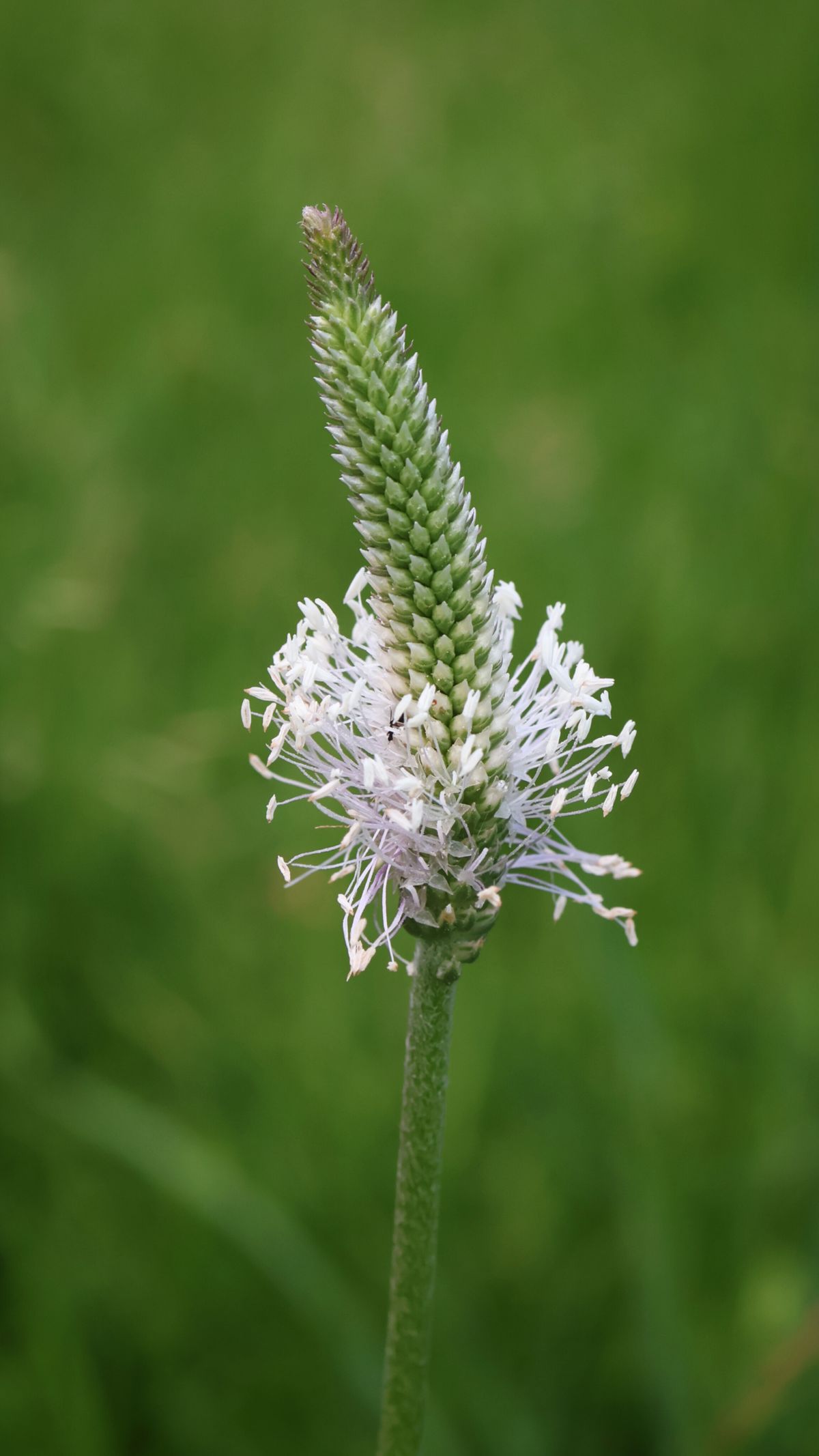
Indigenous peoples of North America called the plantain "white man's footprints" - it appeared wherever settlers went.
The genus name Plantago comes from planta, the sole of the foot, and that's meant quite literally: plantains grow where people walk. Their leaves lie flat in a rosette on the ground, the leaf veins are elastic like rubber bands, and the point of attachment is so low that neither hooves nor lawnmowers can reach it. This isn't an adaptation to a habitat, but to a disturbance – and that's why plantain is one of the most reliable companions of human settlements.
It arrived in North America, Australia, and New Zealand with European settlers. In several indigenous North American languages, it's called something like "white man's footprints" because it appeared wherever settlers built paths and drove cattle. Today, it grows on every continent except Antarctica. This ubiquity has a practical advantage: you never have to look for it. Almost every unsprayed meadow, every dirt road, every older lawn has it.
Ribwort plantain has been documented in European folk medicine since antiquity. Dioscorides describes it, Pliny praises it, it was a staple in medieval monastery gardens, and the Anglo-Saxon Nine Herbs blessing includes it as fry away These are the nine sacred herbs. What's astonishing is that their uses have remained virtually constant for over two thousand years: coughs, sore mucous membranes, minor wounds, insect bites. This is rare – the range of applications for most ancient medicinal plants has shifted several times over the centuries.
To useTwo operating principles in one leaf
Ribwort plantain is pharmacologically interesting because it contains two very different groups of substances that complement each other effectively. The European Medicines Agency lists the herb as traditional use For dry, irritating coughs and inflammation of the oral and pharyngeal mucosa, Commission E issued a positive monograph in 1986, which also includes external use for inflammatory skin conditions. This is a remarkably broad recognition for a wild plant.
The first principle is the mucilage polysaccharides. They swell in water and, when drunk, form a thin film over the irritated mucous membrane of the throat. This mechanically dampens the cough reflex originating from this mucous membrane. This is the same mechanism as with marshmallow and mallow, and it's the reason why ribwort plantain helps with a dry, irritating cough—and why it's the wrong choice for a chesty, phlegmy cough. For that, there's primrose and ivy.
The second principle is the iridoid glycosides, most notably aucubin. Aucubin is ineffective on its own; however, when broken down by enzymes or bacteria, it forms aucubigenin, which exhibits a pronounced antibacterial effect in laboratory tests. In addition, it contains tannins, which have an astringent effect and help stop minor bleeding. This combination—mucus, which soothes, plus an antibacterial component that is only activated at the site of bacterial infection—explains why the same plant appears beneficial both internally for sore throats and externally for grazes.
Regarding the classic application, we have to be honest: a crushed plantain leaf on an insect bite or a nettle sting is purely anecdotal. There are no controlled studies on it, and part of the effect is certainly due to the cooling effect of the plant sap and the distraction from the rubbing. Nevertheless, the substances involved match what we observe, the risk is practically zero, and the leaf is always within reach. We consider this one of the most sensible applications that folk medicine has to offer – without elevating it to the status of a proven therapy.
IngredientsWhy fresh plantain is better than dried plantain
With ribwort plantain, processing is exceptionally more crucial than origin. Aucubin is an unstable molecule: as soon as the leaf is damaged or dries slowly, the plant's own enzymes come into contact with the glycoside and break it down. The fragments then oxidize further and turn dark brown. This is precisely what you see in poorly dried plantain – it's brown instead of grayish-green. A good quality ribwort plantain retains its color because it was dried quickly and at a high temperature, thus destroying the enzymes before they can do their work.
For you, this means practically: the strongest preparations are freshly pressed juice or freshly made syrup. Both utilize the aucubin before it breaks down. A commercially available tea made from dried herb primarily provides mucilage and tannins – this isn't worthless, it's actually just what you need for a tickly cough, but it's a different preparation with a different profile. Those harvesting in summer should boil some of it down into syrup instead of drying everything.
Unlike aucubin, the mucilage polysaccharides are stable and soluble in both cold and hot water. The tannins take time to dissolve, which is why plantain tea should steep for ten minutes – unlike with herbs containing essential oils, nothing is lost in the process. Plantain also contains silica, zinc, and a good amount of vitamin C, which explains its long-standing reputation as a spring herb.
A word about confusion: The closely related broadleaf plantain Plantago major The one with the round, broad leaves is equally usable and contains the same groups of substances, albeit in a lower concentration. The ribwort plantain Plantago media Likewise. There are no dangerous look-alikes when it comes to ribwort plantain – its parallel-veined, distinctly ribbed leaves in a basal rosette are unmistakable. This makes it one of the best plants for beginners.
Enhanced combinationsWhat the ribwort plantain works with
Plantain is the calming component of a mixture. It benefits from being combined with something that performs a secondary function – relieving tension, easing cramps, or warming.
Thyme relaxes the bronchial muscles and releases essential oil, while ribwort plantain coats the sore throat with its mucilage. Together, they soothe a stubborn, agonizing cough, for which both are necessary.
For a purely dry, tickly cough without phlegm, a pure mucilage mixture is the best choice. Drink it lukewarm, not hot – heat breaks down the mucilage.
When gargling, the tannins in sage and the mucilage in ribwort plantain complement each other. The sage has an astringent effect, while the plantain soothes – one of the best combinations for a sore throat.
For the care of healed abrasions: Calendula soothes and moisturizes, while ribwort plantain provides tannins. Use as a combined oil infusion or as a compress made from the tea.
When it comes to contact with stinging nettles, ribwort plantain is a classic remedy: crush a leaf and apply it to the stinging area. Both almost always grow next to each other, which makes it very convenient.
Honey in ribwort plantain syrup is not only a sweetener, but also a preservative and contributes its own active ingredients – for children's coughs, honey is one of the few treatments with proven effectiveness. For children one year and older, not younger.
What contradicts itselfIt's best to avoid these combinations.
A mucilage-containing herb suppresses the urge to cough – but this is counterproductive in the case of a productive cough, because the mucus needs to be expelled. Primrose, ivy, or thyme are indicated here.
Mucilage cannot withstand prolonged heat. An infusion is fine, but a decoction or boiling for several minutes destroys precisely what the plant is used for.
Mucilage can delay the absorption of other active ingredients from the intestines. Maintain a one- to two-hour interval between taking mucilage and other medications – this applies to all mucilage-containing drugs.
Plantains grow where people trample, and these are often precisely the areas with dog feces, road salt, and exhaust fumes. Collect them away from roads and dog walking areas, and always wash them.
Leaves that dry slowly turn brown because the aucubin degrades enzymatically. Those who want to dry them should do so quickly and warm; those who want the full nutritional content should process them fresh.
A crushed meadow leaf is not a sterile bandage. It's fine for small, clean scratches and stings – but deeper or dirty wounds should be cleaned and treated, not planted with it.
To which courtA wild vegetable that can taste like mushrooms
- Wild herb saladOnly the very young leaves from the center of the rosette, finely chopped. Older leaves are almost unchewable due to their tough veins.
- Fried budsSauté the still-closed flower buds in butter – they actually develop a mushroomy, button-like flavor. The best way to eat ribwort plantain.
- Green sauceAs an ingredient in a Frankfurt green sauce or a wild herb variation, it brings a mild, slightly nutty flavor.
- Spinach substituteBlanch young leaves, remove the tough ribs, and prepare like spinach. Time-consuming, but worthwhile.
- Wild herb soupPureed together with nettle, goutweed and dandelion into a potato soup - the classic spring dish.
- herb quarkFinely chopped and mixed with quark, oil, and salt. The astringent flavor blends well with the acidity of the quark.
- Steamed as a side dishSautéed with onion and garlic in oil, treated like chard - the ribs take longer to cook than the leaves.
- PestoBlended with oil, nuts, and hard cheese. Slightly more bitter than wild garlic pesto, keeps in the refrigerator for about a week.
- syrupThe durable storage form: layered with sugar or boiled down with honey - see the home remedy below.
- Seed headsThe ripe seeds can be used like the related psyllium seeds; they swell in water and have a mild regulating effect on the intestines.
As a home remedyThe syrup - the form that preserves summer
Plantain syrup, layer method
- Collect approximately 200g of young, clean leaves away from roads and dog paths. Do not wash if possible – just brush them off; water dilutes the infusion.
- Roughly chop the leaves or crush them with a mezzaluna so that the juice can be released.
- In a clean glass, layer the ingredients alternately: a layer of leaves, a layer of raw cane sugar, and so on, until the glass is full. Press each layer down firmly.
- Seal the jar and leave it to stand in a cool, dark place for four to six weeks. The sugar draws the juice out of the leaves; the mixture will visibly shrink.
- Strain, squeeze the leaves well and briefly heat the resulting syrup to about 60 degrees - do not boil, as this destroys the mucilage.
- Pour into clean, small bottles, label, date, and store in a cool place. Refrigerate opened bottles and consume within a few weeks.
For a dry, scratchy, tickly cough and a sore throat, take it by the spoonful straight so the syrup coats the back of the throat. A good, mild option for children over one year old. Not for a chesty, phlegmy cough – an expectorant is needed in that case.
Adults can take one teaspoon up to three to four times a day; children over one year old should take correspondingly less. If the cough persists for more than three weeks, or if fever, shortness of breath, or blood in the sputum develops, a doctor should be consulted.
Ayurveda & TCMWhat the old systems say
Ayurveda
The genus Plantago In Ayurveda, it is primarily present through the seeds: Isabgol, the husks of the Indian psyllium seed Plantago ovata, are a key remedy for the intestines and are described as cooling, sweet and vata-described as balancing. Ribwort plantain as a leaf drug is not mentioned in the classical texts; it is a European plant with a European tradition of use. The relationship via the seeds is nevertheless interesting because it is based on the same group of substances: swelling mucilage polysaccharides.
Traditional Chinese Medicine
In the Chinese materia medica, plantain is listed under Che Qian Zi guided - these are the seeds of Plantago asiatica and related species –, and the herb as Che Qian Cao. Both are described as sweet and cooling, with a connection to the kidneys, liver, lungs, and small intestine. Their primary use is quite different from what we understand: they are considered diuretics and agents for "eliminating dampness," and are used for urinary tract infections and diarrhea. Their role as cough remedies is also present, but not their primary function.
Warning noticesWhen you should be careful
Please note
- Not for coughs with phlegm: Plantain soothes the urge to cough. If you need to cough up phlegm, this is the wrong approach – then ivy, thyme, or primrose are recommended.
- Distance to medications: Mucus can delay the absorption of other active ingredients. Leave a one- to two-hour interval between taking this medication and taking tablets.
- Please note the collection point: Plantain prefers to grow along paths where dogs walk and cars drive. Collect it from off-road areas, wash it thoroughly, and do not take anything from freshly mowed or sprayed areas.
- No substitute for a bandage: Crushed leaves on stings or scratches are an old, useful practice – but not sterile. For deeper or dirty wounds, clean and treat them properly.
- Homemade syrup: Do not boil, store in a cool place, discard if cloudy, fermenting, or with an off-odor. Sugar only acts as a preservative if the mixture was prepared cleanly.
- Persistent symptoms: A cough lasting over three weeks, high fever, shortness of breath or blood in the sputum is not a case for wild herbs, but for a doctor's appointment.
This page provides information and does not replace medical advice. If symptoms persist, please consult a doctor.
Related to the topicRead on and cook along!
Shop links lead to our product pages; it is indicated there if a partner is involved.
SourcesWhat is this based on?
- European Medicines Agency, HMPC: Community herbal monograph on Plantago lanceolata L., folium - traditional use.
- Commission E, monograph „Plantaginis lanceolatae herba“, BAnz No. 223 of November 30, 1985.
- Beara I. et al.: Comparative analysis of phenolic profile and biological activity of Plantago species. Journal of Pharmaceutical and Biomedical Analysis 2012.
- Blaschek W. (ed.): Wichtl - Herbal Drugs and Phytopharmaceuticals, Chapter Plantaginis lanceolatae herba.
- Oduntan A. et al.: Aucubin and catalpol content in Plantago lanceolata and its degradation during drying. Journal of Agricultural and Food Chemistry, Overview of the stability of iridoids.


