
OriginThe mallow tree by the fence
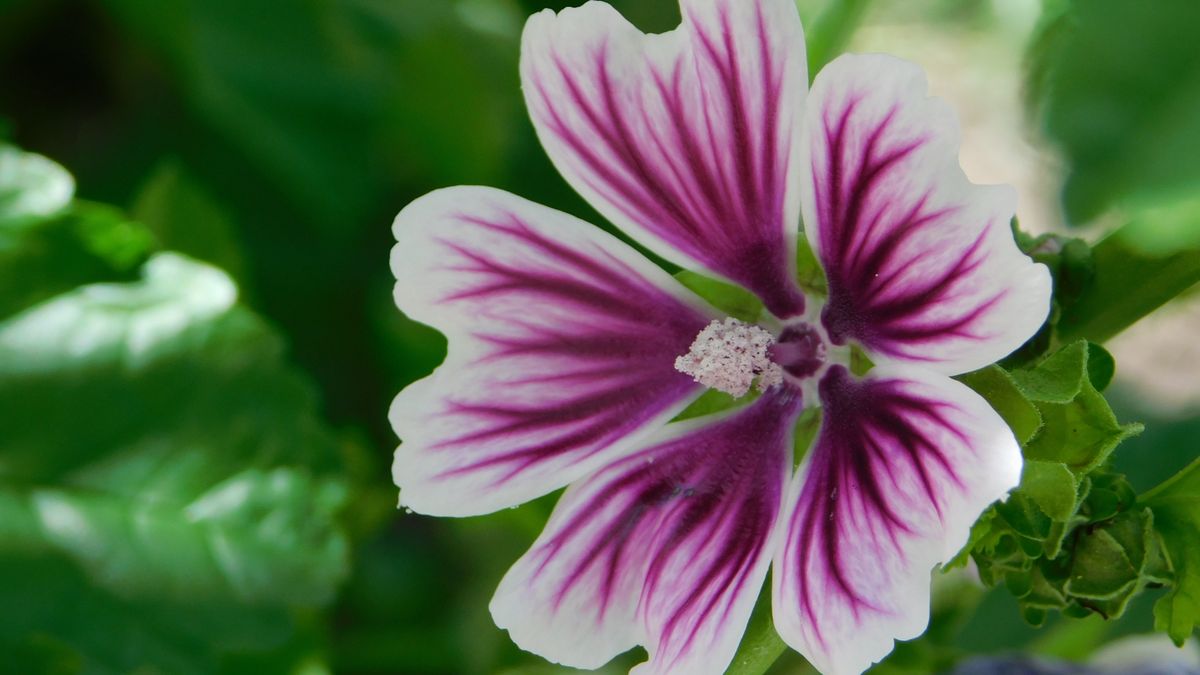
The fruits look like tiny cheese rounds with a rim - hence cheese poplar, and generations of children have called them "Käsle" and eaten them.
The common mallow grows along roadsides, fences, rubble heaps, railway embankments, and walls throughout Europe and Western Asia – a typical ruderal plant that thrives where the soil is disturbed. It grows to knee- to hip-high and blooms from June until autumn with pinkish-purple flowers with dark veins. Its fruits split into ring-shaped mericarps that together resemble a small cheese wheel – hence its common name. Cheese mallow, which has nothing to do with cardboard, but with the porridge ("Papp") that was cooked from the leaves.
It is one of the oldest cultivated and medicinal plants in Europe. Among the Romans, it was a common vegetable – Pliny and Horace mention it – and it is among the plants that Charlemagne had cultivated under his Capitulare de villis (edict concerning royal estates). In folk medicine, it was a mild cough remedy for children, which could be given safely for weeks. Its close relative, the Marshmallow, is richer in mucilage and therefore the stronger medicinal drug; mallow is the more common, milder variant and is therefore available everywhere.
A unique feature that delights children and is also chemistry you can touch: The infusion of mallow blossoms is initially blue to blue-green and turns into a bright red when lemon juice is added Pink The anthocyanins are responsible, acting as natural pH indicators – the same reaction as in red cabbage. This doesn't affect the tea's effectiveness, but it greatly contributes to the enjoyment of the tea.
To useWhat the mallow does for you
The European Medicines Agency lists mallow flowers and leaves as a traditional use for dry, irritating cough and at mild inflammation of the oral and pharyngeal mucosa; Commission E has given it a correspondingly positive assessment. The principle of action is the same as with marshmallow root and just as easily understood: The mucilage swells in water, forming a viscous solution and, when drunk, coating the irritated mucous membrane as a thin film. This shields the cough receptors in the throat, thus relieving the irritation.
With approximately eight to ten percent mucilage in its flowers, the mallow ranks lower than the marshmallow, whose roots can reach up to twenty percent. This is precisely what makes it the better choice in many situations: it is milder in taste, she is unproblematic for children, And it can be used for longer periods. In pediatrics, mallow tea is one of the few cough teas that are drunk without question.
Traditionally, it was used for more than just coughs: as a poultice for irritated skin and minor inflammations, as a gargle, for stomach irritation, and – in peasant cuisine – simply as a vegetable. The young leaves are edible and slightly mucilaginous, the blossoms a pretty salad ingredient, and children have been nibbling the unripe "Käsle" (little cheeses) from the roadside for centuries.
The limitation is the same as with all mucilage-containing drugs and is purely practical: the film over the mucous membrane can also... Delaying the intake of other medications. A one- to two-hour interval between taking tablets completely resolves the problem. And for a chesty, productive cough, mallow is the wrong herb – expectorant herbs like thyme or fennel are needed, not suppressant ones.
IngredientsThis is what's in the flower and leaf
The Mucus They make up about eight to ten percent of the flowers, and slightly less in the leaves. Chemically, they are acidic polysaccharides, primarily galacturonorhamnans and arabinogalactans – the same class of substances as in marshmallow. They are not absorbed and do not act via the bloodstream; they act purely physically as a protective film where they remain.
The Anthocyanins Malvin, named after the genus, is the primary component that gives the flowers their color and the infusion its blue hue. These compounds are pH-dependent: in neutral to slightly alkaline conditions, they appear blue to blue-green, while in acidic conditions, they range from pink to red. This explains the color change when lemon is added. While their antioxidant properties are of interest in laboratory settings, they are irrelevant for cough remedies.
It also contains flavonoids, tannins in small amounts, and essential oil only in trace amounts. Therefore, the same preparation rules apply as with marshmallow: Cold infusion instead of infusion. Steep the blossoms in cold water for one to two hours, strain, and warm only to drinking temperature – never boil. Hot water destroys some of the mucilage and extracts the tannins, making the tea unnecessarily bitter. Furthermore, the beautiful blue hue is preserved with a cold infusion, while it turns gray with a hot one.
Enhanced combinationsWhat makes the mallow stronger
Cold, patient and in the right company - when it comes to mucilage, temperature is everything.
Prepare the mixture from cold, let it steep, then warm it to lukewarm – this way mucilage and color are preserved.
The three harmless mucilage drugs - together stronger than any one of them.
Honey has been well researched for its effectiveness in treating nighttime coughs in children over one year old.
The same extract is used for sore oral mucosa and after dental treatments.
One splash transforms the blue into a vibrant pink - chemistry you can watch.
Apply a strong extract to a cloth for dry, irritated skin.
What contradicts itselfIt's best to avoid these combinations.
Heat destroys mucilage, extracts tannins, and turns the color gray.
The mucus film delays absorption by one to two hours.
For a productive cough, expectorant herbs like thyme are needed, not suppressant ones.
The finished cold infusion is a good breeding ground for germs - prepare fresh.
Mallow likes to grow along paths and railway embankments - choose a clean location.
A cough lasting longer than two weeks should be investigated, no matter how mild the tea is.
To which courtWhere she belongs
- Mallow cold infusionTwo teaspoons of blossoms to 250 ml of cold water, steep for one to two hours, then lukewarm.
- Cough tea mixtureMade with equal parts marshmallow root and ribwort plantain, prepared cold.
- gargle solutionThe same extract for sore oral mucosa and scratchy throat.
- Children's teaOne of the few cough teas that children drink voluntarily.
- Flowers in saladThe pinkish-purple flowers can be used as an edible decoration.
- Young leavesAs a mild, slightly slimy leafy vegetable - steamed like spinach.
- nibbling cheesePicking unripe fruit straight from the roadside – an old children's game.
- Mallow soupBound with young leaves - a recipe from the poor's kitchen.
- Color experimentAdd lemon to the blue infusion and watch it turn pink.
- Skin wrapStrong extract, cooled, applied to dry and irritated skin.
As a home remedyTea for children
Cold infusion of mallow for dry cough
- Place two heaped teaspoons of dried mallow flowers and leaves into a glass and pour 250 ml of cold water over them.
- Leave to stand at room temperature for one to two hours, stirring occasionally - the extract will turn blue and become noticeably thicker.
- Strain and warm in a water bath only to drinking temperature; do not boil, otherwise the mucilage will break down and the color will change.
- For children over one year old, sweeten with a spoonful of honey if desired. If you like, add a squeeze of lemon – this will turn the tea pink.
For dry, tickly coughs, scratchy throats, and irritated oral mucosa—especially in children and sensitive individuals for whom marshmallow or thyme are too strong. The mucilage physically coats the mucous membranes and soothes the urge to cough. This isn't about the active ingredient, but rather the protective film it forms, which is why it works so reliably. Honey has also been well-studied for nighttime coughs in children over one year old.
Up to three cups a day, for as long as the tickly cough lasts. No honey for infants under twelve months. Leave one to two hours between taking this extract and other medications. Prepare the extract fresh and do not store any leftovers for more than one day. Coughs lasting longer than two weeks, accompanied by fever, shortness of breath, wheezing, or bloody sputum, should be evaluated by a doctor—earlier in children than in adults.
Ayurveda & TCMWhat the old systems say
Ayurveda
Mallow is not classically represented in Ayurveda, but its properties correspond to a clear category there: sweet, mucilaginous, cooling and moisturizing - Vata and Pitta soothing, Kapha Increasing. This is the right direction for dry, irritating conditions, but the wrong one for a chesty cough. Ayurvedic equivalents with a similar profile are licorice and bala – the latter, incidentally, is also a member of the mallow family.
Traditional Chinese Medicine
A related species is listed in the Chinese Materia Medica: Dong Kui Zi, the seeds of Malva verticillata, They are considered sweet and cooling, associated with the functional systems of the large intestine, small intestine, and bladder, and are used for moistening and promoting urination. The use of the flowers and leaves for coughs, as we know it, is not documented there – same genus, different focus.
Warning noticesWhen you should be careful
Please note
- Medication intake: The mucus film can delay the absorption of other medications - maintain a one to two hour interval.
- Preparation: Do not pour hot water on the pot; heat destroys some of the mucilage and draws out tannins.
- Durability: Use the prepared cold infusion fresh and do not store it for longer than one day.
- False cough: For a persistent, productive cough, expectorant herbs such as thyme or fennel are the better choice.
- Collection points: Mallow likes to grow along roads and railway embankments - only harvest from clean locations.
- No replacement: A cough lasting longer than two weeks, accompanied by fever, shortness of breath or wheezing, should be investigated by a doctor.
This page provides information and does not replace medical advice. If symptoms persist, please consult a doctor.
Related to the topicRead on and cook along!
Shop links lead to our product pages; it is indicated there if a partner is involved.
SourcesWhat is this based on?
- EMA/HMPC: European Union herbal monograph on Malva sylvestris L., flos and folium - traditional use for tickly coughs and mild inflammation of the oral mucosa.
- Commission E: Monograph Malvae flos/folium (mallow flowers and leaves), Federal Gazette 1990.
- Blaschek W (ed.): Wichtl - Herbal drugs and phytopharmaceuticals. 6th edition 2016, monograph Malvae flos.
- European Pharmacopoeia (Ph. Eur.): Monograph Malvae folium - Determination of swelling capacity.
- Oduwole O et al. Honey for acute cough in children. Cochrane Database of Systematic Reviews 2018; CD007094.


