
Fennel bulb (Foeniculum vulgare var. azoricum)
OriginThe fennel from Florence
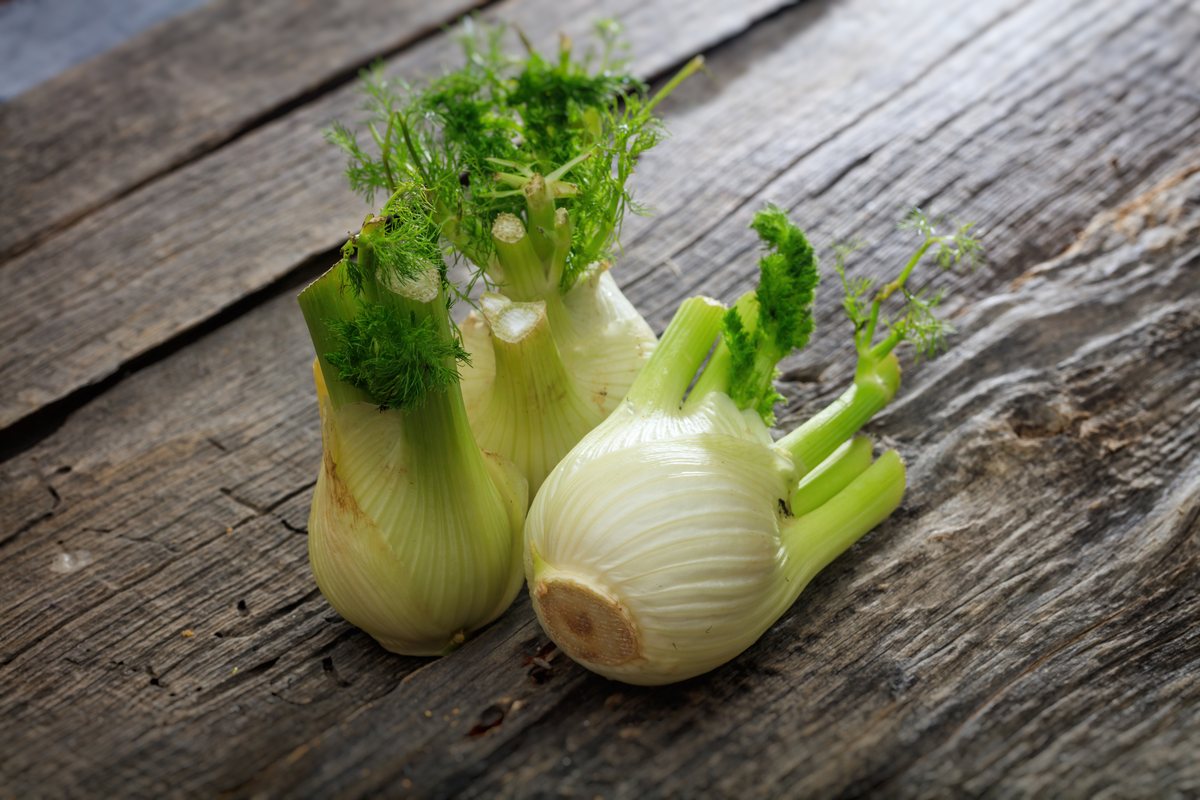
The Italians call him Finocchio - and that's also the name given to a man you shouldn't believe.
Wild fennel grows around the Mediterranean on dry, sunny slopes; the Greeks and Romans used the herb and seeds as a spice and medicine. The vegetable form with the thick "bulb" was cultivated in Italy, probably in Tuscany during the Renaissance – hence the name Florentine fennel.
Botanically speaking, the bulb isn't a bulb at all, but rather the thickened, overlapping leaf sheaths at the base of the plant. The feathery green tops are edible and have a flavor similar to dill. In Germany, fennel has only been widely available since the 1970s; it primarily comes from Italy and Spain.
To useWhat the fennel bulb can do for you
The fennel bulb is a light, easily digestible vegetablesApproximately 31 kcal per 100 g, plus vitamin C, potassium, folate, fiber, and some calcium. Its aroma comes from the essential oil with Anethole as a main component.
Anethole and fenchone have a relaxing effect on the digestive muscles and are mildly carminative. However, the medicinally recognized effect on flatulence and gastrointestinal cramps refers to the fennel fruits (seeds), which contain many times the amount of essential oil. The bulb is the gentle, everyday version: it goes well with bland diets and heavier dishes.
Fennel is traditionally considered to promote milk production during breastfeeding. However, there are no reliable studies to support this; as a vegetable, it is safe to eat while breastfeeding.
IngredientsThis is what's in the fennel bulb
The tuber contains water, fiber, potassium, Vitamin C, folate, calcium, magnesium and a small amount essential oil containing anethole, fenchone, limonene, and estragole. It also contains flavonoids such as quercetin and rutin.
Estragole Fennel is under scrutiny due to animal studies involving very high doses. The European Medicines Agency therefore advises caution when using concentrated fennel preparations in young children and during pregnancy. The amount of fennel in the bulb is very small – as a vegetable, fennel is considered safe for everyone.
Enhanced combinationsWhat makes the fennel bulb stronger
Fennel is fresh and anise-like - it loves citrus, fish and olive oil.
Sicilian salad: fennel, orange segments, black olives, red onion, olive oil.
Fennel under sea bream or salmon in the oven - a classic of Mediterranean cuisine.
Braised in wedges with broth, topped with Parmesan cheese - sweet and tender.
As a side dish to roast pork or sausage - fennel eases digestion.
Thinly sliced with apple, lemon and dill.
Chop the fennel greens and sprinkle them over the finished dish – like dill.
What contradicts itselfIt's best to avoid these combinations.
Cross-reactions within the Apiaceae family are common.
Concentrated fennel oil should not be used on infants and toddlers, nor during pregnancy - the bulb itself is harmless.
Raw, it is only shaved paper-thin - if cut thick, it is fibrous.
Dried, brown spots indicate age - fennel becomes fibrous after a week in the refrigerator.
Cut out the hard core in a wedge shape.
Using anise, star anise, or pastis quickly makes it one-dimensional.
In the kitchenWhere he belongs
- Fennel and orange saladWith olives, red onion and olive oil.
- Braised fennelTopped with broth, garlic and Parmesan cheese.
- Baked fish on fennelSea bream or salmon on fennel slices with lemon.
- Fennel soupWith potato and a shot of Pernod.
- Fennel risottoWith lemon zest and fennel greens.
- Grilled fennelSliced with olive oil.
- Fennel and apple raw saladPaper-thin with lemon and dill.
- Fennel vegetableSautéed in butter as a bland diet.
- Pasta con finocchioWith sardines, raisins and pine nuts, Sicilian style.
- Pickled fennelWith lemon and chili in olive oil.
As a home remedyFennel vegetables for bloating
Steamed fennel as a bland diet
- Clean a fennel bulb, remove the core, and cut into thin strips.
- Sauté briefly in a teaspoon of butter or olive oil.
- Cover with a little water or broth and simmer gently for 10 to 15 minutes until soft.
- Season with salt and chopped fennel greens, eat warm.
For bloating, fullness, and sensitive stomachs, try this as a light side dish or dinner. Steamed, the tuber is particularly easy to digest; its essential oil has a mild antispasmodic effect.
As a serving of vegetables, as often as it feels good. For a stronger effect on bloating, tea made from crushed fennel seeds is more suitable – see our fennel page. Consult a doctor if symptoms are severe or persistent.
Ayurveda & TCMWhat the old systems say
Ayurveda
Fennel (Shatapushpa or MishreyaIn Ayurveda, it is considered one of the mildest digestive aids: sweet, slightly bitter, and cooling. It strengthens the digestive fire without aggravating Pitta and is chewed after meals. The tuber is considered gentle and suitable for all doshas.
Traditional Chinese Medicine
In Traditional Chinese Medicine (TCM), fennel fruits are called... Xiao Hui XiangThey are described as pungent and warming. They are said to dispel cold, move the Qi of the stomach and liver, and relieve pain – specifically cold-related pain in the lower abdomen and bloating. The tuber is classified similarly, but with milder properties.
Warning noticesWhen you should be careful
Please note
- Allergy: Cross-reaction with celery, carrot, mugwort and birch is possible.
- Essential oil: Not for infants, toddlers and during pregnancy; the tuber is harmless.
- Blood thinners: Small amounts of vitamin K are not a problem in normal portions.
- Hormone-sensitive diseases: Anethole has a weak estrogen-like effect - harmless as a vegetable, but advise against concentrated preparations.
- Potassium: Pay attention to the amounts in cases of kidney failure.
This page provides information and does not replace medical advice. If symptoms persist, please consult a doctor.
Related to the topicRead on and cook along!
Shop links lead to our product pages; it is indicated there if a partner is involved.
SourcesWhat is this based on?
- Badgujar SB, Patel VV, Bandivdekar AH. Foeniculum vulgare Mill: a review of its botany, phytochemistry, pharmacology, contemporary application, and toxicology. BioMed Research International 2014; 2014: 842674.
- HMPC. Public statement on the use of herbal medicinal products containing estragole. European Medicines Agency 2005.
- HMPC. Community herbal monograph on Foeniculum vulgare Miller subsp. vulgare var. vulgare, fructus. European Medicines Agency.
- Commission E: Monograph Foeniculi fructus (Fennel), Federal Gazette.
- USDA FoodData Central: Fennel, bulb, raw.


