
Macadamia (Macadamia integrifolia)
OriginAustralia's contribution to world cuisine
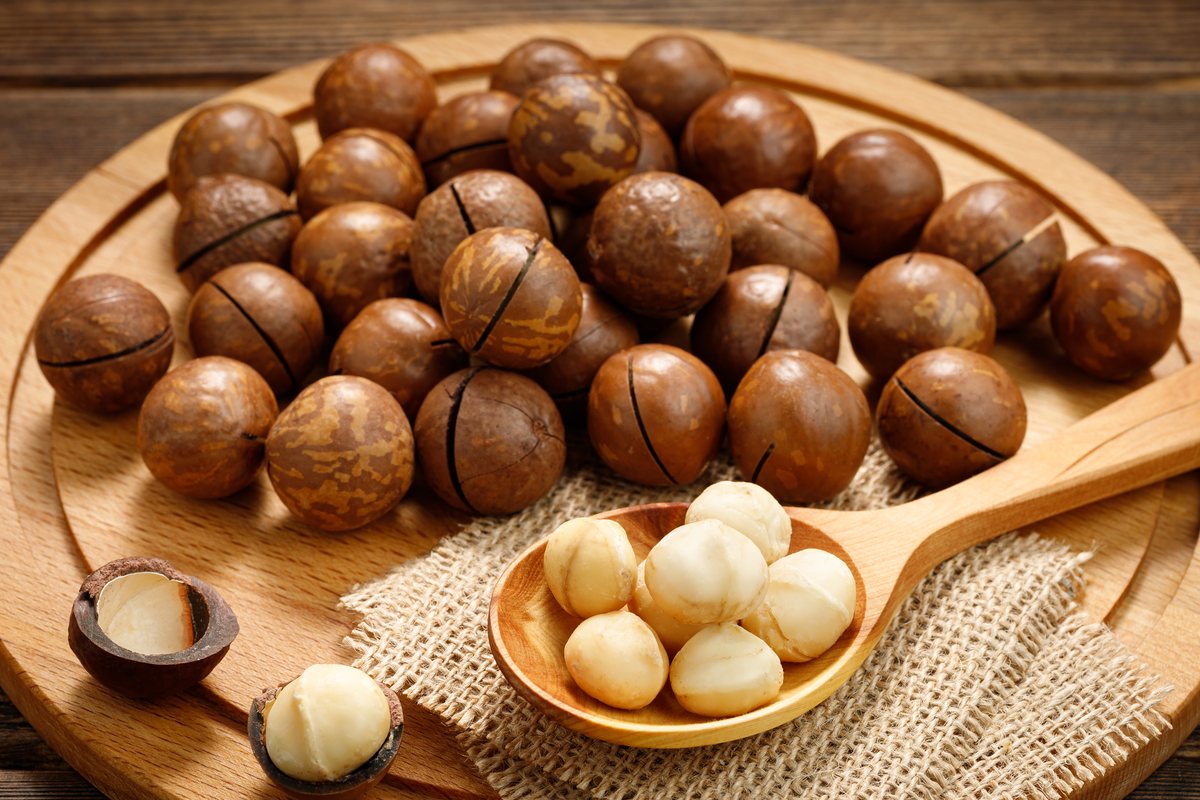
The macadamia is the only plant from Australia that is grown worldwide as food.
The Aborigines gathered the nuts in the subtropical rainforests of Queensland and New South Wales long before the arrival of Europeans. The genus was scientifically described in 1857 by the botanist Ferdinand von Mueller, who named it after his friend John Macadam. Europeans planted the first trees soon afterward.
Macadamia nuts were introduced to Hawaii in the 1880s, where the first large-scale cultivation began in the 20th century. Today, South Africa and Australia are the leading producers, followed by Kenya and China. The shell is so hard that it can only be opened with specialized machinery or a special nutcracker. Therefore, commercially available nuts are usually shelled, while gift sets may include partially sawn nuts with a small key for prying them open.
To useWhat Macadamias Can Do for You
100g of macadamia nuts provide approximately 76g of fat, of which almost 60g is fat. monounsaturated fatty acids - more than any other nut. Besides oleic acid, this is especially true. Palmitoleic acid, Macadamia contains omega-7 fatty acids, which are rarely found in significant quantities in other plant-based fats. In contrast, it contains very little polyunsaturated fat, and therefore very little omega-3. It also provides a good 8g of fiber, plenty of manganese, and vitamin B1.
In an Australian study, men with elevated cholesterol replaced some of their fats with 40 to 90 grams of macadamia nuts per day for four weeks: LDL cholesterol decreased by a good 5 percent, while HDL cholesterol increased. Based on this, the FDA issued a [recommendation/regulation] in 2017. qualified health statement allowed - it states that supportive, but non-exhaustive Research shows that 1.5 ounces (about 40 g) of macadamia nuts per day, as part of a diet low in saturated fat, can reduce the risk of coronary heart disease, provided that no additional calories are consumed.
The crucial postscript concerns the caloriesWith around 720 kcal per 100 g, the macadamia nut is the most energy-dense nut. A handful of 30 g already provides over 200 kcal. Therefore, its benefits only arise when it replaces butter, sausage, or snacks – not when eaten in addition to them.
IngredientsThis is what's in macadamia nuts
Macadamias contain fats including oleic and palmitoleic acids, a small amount of protein, fiber, phytosterols, tocotrienols, squalene, polyphenols, as well as manganese, magnesium, copper, iron, and vitamins B1 and B3. They contain very little sugar and starch.
Due to its high proportion of monounsaturated fats, macadamia oil is more heat-stable than many seed oils and is also suitable for frying at medium heat.
Enhanced combinationsWhat makes macadamias stronger
Macadamias are a gourmet fat - they work best when they replace other fats.
This is the only way to improve blood lipids.
Macadamia provides hardly any Omega-3.
Tropical fruit salad.
Fat helps with carotenoids.
A few kernels are sufficient.
Over medium heat.
What contradicts itselfIt's best to avoid these combinations.
Approximately 720 kcal per 100 g.
Toxic to dogs.
More salt, often additional fat.
Utility turns into sugar.
It goes rancid.
Danger of suffocation.
In the kitchenWhere they belong
- Macadamia cookiesWith white chocolate - as an exception.
- MacadamiamusButtery on bread.
- Nut milkEspecially creamy.
- PestoWith basil and lemon.
- crustFor fish or chicken.
- Tropical fruit saladWith mango.
- PorridgeWith banana.
- Oven-roasted vegetablesWith roasted kernels.
- Vegan cheese spreadSoaked and pureed.
- lettuceWith avocado and lime.
As a home remedyMacadamia spread instead of butter
Macadamia spread
- Soak 150g of unsalted macadamia nuts in water for 2 hours and drain.
- Blend in a blender with 3 to 4 tablespoons of fresh water, a pinch of salt and a squeeze of lemon juice until smooth.
- If desired, stir in herbs such as chives or parsley.
- Pour into a glass and store in the refrigerator.
As a spread that replaces butter: It provides monounsaturated instead of saturated fats – precisely the substitution on which the positive study results are based. A kitchen aid, not a cure.
1 to 2 teaspoons per slice of bread. Keeps for 4 to 5 days in the refrigerator. Keep out of reach of dogs.
Ayurveda & TCMWhat the old systems say
Ayurveda
Macadamia is not described in classical Ayurveda. According to current classification, it is considered sweet, heavy, oily, and warming – nourishing for Vata, but only suitable for Kapha in small quantities.
Traditional Chinese Medicine
Macadamia nuts traditionally play no role in Traditional Chinese Medicine (TCM). Modern nutritional theories classify them as sweet and neutral to warming, moistening for the intestines and lungs.
Warning noticesWhen you should be careful
Please note
- Dogs: Macadamias are poisonous to dogs. Even a small amount, around 2.4 grams per kilogram of body weight – just a few nuts for a small dog – can cause weakness, tremors, vomiting, unsteady gait, and fever within 12 hours. These symptoms usually subside after 1 to 2 days, but you should still call your vet immediately.
- Energy: Approximately 720 kcal per 100 g - the portion is a small handful.
- Allergy: Macadamias are nuts and major allergens; severe reactions are possible.
- Toddlers: No whole nuts for children under 4 years old due to choking hazard.
- Crack: The shell is extremely hard - only open with suitable tools, risk of injury.
This page provides information and does not replace medical advice. If symptoms persist, please consult a doctor.
Related to the topicRead on and cook along!
Shop links lead to our product pages; it is indicated there if a partner is involved.
SourcesWhat is this based on?
- USDA FoodData Central: Nuts, macadamia nuts, raw.
- Garg ML, Blake RJ, Wills RBH. Macadamia nut consumption lowers plasma total and LDL cholesterol levels in hypercholesterolemic men. Journal of Nutrition 2003; 133(4): 1060–1063.
- US Food and Drug Administration: FDA Completes Review of Qualified Health Claim Petition for Macadamia Nuts and the Risk of Coronary Heart Disease. July 24, 2017.
- Aune D et al. Nut consumption and risk of cardiovascular disease, total cancer, all-cause and cause-specific mortality: a systematic review and dose-response meta-analysis of prospective studies. BMC Medicine 2016; 14: 207.
- Hansen SR et al. Weakness, tremors, and depression associated with macadamia nuts in dogs. Veterinary and Human Toxicology 2000; 42(1): 18–21.


