
Brazil nut (Bertholletia excelsa)
OriginThe nut that cannot be planted
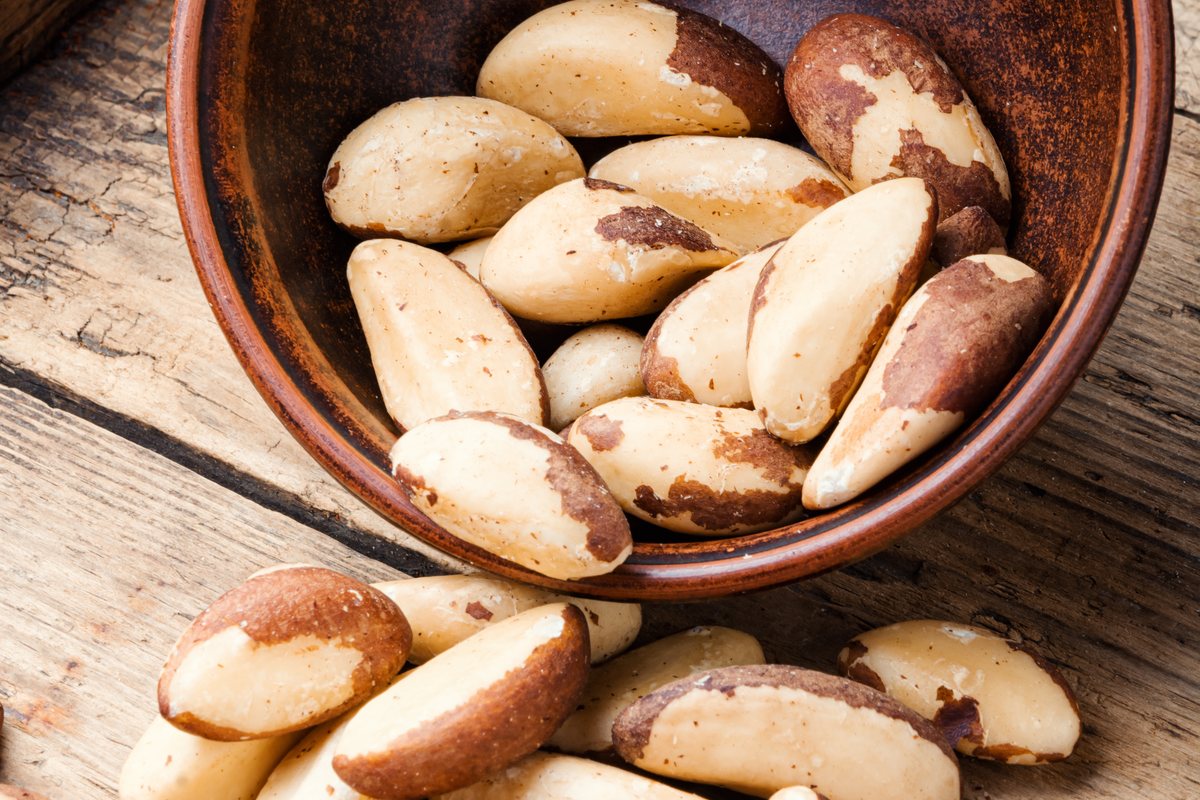
The nuts grow in groups of 10 to 25 inside a coconut-sized, rock-hard capsule - pressed tightly together like orange segments.
The Brazil nut tree grows up to 50 meters tall and can live for several hundred years. It only bears fruit reliably in intact rainforests: its blossoms are pollinated by large wild bees that depend on specific orchids in the surrounding area, and its seeds are dispersed by the agouti, a rodent that can open the hard capsule and bury the nuts as a food cache. This is hardly possible in plantations, which is why almost all Brazil nuts come from wild harvesting.
The heavy capsules fall to the ground during the rainy season and are collected by families of collectors. castañeros in Bolivia and castanheiros Collected in Brazil. It is named after the Brazilian port of Belém in the state of Pará, from which it was formerly shipped. Because only a standing forest generates income, the collection protects the rainforest.
To useWhat Brazil nuts can do for you
Brazil nuts provide an average of around 1,900 µg selenium Per 100 g – a single nut of about 5 g therefore theoretically contains around 90 µg. The actual content varies enormously depending on the soil of origin, from a few to several hundred micrograms per nut. The German Nutrition Society (DGE) estimates the daily requirement for adults at 60 to 70 µg. Selenium is a building block of enzymes that protect cells from oxidative stress and is needed for thyroid hormones.
A New Zealand study already highlighted two Brazil nuts daily Over twelve weeks, Brazil nuts raise selenium levels just as effectively as a 100 µg selenium supplement. This makes Brazil nuts a natural source of selenium – especially in regions with selenium-deficient soils like Germany. However, there is no proven benefit from additional selenium intake beyond basic selenium supply, such as protection against cancer or heart disease.
In addition, Brazil nuts provide approximately 14 g of protein, 67 g of fat and almost 380 mg of [unclear text]. magnesium per 100 g. The downside is the dose: EFSA has set 2023 as the safe upper limit for adults. 255 µg selenium per day The guideline specifies a limit, and it explicitly mentions regular Brazil nut eaters as a group that can exceed this value. Too much selenium can manifest itself through hair loss, brittle nails, and garlic-like breath.
IngredientsThis is what's in Brazil nuts
Brazil nuts contain fat with oleic, linoleic and palmitic acids, protein with many sulfur-containing amino acids, fiber, selenium (predominantly as selenomethionine), magnesium, phosphorus, copper, zinc, vitamin E and B1, as well as phytosterols and polyphenols.
The tree also absorbs barium and natural radionuclides such as radium-226 and radium-228 from the soil. The German Federal Office for Radiation Protection has measured radium levels in Brazil nuts that are approximately a thousand times higher than those found in common foods.
Enhanced combinationsHow Brazil nuts go well together
With Brazil nuts, it's all about the right amount - one or two pieces, but regularly and consciously.
It covers selenium requirements.
Roughly chopped.
Walnut, hazelnut, almond for variety.
As a snack.
Mixed with cashews.
Not needed every day.
What contradicts itselfIt's best to avoid these combinations.
Exceeds the selenium limit.
Double supply.
Advice from the Federal Office for Radium.
Avoid because of radium and selenium.
Suspected aflatoxin infection.
Lots of fat - goes rancid quickly.
In the kitchenWhere they belong
- trail mixOne Brazil nut per serving.
- MuesliRoughly chopped.
- Nut milkWith cashews and dates.
- PestoWith arugula instead of pine nuts.
- Energy ballsWith cocoa and dates.
- Salad toppingRoasted and chopped.
- pastriesIn bread or cookies.
- Chocolate nutsCovered in dark chocolate.
- Brazil nut butterHomemade, used sparingly.
- fruit saladWith mango and pineapple.
As a home remedyThe daily selenium nut
Selenium nut
- Plan to include one Brazil nut per day, for example in your morning muesli.
- On days with plenty of fish, eggs, or mushrooms, it's best to skip feeding.
- Do not take additional selenium supplements without consulting a doctor.
- Check the nuts in a pack: if they are bitter, musty, or discolored, throw them away.
To meet selenium requirements naturally, especially with a plant-based diet, because grains and vegetables from Germany contain little selenium. Not a cure for diseases, but a basic source of nutrition.
One, at most two, Brazil nuts per day. Not for pregnant women, breastfeeding mothers, or children.
Ayurveda & TCMWhat the old systems say
Ayurveda
The Brazil nut is not described in classical Ayurveda. According to current understanding, it is considered, like other nuts, to be sweet, heavy, oily, and warming – nourishing for Vata, but burdensome for Kapha in larger quantities.
Traditional Chinese Medicine
In Traditional Chinese Medicine (TCM), the Brazil nut traditionally plays no role. Modern nutritional theories classify it as sweet and warming, nourishing for kidney essence and the digestive system, but only in small quantities.
Warning noticesWhen you should be careful
Please note
- Selenium: No more than 1 to 2 nuts per day. The EFSA upper limit is 255 µg of selenium per day for adults; individual nuts can have very high levels.
- Radioactivity: Brazil nuts contain natural radium. The Federal Office for Radiation Protection advises pregnant women, breastfeeding mothers, and children to avoid consuming them altogether as a precautionary measure, and adults to avoid excessive amounts.
- Barium: Brazil nuts accumulate a lot of barium, depending on their origin - another reason to stick to small amounts.
- Aflatoxins: The EU strictly controls Brazil nuts due to mold toxins. Discard musty, bitter, or discolored nuts.
- Allergy: Brazil nuts are tree nuts and major allergens; severe reactions are possible.
- Preparations: Those who take selenium as a dietary supplement should not eat Brazil nuts regularly in addition.
This page provides information and does not replace medical advice. If symptoms persist, please consult a doctor.
Related to the topicRead on and cook along!
Shop links lead to our product pages; it is indicated there if a partner is involved.
SourcesWhat is this based on?
- USDA FoodData Central: Nuts, brazilnuts, dried, unblanched.
- EFSA Panel on Nutrition, Novel Foods and Food Allergens (NDA). Scientific opinion on the tolerable upper intake level for selenium. EFSA Journal 2023; 21(1): 7704.
- Thomson CD, Chisholm A, McLachlan SK, Campbell JM. Brazil nuts: an effective way to improve selenium status. American Journal of Clinical Nutrition 2008; 87(2): 379–384.
- Federal Office for Radiation Protection (BfS): Brazil nuts: A snack with natural radioactivity.
- Federal Institute for Risk Assessment (BfR): Selenium: The content in plant-based foods varies from region to region. FAQ from August 4, 2025.
- Parekh PP, Khan AR, Torres MA, Kitto ME. Concentrations of selenium, barium, and radium in Brazil nuts. Journal of Food Composition and Analysis 2008; 21(4): 332–335.


