Pine nuts (Pinus pinea)
OriginThree years in the pine cone
It takes about three years for a pine cone to produce ripe seeds.
The stone pine, with its umbrella-shaped crown, is a defining feature of the landscape in Spain, Portugal, Italy, Turkey, and Lebanon. Even the Romans and Greeks collected the kernels; pine cones and kernels have been found in Pompeii. To this day, the heavy cones are often harvested by hand or with shakers, dried in the sun, cracked open – and then each seed must be extracted from its hard shell.
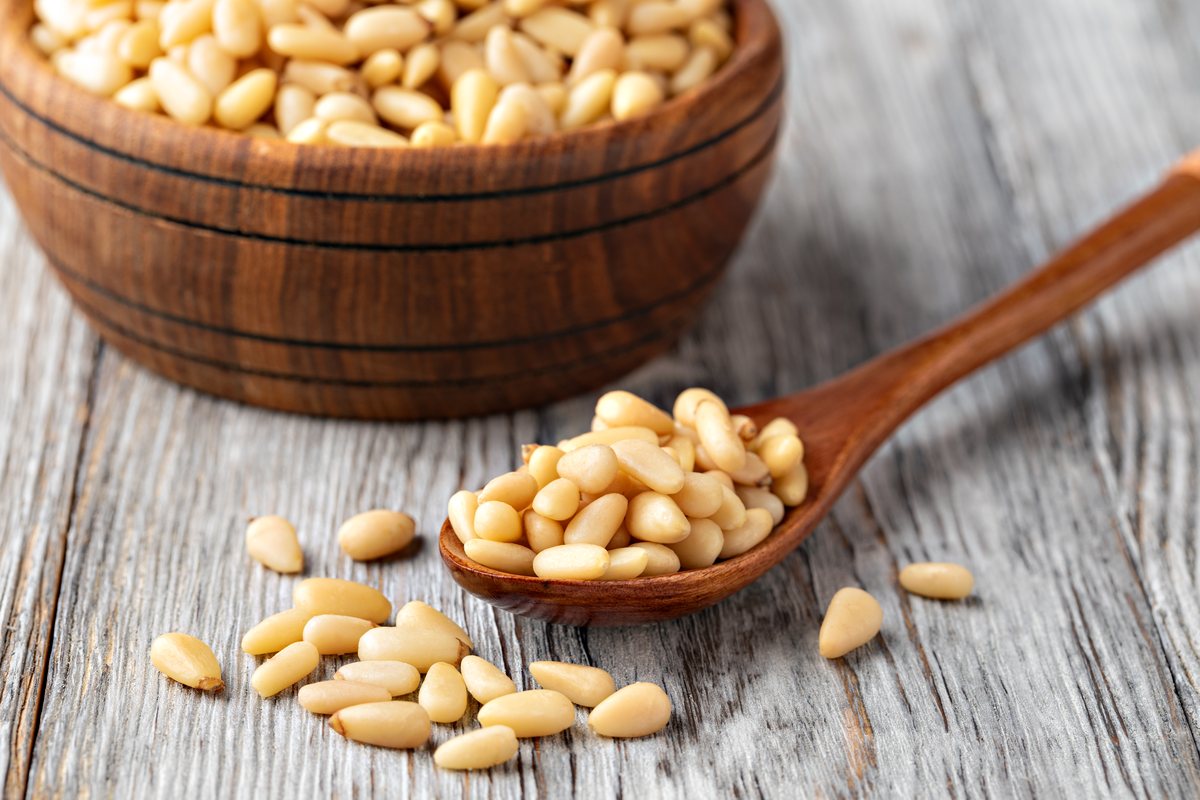
This labor makes pine nuts expensive, and the Mediterranean harvest is far from sufficient. A large portion therefore comes from Asia, primarily from the Korean pine, the Siberian pine (known as "cedar nuts"), and from Pakistan. Mediterranean pine nuts are elongated and narrow, while Asian ones are more rounded and shorter. In the past, Asian pine nuts have also included seeds from species not considered food.
To useWhat pine nuts can do for you
According to USDA data, 100 g of dried pine nuts provide approximately 670 kcal, nearly 14 g of protein, and about 68 g of fat, predominantly unsaturated. They also contain approximately 9 mg of [unspecified substance]. Vitamin E, approximately 250 mg magnesium, zinc, iron and especially much manganese. A typical portion of 15 g already covers a good part of the daily requirement for manganese and about one tenth of the daily requirement for vitamin E.
One special feature is the Pinolenic acid, Pine nuts are a fatty acid found almost exclusively in pine nuts. Small studies have shown that they stimulate the release of satiety hormones; however, whether this helps with weight loss in everyday life is unproven. As with other nuts, large observational studies link regular nut consumption with fewer cardiovascular diseases – though there is hardly any specific data on this for pine nuts alone.
Their true value lies in the kitchen: a few seeds add richness and a delicate aroma to pesto, salads, and vegetables. Due to their high calorie count and price, they generally remain more of a seasoning than a main ingredient.
IngredientsThis is what's in pine nuts
Pine nuts contain fat with a lot of oleic and linoleic acid as well as the typical pinolenic acid, protein (with arginine), little fiber, vitamin E, vitamin K, B vitamins (especially B1 and niacin), magnesium, phosphorus, potassium, zinc, iron, copper and a lot of manganese, as well as phytosterols.
Due to their high proportion of unsaturated fatty acids, pine nuts quickly become rancid. They keep significantly longer if stored in a cool, dark, and airtight container; in the freezer, they can last for several months.
Enhanced combinationsWhat makes pine nuts stronger
Pine nuts are a flavor carrier - they show what they can do when combined with herbs, cheese and vegetables.
The classic from Genoa.
Catalan, with iron and magnesium.
It helps with plant-based iron.
Toasted, still warm.
Like in Lebanese cuisine.
It gives bite and body.
What contradicts itselfIt's best to avoid these combinations.
Burning in seconds.
Risk for the bitter „Pine Mouth“.
The fat quickly becomes rancid.
Approximately 100 kcal per tablespoon.
It can be severe.
The effects of pinolenic acid are uncertain.
In the kitchenWhere they belong
- Pesto alla genoveseWith basil, Parmesan cheese, and olive oil.
- Spinach leavesWith raisins and pine nuts.
- Arugula saladWith roasted kernels.
- pastaWith lemon and herbs.
- Stuffed vegetablesRice filling with pine nuts.
- Couscous and bulgurWith mint and pomegranate.
- PinolataItalian cake with pine nuts.
- Bread and focacciaSprinkled on top.
- Oven-roasted vegetablesFinally, about that.
- Hummus toppingToasted, with olive oil.
As a home remedyPesto without additives
Basil pesto
- Briefly toast 30g of pine nuts in a dry pan and let them cool.
- Crush a large bunch of basil (about 50g of leaves) with 1 clove of garlic and a pinch of coarse salt in a mortar or blender.
- Add the pine nuts and 30g of grated Parmesan or Pecorino cheese.
- Gradually stir in about 80 ml of olive oil until a creamy sauce is formed.
- Pour into a glass and cover with a thin layer of oil.
As a fresh, spicy base for pasta, vegetables, bread or soups - with vitamin E, magnesium and the aromatic substances of basil, completely without additives from a jar.
It will keep for about three to five days in the refrigerator, and for several months in the freezer (e.g., in ice cube trays). Two tablespoons per serving of pasta are sufficient.
Ayurveda & TCMWhat the old systems say
Ayurveda
Pine nuts (chilgoza) are described in Ayurveda as warming, sweet, and oily. They are considered nourishing and strengthening – balancing Vata, and suitable for Pitta and Kapha in small quantities.
Traditional Chinese Medicine
In Traditional Chinese Medicine (TCM), the kernels of the Korean pine are called Song Zi Ren. They are considered sweet and warming, are said to moisten the lungs and intestines, and are used for dry coughs and dry constipation.
Warning noticesWhen you should be careful
Please note
- Pine Mouth: A bitter or metallic taste may occur 1 to 3 days after eating and last for up to 2 weeks; it is considered harmless and goes away on its own, do not continue eating affected packages.
- Origin: The complaints were primarily linked to Asian goods, and analyses frequently revealed seeds from Pinus armandii; elongated Mediterranean kernels are considered safe.
- Allergy: Pine nuts can trigger severe allergic reactions, even in people without other nut allergies.
- Freshness: Do not eat kernels that smell or taste rancid.
- Energy: very high in calories; a 15g portion is enough.
This page provides information and does not replace medical advice. If symptoms persist, please consult a doctor.
Related to the topicRead on and cook along!
Shop links lead to our product pages; it is indicated there if a partner is involved.
SourcesWhat is this based on?
- Federal Institute for Risk Assessment (BfR): The cause of the bitter taste of pine nuts is still unclear. Statement No. 045/2011 of 26 September 2011.
- Destaillats F, Cruz-Hernandez C, Giuffrida F, Dionisi F, Mostin M, Verstegen G. Identification of the botanical origin of commercial pine nuts responsible for dysgeusia by gas-liquid chromatography analysis of fatty acid profile. Journal of Toxicology 2011; 2011: 316789.
- Munk MD. „Pine mouth“ syndrome: cacogeusia following ingestion of pine nuts (genus: Pinus). An emerging problem? Journal of Medical Toxicology 2010; 6(2): 158–159.
- Ros E. Health benefits of nut consumption. Nutrients 2010; 2(7): 652–682.
- USDA FoodData Central: Nuts, pine nuts, dried.