
Gooseberry (Ribes uva-crispa)
OriginThe passion of the English
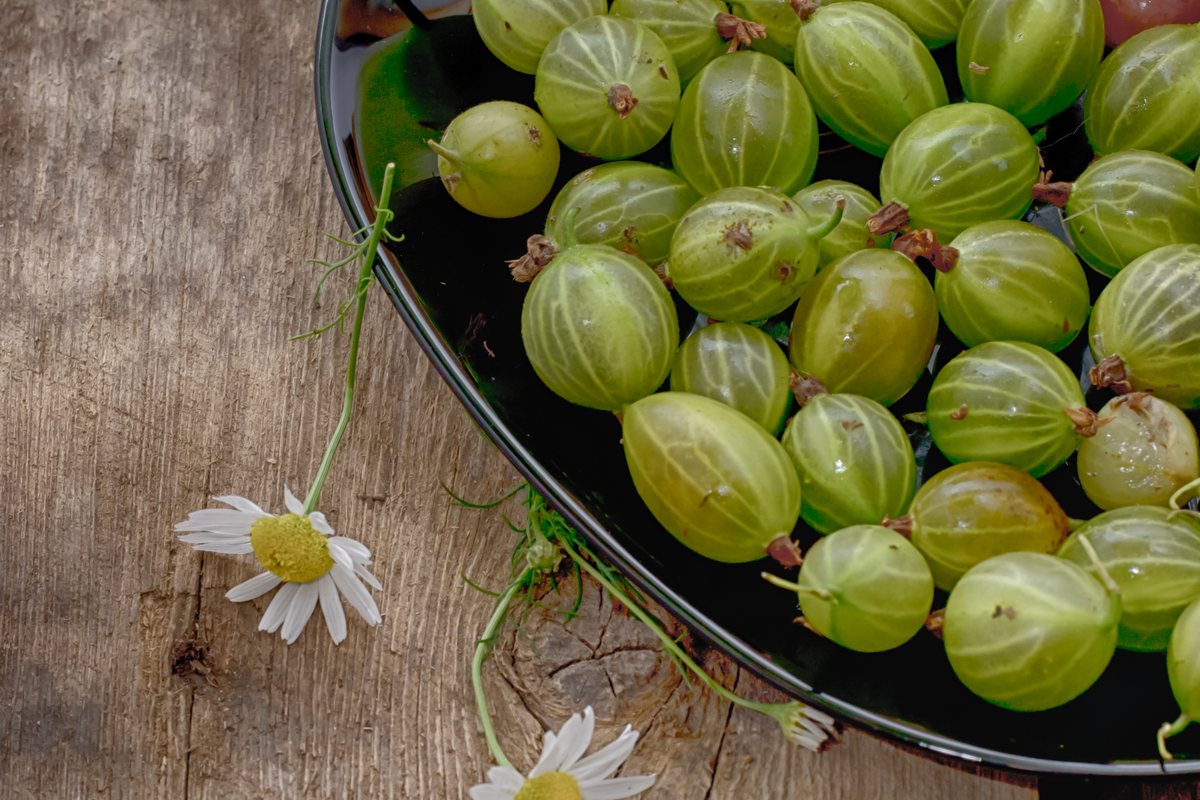
In the 19th century, there were over 170 gooseberry societies in England, which held competitions for the heaviest berry.
Gooseberries grow wild throughout Europe and are closely related to currants. They have been cultivated since the 16th century, primarily in England and the Netherlands, where hundreds of varieties have been developed. Record-breaking berries from English clubs weighed over 50 grams.
In Germany, it was a common sight in every farm garden until the beginning of the 20th century, when a powdery mildew introduced from America decimated the populations. Today, there are robust, sometimes thornless varieties, and the gooseberry is experiencing a comeback in home gardens.
To useWhat the gooseberry can do for you
Gooseberries provide approximately 28 mg Vitamin C and 4 g Dietary fiber Per 100g, they also contain potassium, manganese, vitamin A, and polyphenols – red varieties additionally contain anthocyanins. At around 44 kcal per 100g, they are light and refreshing.
Their high Pectin content This makes them an ideal fruit for jam and provides soluble fiber, which nourishes the gut flora and slows the rise in blood sugar. As with all berries, observational studies link high consumption with better cardiovascular health.
The gooseberry is a good example of seasonal cuisine: those who harvest it green in June have compote fruit, in July ripe snack berries - from their own garden, without transport and packaging.
IngredientsThis is what's in the gooseberry
Gooseberries contain fruit acids (especially citric and malic acid), sugar, Vitamin C, pectin and other dietary fiber, potassium, manganese, and polyphenols such as quercetin, kaempferol, and anthocyanins in red varieties.
Unripe green berries are more acidic and higher in pectin, while ripe berries are sweeter and more aromatic. The skin is firm and contains a large proportion of polyphenols.
Enhanced combinationsWhat makes the gooseberry stronger
Gooseberries need sweetness to counteract the acidity - or fat that carries it.
Gooseberry and elderflower jam - an English classic.
Gooseberry pie with meringue topping: sour and sweet.
Gooseberry sauce cuts through fatty fish and poultry.
Gooseberry Fool - compote with whipped cream.
Ripe berries in muesli.
Green gooseberries gel due to their own pectin.
What contradicts itselfIt's best to avoid these combinations.
Very sour - use cooked green berries.
Fruit acid - wait 30 minutes.
Acid can be irritating.
The spines - hence the name.
It's better to use ripe berries than to add a lot of sugar.
Ripe berries only keep for a few days in the refrigerator.
In the kitchenWhere she belongs
- Gooseberry pieWith a meringue topping.
- Gooseberry FoolCompote with cream.
- Gooseberry jamWith elderflowers.
- compoteServe with vanilla in semolina pudding.
- CrumbleWith oat crumble.
- Sauce for mackerelEnglish with a little sugar.
- ChutneyGinger with cheese.
- Red fruit jellyWith other summer berries.
- SmoothieRipe berries with banana.
- Fresh from the bushRipe, soft berries.
As a home remedyGooseberry compote with little sugar
gooseberry compote
- Wash 500g of green gooseberries and trim off the ends.
- Bring to a boil with 100 ml of water, 2 to 3 tablespoons of honey or sugar and a vanilla pod.
- Simmer gently for 5 minutes, until the first berries burst.
- Let it cool down, then eat it with yogurt, porridge or semolina pudding.
A vitamin- and pectin-rich side dish for breakfast and dessert. The pectin is satiating and slows down blood sugar levels, while the acid largely eliminates the need for additional sugar.
Keeps for about a week in the refrigerator. One serving per day.
Ayurveda & TCMWhat the old systems say
Ayurveda
The European gooseberry is not described in Ayurveda - not to be confused with the Indian gooseberry Amla (Phyllanthus emblica), one of the most important Ayurvedic plants. Based on its sour taste, it would be classified as Vata-reducing and Pitta-stimulating.
Traditional Chinese Medicine
Gooseberries play no role in Traditional Chinese Medicine (TCM). Sour berries are generally described as astringent and as conserving body fluids.
Warning noticesWhen you should be careful
Please note
- Acid: Use with caution if you suffer from heartburn and sensitive teeth.
- Thorns: Wear gloves when picking.
- Confusion: Do not confuse it with the Indian gooseberry Amla - different plant.
- Allergy: rarely.
- Sugar: Sweeten compote and jam sparingly.
This page provides information and does not replace medical advice. If symptoms persist, please consult a doctor.
Related to the topicRead on and cook along!
Shop links lead to our product pages; it is indicated there if a partner is involved.
SourcesWhat is this based on?
- Basu A, Rhone M, Lyons TJ. Berries: emerging impact on cardiovascular health. Nutrition Reviews 2010; 68(3): 168–177.
- Hummer KE, Dale A. Horticulture of Ribes. Forest Pathology 2010; 40(3–4): 251–263.
- Aune D et al. Fruit and vegetable intake and the risk of cardiovascular disease, total cancer and all-cause mortality - a systematic review and dose-response meta-analysis of prospective studies. International Journal of Epidemiology 2017; 46(3): 1029–1056.
- German Nutrition Society: Reference values for nutrient intake - Vitamin C.
- USDA FoodData Central: Gooseberries, raw.


