
OriginThe orchid that turned a child into a spice
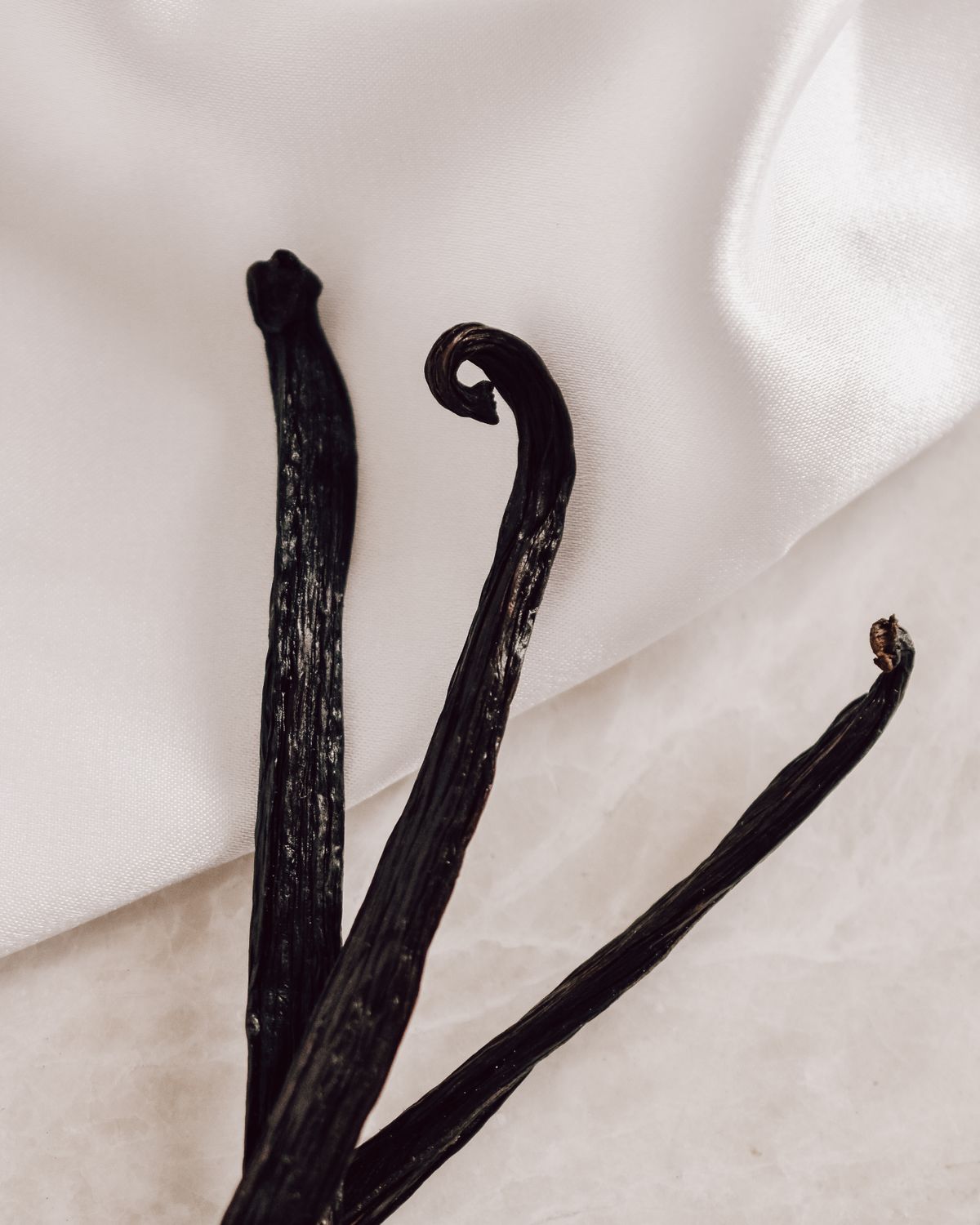
Until 1841, vanilla grew nowhere outside of Mexico because only a specific Mexican bee species could pollinate it. Then, a twelve-year-old enslaved boy on Réunion found the solution.
Vanilla originates from the rainforests of southeastern Mexico, where it was cultivated by the Totonac people and later claimed as tribute by the Aztecs, who used it to flavor their cacao. The Spanish brought the vines to Europe in the 16th century, where they thrived and blossomed, but never produced fruit. The reason remained a mystery for three hundred years: In Mexico, a specialized bee pollinates the flowers, and this bee is found nowhere else.
It solved it Edmond Albius, Albius, a twelve-year-old enslaved boy on the island of Réunion, developed the pollination technique used worldwide in 1841: Using a thin wooden stick, the dividing lamella between the stamen and stigma is lifted and pressed together. The flower opens for only one morning – those who miss this window lose the fruit. Albius was never compensated and died in poverty; his method made entire island economies wealthy. That's part of the story of this plant.
The processing is the second reason for the price. The green capsule smells of nothing Vanillin is present in a bound form as odorless glucovanillin. It is only released through a months-long process: brewing in hot water, then daily sun exposure and fermentation wrapped in cloths at night, followed by weeks or months of drying and maturation. Five kilograms of green vanilla pods yield one kilogram of black vanilla. Incidentally, Bourbon vanilla has nothing to do with whiskey, but rather refers to its origin on the island of Bourbon – present-day Réunion – and the surrounding islands.
To useWhat vanilla does for you - honestly
There's no need to beat around the bush here: Vanilla is a luxury item. There is no recognized medicinal use, no Commission E monograph, and no EMA classification. The traditional attributions—calming, aphrodisiac, digestive—originate from a time when every expensive exotic spice was automatically considered a medicine. There are no reliable studies to support these claims.
What we do have are laboratory findings regarding VanillinIt has antioxidant properties, anti-inflammatory effects in cell culture studies, and suggests anxiolytic effects in animal studies. There's also a small but interesting study from neonatology in which the scent of vanilla reduced breathing pauses in premature infants. These are interesting individual findings, but no practical application can be derived from them—and we won't here.
However, what vanilla is really good for is something practical: It replaces sugar in perception. The scent makes food taste sweeter to our brains than it actually is – an effect well-documented in sensory research. A yogurt with real vanilla and little sugar tastes sweeter than one with more sugar and no vanilla. For those looking to reduce their sugar intake, vanilla is a valuable tool. This is the most genuine benefit this plant has to offer – and it's a significant one.
IngredientsThis is what's inside the capsule
The most well-known flavoring agent is Vanillin, which makes up about one to three percent of the finished capsule. But this is precisely the difference between real vanilla and vanillin: A real capsule also contains over two hundred other flavorings p-Hydroxybenzaldehyde, vanillic acid, anisaldehyde, guaiacol, cinnamic acid esters, and many more. Together, they create what we perceive as "round," "creamy," and "floral." Synthetic vanillin, on the other hand, tastes one-dimensional—correct, but flat.
Synthetic vanillin is now predominantly produced from Guaiacol It's produced using petrochemicals, with a smaller portion derived from lignin, a byproduct of the paper industry. It's chemically identical to natural vanillin and harmless to health – it's just one molecule instead of two hundred. This makes sense for mass-produced products, but not for a good dessert.
The labeling is the deciding factor when shopping. „Vanilla extract“ or „"ground vanilla"“ means real vanilla. „"Vanilla flavor"“ or „"Vanillin"“ "Natural vanilla flavoring" usually means synthetic – "natural vanilla flavoring" only means that the starting material was organic, not that it comes from vanilla. And a word of warning about cheap products: In Mexico, extract is occasionally sold that contains... Tonka bean It's been diluted. It contains coumarin, which is harmful to the liver in larger quantities and is not approved as a food additive in Germany. A suspiciously cheap "vanilla extract" from your vacation is a reason to be cautious.
Enhanced combinationsWhat makes vanilla stronger
Vanilla is both fat-soluble and heat-sensitive - almost all the rules for its use follow from this.
The flavorings are fat-soluble. Dissolving the capsule in warm cream is the best extraction method available.
Slit capsule and leave in milk overnight - more flavor than any brief boiling.
Vanilla makes food taste sweeter - a chance to reduce sugar without it being noticeable.
Salt noticeably enhances the vanilla aroma, just as it rounds out chocolate.
Place the scraped-out capsules into a glass of sugar - after two weeks the sugar will be flavored.
A touch of vanilla in fish sauce, pumpkin soup or carrots - surprising, but an old kitchen trick.
What contradicts itselfIt's best to avoid these combinations.
The delicate aromatic compounds evaporate; vanilla infuses into warm liquid, it is not boiled.
This is usually synthetic vanillin; real vanillin is called "vanilla extract" or "ground vanilla".
Cheap Mexican extract may be adulterated with tonka bean containing coumarin.
Capsules will get moldy there - if stored airtight at room temperature, they will remain good for two years.
There is no recognized medicinal use - anyone who promises otherwise is selling a story.
Vanilla is dominant and becomes perfumed if overdosed - one capsule is enough for one liter of milk.
To which courtWhere she belongs
- vanilla sauceMilk, cream, split capsule, egg yolk, a little sugar - stirred to rest, never boiled.
- Crème brûléeThe classic where you can immediately taste the difference between real and artificial flavoring.
- Panna cottaHeat the cream with the capsule, let it steep, then thicken.
- Vanilla ice creamYou can recognize real vanilla by the black specks - and by the aftertaste.
- vanilla sugarScraped-out capsules into a glass of sugar - the best way to use up leftovers.
- Homemade vanilla extractPlace capsules in vodka, let it steep for two months, and top up as needed.
- apple compoteLeave a piece of the capsule to steep – then the compote will hardly need any sugar.
- Pumpkin soupA touch of vanilla at the end - the trick of many good chefs.
- fish sauceBeurre blanc with vanilla served with scallops or white fish.
- cocoaThe original use: vanilla in cocoa, as with the Aztecs.
As a home remedyMake your own vanilla extract
Real vanilla extract
- Slit four to five vanilla capsules lengthwise without completely splitting them - the pulp can remain inside.
- Place in a clean bottle and cover with 250 ml of vodka or neutral alcohol with at least 35 percent alcohol content.
- Seal, store in a dark place and let it steep for at least two months; shake once a week. The extract will gradually turn dark brown.
- Do not strain, simply use and top up with alcohol when the level drops - this way the mixture will continue for years.
For anything sweet that would otherwise require vanilla sugar or flavoring: cakes, sauces, ice cream, pancakes, porridge. This is purely a kitchen recipe with no health claims – but it's significantly cheaper than store-bought extract and usually tastes better. One teaspoon is roughly equivalent to half a capsule.
In the kitchen, use as needed, usually half a teaspoon to a teaspoon per recipe. The alcohol largely evaporates during baking but remains in cold dishes – for children's desserts and during pregnancy, it's best to use ground vanilla or vanilla sugar. Stored in a dark place, the mixture keeps practically indefinitely.
Ayurveda & TCMWhat the old systems say
Ayurveda
Vanilla is an American plant and is not mentioned in classical Ayurveda. Based on its properties, it would be described as sweet, heavy, and cooling, with a slightly oily texture. Vata and Pitta soothing, Kapha Invigorating – an aroma for nervous, dry, exhausted states, and not for sluggish, heavy ones. A general interpretation; it is not documented there.
Traditional Chinese Medicine
Vanilla is also absent from the Chinese Materia Medica. According to its character, it would be sweet and neutral to slightly warm, associated with the heart and spleen – an aroma that calms the mind and nourishes the center, thus belonging to the same category as sweet, harmonizing herbs like jujube. This is a classification, not a tradition, and we prefer to state it this way rather than invent one.
Warning noticesWhen you should be careful
Please note
- No cure: There is no recognized medicinal use for vanilla - anyone who advertises it is selling a story.
- Tonka bean: Conspicuously cheap vanilla extract, especially from Mexico, may be adulterated with tonka bean containing coumarin.
- Labeling: „Vanilla flavor“ and „natural vanilla flavor“ usually do not mean a vanilla product.
- Alcohol: Homemade extract contains alcohol - it is retained in cold foods.
- Contact allergy: Skin reactions (vanillism) have been described when processing large quantities - not an issue in the household.
- Storage: Do not store capsules in the refrigerator, they will get moldy there.
This page provides information and does not replace medical advice. If symptoms persist, please consult a doctor.
Related to the topicRead on and cook along!
Shop links lead to our product pages; it is indicated there if a partner is involved.
SourcesWhat is this based on?
- Havkin-Frenkel D, Belanger FC (ed.): Handbook of Vanilla Science and Technology. Wiley-Blackwell, 2nd edition 2018 - Pollination, fermentation and aroma formation.
- Federal Institute for Risk Assessment: Coumarin in cinnamon and other foods - Review and information on tonka beans.
- Sinha AK et al. A comprehensive review on vanilla flavor: extraction, isolation and quantification of vanillin and other constituents. International Journal of Food Sciences and Nutrition 2008; 59(4): 299–326.
- Labbe D et al. Sweetness enhancement by aroma: effects on perceived sweetness and sugar reduction. Food Quality and Preference - on the effect of vanilla flavor on sweetness perception.
- Guidelines for spices and other flavoring ingredients, German Food Code - Labelling of vanilla extract, vanillin and vanilla flavoring.


