OriginTwo barks, one name
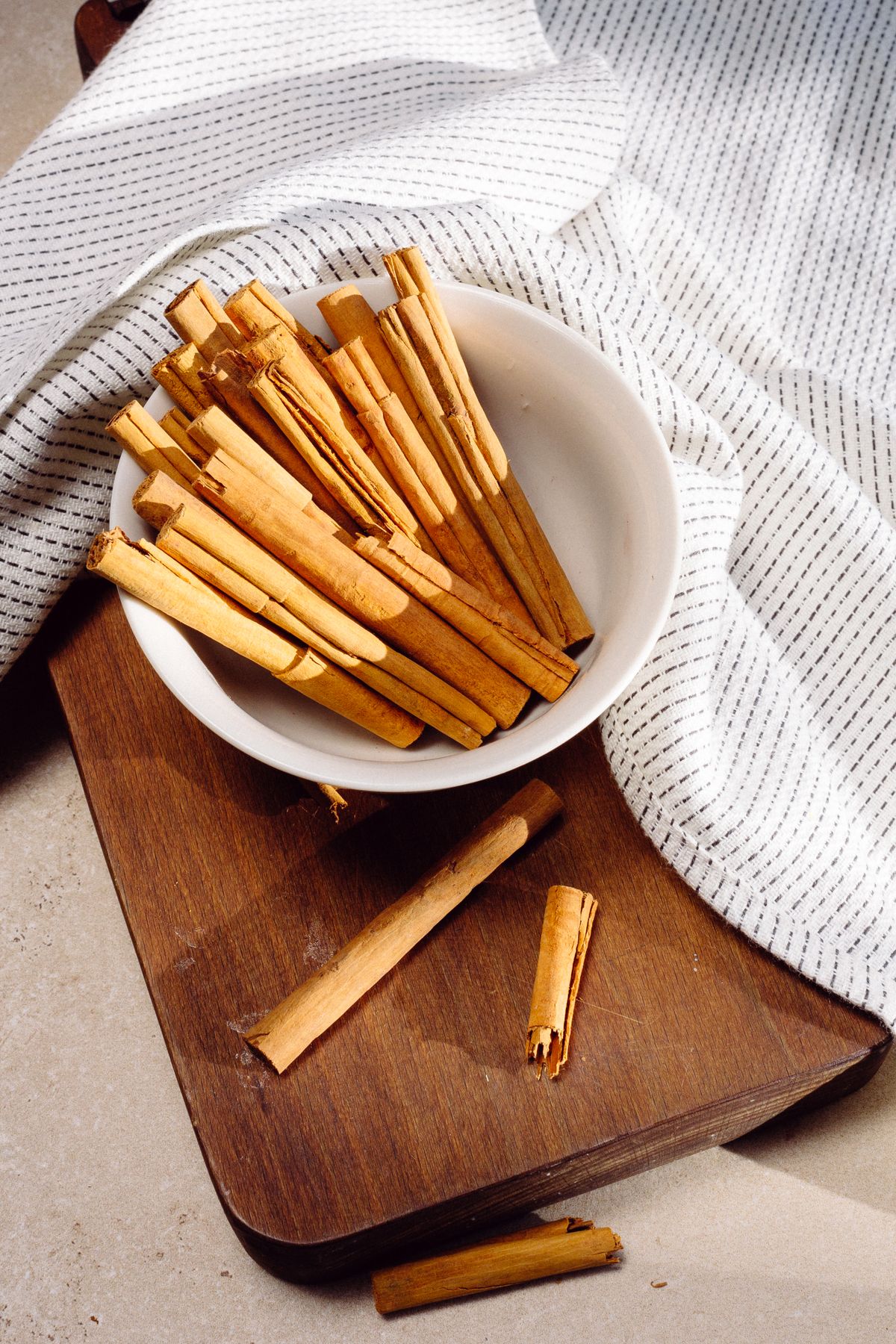
In supermarkets, the packaging usually only says "cinnamon" - but the type determines whether you can use it daily or not.
Cinnamon is the dried inner bark of various trees from the genus Cinnamomum. The Ceylon cinnamon (Cinnamomum verum) originates from Sri Lanka and South India; its bark is peeled in thin layers that curl up together as they dry – a Ceylon bark looks in cross-section like a cigar made of many layers and can be crumbled with the fingers. The Cassia cinnamon (Cinnamomum cassia or C. aromaticumIt comes from China, Vietnam, and Indonesia; here, the thicker bark is used in one piece, while the stick consists of a single, hard, reddish-brown cylinder. This difference is immediately visible on the stick—but not on the powder.
For millennia, cinnamon was one of the most valuable commodities in the world. The Egyptians used it for embalming, it is an ingredient in holy anointing oil in the Old Testament, and Arab traders kept its origin secret with fabricated stories – Herodotus recounts tales of giant birds gathering cinnamon sticks for their nests. It was only the Portuguese conquest of Ceylon in the 16th century that revealed the source; after that, the Portuguese, Dutch, and British fought for a monopoly for centuries.
For the kitchen, this means in practical terms today: The vast majority of cinnamon in German stores – especially as powder and in ready-made products – is Cassia, Because it's cheaper and has a more dominant flavor. Ceylon cinnamon is more expensive, more delicate, more floral, and is often explicitly labeled as such. If you can't find it: look at the stick. Many thin layers mean Ceylon, a thick roll means Cassia.
To useWhat cinnamon does for you
The recognized use is more modest than its reputation suggests: Commission E has approved cinnamon bark for Loss of appetite and dyspeptic symptoms It has received positive reviews – for example, for bloating, mild cramps, and flatulence – and the European Medicines Agency lists it as a traditional use in the same direction. The essential oil containing cinnamaldehyde and the tannins are responsible for its digestive and mildly antispasmodic effects. This is a solid effect, but it is, after all, the effect of a digestive spice.
The main issue is something else: Blood sugar. Since the 2000s, studies have shown that cinnamon extracts can lower fasting blood sugar levels in people with type 2 diabetes. Meta-analyses have found small effects on average, but also significant differences between studies, with varying preparations, dosages, and little information on long-term HbA1c levels. Therefore, professional societies recommend cinnamon. not as a treatment. To be honest, the situation is this: there might be a small effect, but no one should reduce or stop taking medication because of it, and anyone with diabetes should discuss cinnamon supplements with their doctor.
And that brings us to the point that determines the entire page: Coumarin. Cassia cinnamon contains significant amounts of coumarin, while Ceylon cinnamon contains practically none. Coumarin can put a strain on the liver in sensitive individuals and with regular, higher intake – reversibly, but a real possibility. The German Federal Institute for Risk Assessment (BfR) has established a tolerable daily intake of 0.1 milligrams per kilogram of body weight; with cassia cinnamon, an adult can reach this with just a few grams of powder, a child with considerably less. This is no reason to panic at Christmas, but a very good reason to be mindful of your daily consumption – in porridge, coffee, smoothies, etc. Ceylon cinnamon to buy.
IngredientsThat's what's in the bark.
The main flavoring agent is Cinnamaldehyde, Ceylon cinnamon contains 60 to 80 percent of the essential oil, which is responsible for its characteristic warm, sweet scent. It has antibacterial, antifungal, and mildly antispasmodic properties. Ceylon cinnamon also contains 100 other components. Eugenol - the same substance as the clove -, which gives it the fine, slightly clove-like depth; in cassia it is largely absent, but the cinnamaldehyde content is higher there, which explains the stronger, sharper impression.
The crucial difference lies in the Coumarin. Cassia cinnamon contains between 2 and 4 grams per kilogram, depending on its origin, sometimes considerably more; Ceylon cinnamon typically contains less than 0.02 grams per kilogram – that is, a factor of one hundred to two hundred lower. Coumarin is the same substance that gives freshly cut hay and woodruff their fragrance. It is not a blood thinner, even though this is often claimed – that is a confusion with the synthetic coumarin derivatives in medications. However, in higher doses, it puts a strain on the liver, and this is the basis for the guideline value.
Join in tannins (Proanthocyanidins), mucilage, and cinnamic acid. Two practical points for the kitchen: Cinnamon powder loses its essential oil quickly—after six months in an open jar, most of it is gone; sticks last for years. And those who buy cinnamon powder can hardly distinguish between Ceylon and Cassia cinnamon visually, so they have to rely on the label. With sticks, you can see the difference immediately.
Enhanced combinationsWhat makes cinnamon stronger
A spice that needs warmth, fat and time - and where the choice of variety is more important than anything else.
Anyone who uses cinnamon daily should choose Ceylon cinnamon - because of the coumarin, it's the only sensible choice.
Cinnamaldehyde is fat-soluble; it develops much better in rice pudding or butter dough than in water.
The three sweet spices enhance each other, making less sugar sufficient.
From Morocco to Greece: A stalk in the stew pot adds depth without tasting sweet.
Sticks last for years, powder loses its oil in months - and you can tell the species by the stick.
The Indian spiced tea: cinnamon provides the sweet base, the others the spiciness.
What contradicts itselfIt's best to avoid these combinations.
The coumarin content makes cassia a spice for special occasions, not for daily use in porridge.
Because of their lower body weight, children reach the target value much faster.
The effects on blood sugar are small and inconsistent - no reason to change therapy.
After half a year in an open jar, most of the aroma has dissipated.
Cinnamon quickly overpowers everything else; especially cassia overpowers delicate aromas.
Cinnamon oil is highly irritating to the skin and should not be applied undiluted to or in the body.
To which courtWhere he belongs
- Rice pudding and semolina puddingThe German classic - Ceylon is particularly worthwhile here because it can be enjoyed daily.
- cinnamon rollsYeast dough, butter, sugar, cinnamon - and consciously keeping an eye on the quantity.
- Apple compote and baked appleLet a stick steep instead of stirring in powder.
- ChaiCinnamon, ginger, cardamom, clove, pepper boiled in milk and black tea.
- Lamb tagineMoroccan style with cinnamon, ginger, saffron and dried fruit.
- Pastitsio and MoussakaGreek meat sauce contains cinnamon - that's its secret.
- Mulled wine and punchLet the stalk steep, but don't boil it - otherwise it will become bitter.
- Hummus with lambA sprinkle of cinnamon over the minced meat - Lebanese style.
- Chocolate dessertsCinnamon and cocoa enhance each other.
- CoffeeA pinch in the filter or on the milk foam - daily, so Ceylon.
As a home remedyThe spiced tea
Chai with cinnamon, ginger and cardamom
- Place one Ceylon cinnamon stick, four crushed cardamom pods, two cloves, three slices of fresh ginger and three black peppercorns into a pot.
- Bring to a boil with 300 ml of water and simmer gently for ten minutes - bark and seeds need this time, unlike leafy herbs.
- Add 200 ml of milk or oat milk, bring to a boil once, then remove the pot from the heat and add a teaspoon of black tea.
- Let it steep for three to four minutes, strain and sweeten to taste - traditionally with sugar or honey.
After a heavy meal, when feeling bloated, on cold days, and when you're feeling chilly inside. Several recognized digestive spices work together here: cinnamon and cardamom for dyspeptic symptoms, ginger to combat nausea and provide warmth, and pepper as an enhancer. This is well-founded spice cuisine – it's not a medicine, and we don't sell it as such.
One to two cups daily. With Ceylon cinnamon, daily consumption is also fine; with cassia, the coumarin content should be monitored. Black tea contains caffeine – so avoid it in the evening. During pregnancy, stick to the normal amount of spices.
Ayurveda & TCMWhat the old systems say
Ayurveda
Twak or Dalchini In Ayurveda, it is an important spice and a component of the classic mixture. Trijatha (Cinnamon, cardamom, tejpatra). It is considered spicy, sweet and bitter, warming and light: Kapha and Vata lowering, Pitta increasing. It is used as Deepana and Pachana, also to stimulate the digestive fire, for colds and to improve the absorption of other herbs.
Traditional Chinese Medicine
In Traditional Chinese Medicine (TCM), cinnamon is represented in two ways, and the difference is important: Rou Gui The thick bark of the Cassia cinnamon tree is spicy, sweet, very hot, associated with the kidneys and spleen, classically used to strengthen kidney yang in cases of deep internal cold. Gui Zhi In contrast, the thin twigs of the same species are sharp, sweet, warm, and act superficially to dispel coldness on the surface and open the meridians. Two parts of one tree, two different remedies.
Warning noticesWhen you should be careful
Please note
- Coumarin in Cassia: The tolerable daily guideline value of the BfR is 0.1 mg per kilogram of body weight - with Cassia cinnamon this is quickly reached.
- Children: Because of their lower body weight, the guideline value is exceeded much faster - use Ceylon cinnamon for children.
- Liver diseases: If you have existing liver problems, avoid consuming large amounts of cassia cinnamon on a regular basis.
- Diabetes: Cinnamon supplements are not a substitute for therapy; discuss their use with your doctor.
- Cinnamon essential oil: Severely irritating to skin and mucous membranes - do not use undiluted and do not ingest.
- Pregnancy: It is unproblematic as a spice; avoid high doses of cinnamon extract and essential oil.
This page provides information and does not replace medical advice. If symptoms persist, please consult a doctor.
Related to the topicRead on and cook along!
Shop links lead to our product pages; it is indicated there if a partner is involved.
SourcesWhat is this based on?
- Federal Institute for Risk Assessment: New findings on coumarin in cinnamon - tolerable daily intake and levels in cassia and Ceylon cinnamon.
- Commission E: Monograph Cinnamomi cassiae cortex and Cinnamomi ceylanici cortex, Federal Gazette 1990 - Loss of appetite and dyspeptic complaints.
- EMA/HMPC: European Union herbal monograph on Cinnamomum verum JS Presl, cortex.
- Allen RW et al. Cinnamon use in type 2 diabetes: an updated systematic review and meta-analysis. Annals of Family Medicine 2013; 11(5): 452–459.
- Blaschek W (ed.): Wichtl - Herbal drugs and phytopharmaceuticals. 6th edition 2016, monograph Cinnamomic cortex.