Blueberries (Vaccinium myrtillus)
OriginTwo species, one name
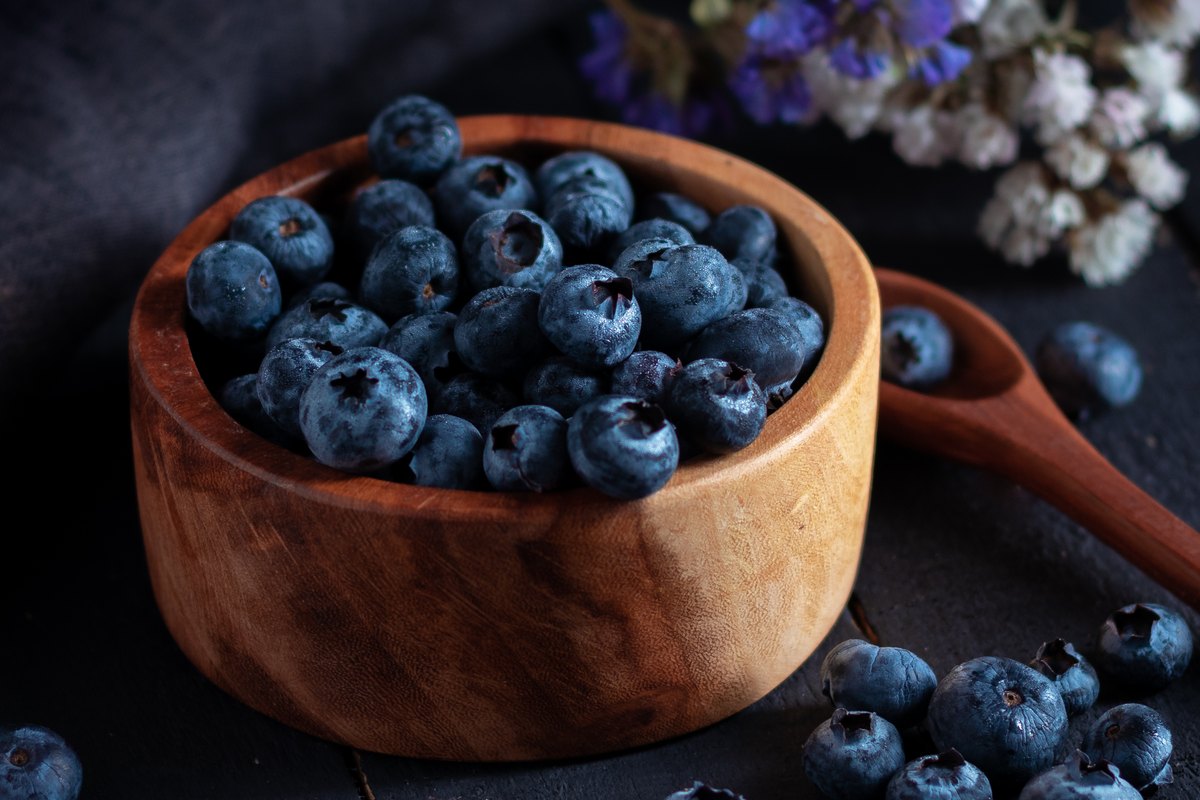
The crucial question in the supermarket: Does it turn your mouth blue or not?
The blueberry is native to Europe. Vaccinium myrtillus - A low-growing, knee-deep dwarf shrub that forms dense stands in coniferous and mixed forests on acidic soils. Its berries are small, covered with a dark blue bloom, and—crucially—deep blue to violet inside as well. Those who eat them will have a blue mouth; this is precisely the origin of the regional names blueberry, bilberry, and blackberry.
What you find in trays in supermarkets is usually a different type: the American blueberry. Vaccinium corymbosum, A shrub native to North America, growing up to two meters tall, which has been cultivated since the early 20th century and is now grown worldwide. Its berries are significantly larger, firmer, sweeter – and greenish-white inside. They do not stain.
The color difference is not cosmetic, but chemical. The blue color comes from anthocyanins, and in wild blueberries, these are located in the skin. and Wild blueberries contain pulp; cultivated blueberries contain it only in the skin. Analyses have found several times more anthocyanins in wild blueberries – three to five times more, depending on the study. Those who eat the berries for their nutritional content should be aware of this difference; those who eat them for their taste might even prefer cultivated blueberries.
To useA good food – and a persistent rumor.
Blueberries are a food, and a good one at that: They provide fiber, vitamin C, vitamin K, manganese, and above all, anthocyanins, those blue-violet pigments that are among the best-studied phytochemicals. There is extensive research on anthocyanins and their connection to vascular function, blood pressure, and cognitive performance, though it consists mostly of small studies with mixed results. The honest conclusion: Berries are a sensible part of a good diet, and there is no reason to attribute any additional health benefits to them.
The medicinal uses of blueberries – dried blueberries for diarrhea, the anthocyanin and night vision myth from World War II – have their own page in the archive. This page is about the berry on your plate.
And now to the rumor that resurfaces every summer: the fox tapeworm. The idea that wild berries are infested with the fox tapeworm and therefore shouldn't be eaten raw is extremely widespread. The facts tell a different story. Alveolar echinococcosis is a rare disease in Germany, with only about thirty to fifty reported cases per year. Tests have practically never detected fox tapeworm eggs on wild berries, and epidemiological studies have not found berry consumption to be a significant risk factor.
The Robert Koch Institute and the Federal Institute for Risk Assessment consider the risk from consuming wild berries to be very low. Close contact with dogs and foxes, as well as activities involving contact with soil, are considered more significant transmission routes. For those who still want to be on the safe side: heating to over 60 degrees Celsius for a few minutes reliably kills the eggs – freezing in a household freezer does not. Washing offers little help. Our assessment: wild berries can be eaten raw without concern; those who have reservations should preserve them by cooking.
IngredientsAnthocyanins, collection rules, and the question of freezing
Anthocyanins are water-soluble plant pigments belonging to the flavonoid group. Blueberries contain primarily delphinidin, cyanidin, and malvidin glycosides. They are pH-sensitive—which is why the color of a berry compote changes when lemon juice is added—and heat-sensitive, meaning that prolonged cooking destroys some of them.
For the kitchen, this means: Freezing preserves anthocyanins significantly better than canning. Frozen berries can even yield more released anthocyanins than fresh ones because the ice crystals break down the cell walls – an effect that has been described in studies. If you want to preserve the nutrient content, freeze; if you want storage and sweetness, can.
For harvesting: Wild blueberries grow in abundance in acidic coniferous forests, and picking them is laborious – the berries are small and firmly attached. The commonly used berry combs significantly speed up the process but damage the plants; their use is prohibited in some German states and many protected areas. For personal use, the rule of thumb, as with mushrooms, is to pick only a handful.
Confusion is practically impossible. The only berry that looks similar is the bog bilberry. Vaccinium uliginosum, The berry that grows in bogs has larger, pear-shaped berries with white flesh, and consuming large quantities can cause dizziness – however, this is probably due to a fungal infection and not the berry itself. It is not dangerous, and its white flesh clearly distinguishes it from the true blueberry.
Enhanced combinationsBerries in the kitchen
The wild and the cultivated berry have different strengths - they should be used accordingly.
It colors intensely and has more acidity and aroma. A better choice for compote, pancakes, and cakes.
Larger, firmer, sweeter, and it doesn't stain. More practical for yogurt, muesli, and as a snack.
It preserves the anthocyanins significantly better than boiling and makes them additionally available.
A squeeze of lemon juice enhances the aroma and stabilizes the color.
The classic partner - acid and fat carry the berry aroma.
Whether as a compote with game or on a cheese board - the acid cuts through fat.
What contradicts itselfIt's best to avoid these combinations.
They are not equivalent. A recipe that relies on the color and acidity of wild berries will only work halfway with cultivated berries.
Anthocyanins are sensitive to heat. Briefly boiling them is sufficient for compote.
They damage plants and are banned in many places.
According to the Robert Koch Institute (RKI) and the Federal Institute for Risk Assessment (BfR), the risk is very low. Those who want to be on the safe side should heat their food – washing and freezing are ineffective.
They contain tannins and fiber; eaten raw in large quantities, they can irritate the intestines.
The bog bilberry from the moor has white flesh. It is not dangerous, but bland in taste.
In the kitchenWhat happens to them
- compoteBriefly boiled with a little sugar and lemon - do not cook for long.
- pancakeThe classic use of wild blueberries in southern Germany.
- CakeIn batter or on crumb cake.
- MuesliCultivated blueberries raw with yogurt and oatmeal.
- SmoothieFrozen, directly into the blender.
- jamApple is used for the pectin content.
- Wild sauceServe as a compote with venison and deer.
- cheese boardAs a berry jelly to go with strong cheese.
- FreezeThe best preservation method – it retains anthocyanins better than canning.
- blueberry syrupFor water and sparkling wine, briefly boil and strain.
As a home remedyHow to properly preserve berries
Freeze blueberries instead of canning them.
- Sort through the berries, but avoid washing them if possible – they will become mushy. Briefly inspect wild blueberries that you have picked yourself and remove any leaves.
- Spread the berries in a single layer on a baking sheet lined with parchment paper, ensuring they do not touch each other.
- Place the baking tray in the freezer for two to three hours, until the berries are individually frozen.
- Only then should you transfer them into bags or containers. This way they remain free-flowing and don't clump together into a block – you can take out portions as needed.
- Frozen, they keep for at least twelve months. For smoothies and compotes, they are used directly from frozen, without thawing.
- If you're unsure about the fox tapeworm: Freezing won't help. Heating to over sixty degrees for a few minutes reliably kills the eggs – a briefly boiled compote is sufficient.
For storage, with better preservation of the anthocyanins than when canning. Blueberries are a foodstuff; for medicinal uses of dried berries, see the blueberry page in the archive.
May be consumed as food at will. For wild harvesting, the rule of personal use applies; picking berries is prohibited in many protected areas.
Ayurveda & TCMWhat the old systems say
Ayurveda
The blueberry is a Nordic plant and not included in Ayurveda. There, it belongs to the category of sour, astringent berries. Amalaki occupied, the Indian gooseberry, which is considered one of the central Rasayana-Fruits applies.
Traditional Chinese Medicine
Blueberries play no role in the Chinese materia medica; the comparable position – dark, sweet-sour berry with a connection to the liver and eyes – is held there. Gou Qi Zi One example is the goji berry. Interestingly, the association is similar in both Europe and China: the dark or red berry is traditionally linked to the eyes. However, in both cases, modern evidence is considerably weaker than its reputation suggests.
Warning noticesWhen you should be careful
Please note
- Distinguish between wild and cultivated: Wild blueberries are blue inside and significantly richer in anthocyanins; cultivated blueberries are greenish-white inside.
- A factual classification of the fox tapeworm: The Robert Koch Institute (RKI) and the Federal Institute for Risk Assessment (BfR) consider the risk from wild berries to be very low. Heating above 60 degrees Celsius kills eggs; washing and freezing do not help.
- Anthocyanins are sensitive to heat: Freezing preserves them better than canning.
- Berry combs: They damage plants and are prohibited in many protected areas.
- Bilberry: White flesh, grows in bogs. Not dangerous, but bland in taste.
- Do not expect any healing effect: Blueberries are a good food. For information on the medicinal uses of dried berries, please see the separate archive page.
This page provides information and does not replace medical advice. If symptoms persist, please consult a doctor.
Related to the topicRead on and cook along!
Shop links lead to our product pages; it is indicated there if a partner is involved.
SourcesWhat is this based on?
- Robert Koch Institute: Echinococcosis - RKI guide, section on transmission routes.
- Federal Institute for Risk Assessment: Fox tapeworm - Risk assessment for the consumption of wild berries.
- Souci-Fachmann-Kraut: The composition of foodstuffs, entries on wild and cultivated blueberries.
- Määttä-Riihinen KR et al.: Distribution and contents of phenolic compounds in Vaccinium species. Journal of Agricultural and Food Chemistry 2004.
- Kraft TE et al.: Chemopreventive potential of wild lowbush blueberry - anthocyanin comparison of wild and cultivated forms.