
Guava (Psidium guajava)
OriginFrom Central America to India
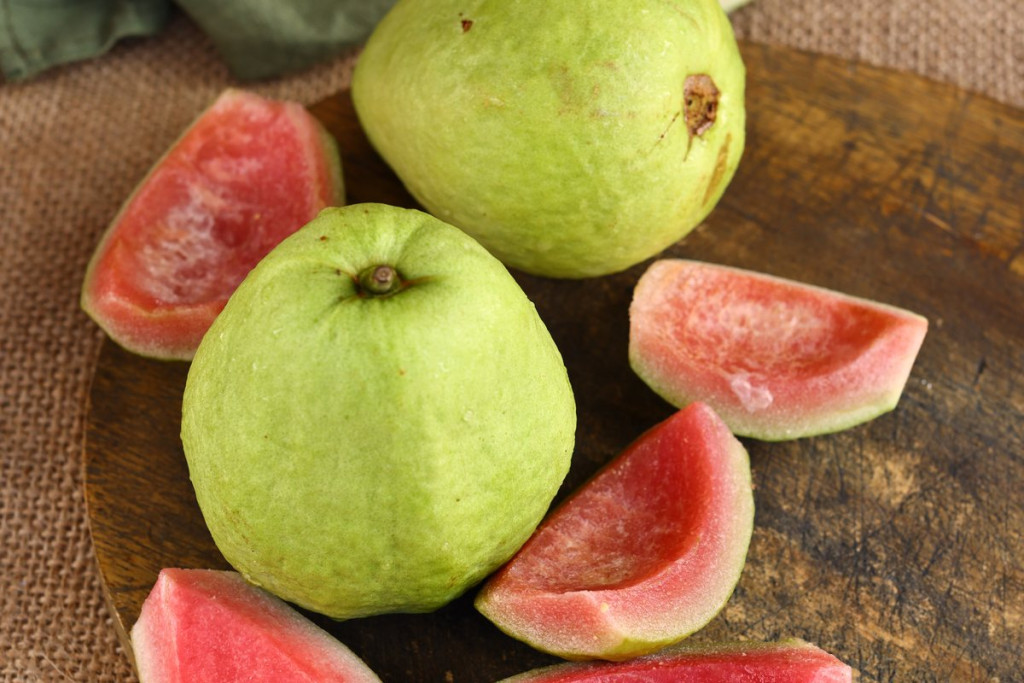
The name originates from Spanish. guayaba from a language of the Caribbean natives.
The guava originally grew in tropical America and was eaten there thousands of years ago. Spanish and Portuguese sailors brought it to Asia and Africa in the 16th and 17th centuries, where it thrived so well that it now grows wild in many places – on some islands, such as the Galápagos, it is even considered an invasive species. India is now the largest producer, where the fruit Amrud is called.
There are varieties with white, yellow, and pink to salmon-colored flesh, round or pear-shaped, with many or few seeds. In Brazil, they are cooked into a firm paste. Goiabada One variety is eaten with cheese as "Romeu e Julieta"; in Mexico, it is eaten with lime and chili. Fresh guavas are rarely found in Germany, more often as juice, nectar, or purée.
To useWhat guava does for you
According to USDA data, 100 g of guava provides approximately 230 mg. Vitamin C An orange contains about 50 mg of vitamin C. Even a small fruit of 55 g covers the daily requirement, which the German Nutrition Society (DGE) recommends as 95 mg for women and 110 mg for men. Vitamin C levels vary considerably depending on the variety and ripeness, but are almost always significantly higher than in citrus fruits. A lot of vitamin C is found in and directly under the peel, so it's best to eat it as well.
In addition, there are about 5g. Dietary fiber Per 100g, approximately 420mg potassium, folate and beta-carotene – with just under 70 kcal. Pink varieties contain up to around 5mg. Lycopene Per 100g, about twice as much as a raw tomato. Lycopene is a fat-soluble pigment that is better absorbed when consumed with some fat. White guavas contain practically none.
The Guava leaves Guava leaves are rich in tannins and flavonoids such as quercetin. In Latin America and Asia, they are traditionally drunk to treat diarrhea; in Japan, guava leaf tea is commonly used for people with slightly elevated blood sugar. Small human studies suggest a somewhat lower rise in blood sugar after meals, and one study reported fewer abdominal cramps in cases of acute diarrhea. Large, independent studies are lacking—the tea is not a substitute for diabetes treatment or medical attention for diarrhea.
IngredientsThis is what's inside the guava
The fruit contains vitamin C, sugar, pectin and other dietary fiber, carotenoids (lycopene in pink varieties, beta-carotene), folate, potassium, magnesium and copper, as well as polyphenols. The numerous seeds are very hard and consist primarily of insoluble dietary fiber.
The leaves contain tannins, flavonoids such as quercetin and its glycoside guaijaverin, triterpenes, and essential oil. Unripe fruits are also rich in tannins and therefore taste bitter and astringent.
Enhanced combinationsWhat makes guava stronger
Guava is a source of vitamin C - best eaten raw and together with iron sources.
Vitamin C significantly improves iron absorption.
Fat helps with the dyeing process.
The Mexican way.
Romeu e Julieta from Brazil.
A fruity dose of vitamin C.
Aroma plus acidity.
What contradicts itselfIt's best to avoid these combinations.
Vitamin C is lost.
The peel contains a lot of vitamin C.
Very hard - caution with dentures.
Tannins, rather constipating.
Lots of sugar, less fiber.
Hypoglycemia is possible.
In the kitchenWhere she belongs
- Pure with peelCut into wedges.
- With lime and chiliMexican snack.
- GoiabadaBrazilian guava paste.
- Romeo and JulietGuava paste with cheese.
- Fresh waterPurée with water and lime.
- SmoothieSifted, with banana.
- fruit saladWith passion fruit and mango.
- Guava chutneyIndian with ginger.
- PastelitosCuban puff pastry.
- lettuceWith cucumber, mint and salt.
As a home remedyGuava leaf tea
Guava leaf tea
- Place 1 teaspoon of dried, crushed guava leaves (about 2 g) into a cup.
- Pour 250 ml of boiling water over it.
- Cover and let steep for 10 minutes, then strain.
- Drink unsweetened and warm in small sips.
In folk medicine, it is used for mild diarrhea and upset stomach because the tannins have an astringent effect. In Japan, the tea is drunk with carbohydrate-rich meals. Research is limited – the tea is a traditional home remedy, not a scientifically proven treatment.
1 to 2 cups a day, for a short time only. Not suitable for pregnant or breastfeeding women, and only after consulting a doctor if taking diabetes medication.
Ayurveda & TCMWhat the old systems say
Ayurveda
In India, guava (Amrud) is an integral part of both cuisine and folk medicine. According to Ayurvedic principles, the ripe fruit is considered sweet, slightly tart, and cooling – balancing Pitta; unripe fruits and leaves are considered astringent and are used to treat diarrhea.
Traditional Chinese Medicine
In southern China and Taiwan, guava leaves are used in folk medicine to treat diarrhea. According to Traditional Chinese Medicine (TCM), they are considered bitter, neutral, and astringent; the fruit is described as sweet and slightly cooling.
Warning noticesWhen you should be careful
Please note
- Diabetes: Guava leaf tea can further lower blood sugar - only use with medication after consulting a doctor.
- Pregnancy and breastfeeding: Avoid leaf tea; the fruit is harmless.
- Cores: very hard - sift out if you have sensitive teeth or dentures.
- Diarrhea: In children, if fever, blood in the stool or symptoms lasting more than 3 days should be checked by a doctor, and attention should be paid to fluid intake.
- Constipation: Unripe fruits and leaf tea have a constipating effect.
This page provides information and does not replace medical advice. If symptoms persist, please consult a doctor.
Related to the topicRead on and cook along!
Shop links lead to our product pages; it is indicated there if a partner is involved.
SourcesWhat is this based on?
- USDA FoodData Central: Guavas, common, raw.
- Gutierrez RMP, Mitchell S, Solis RV. Psidium guajava: a review of its traditional uses, phytochemistry and pharmacology. Journal of Ethnopharmacology 2008; 117(1): 1–27.
- Díaz-de-Cerio E et al. Health Effects of Psidium guajava L. Leaves: An Overview of the Last Decade. International Journal of Molecular Sciences 2017; 18(4): 897.
- Deguchi Y, Miyazaki K. Anti-hyperglycemic and anti-hyperlipidemic effects of guava leaf extract. Nutrition & Metabolism 2010; 7:9.
- Lozoya X et al. Intestinal anti-spasmodic effect of a phytodrug of Psidium guajava folia in the treatment of acute diarrheal disease. Journal of Ethnopharmacology 2002; 83(1–2): 19–24.
- German Nutrition Society: Reference values for nutrient intake - Vitamin C.


