
Passion fruit (Passiflora edulis)
OriginThe fruit of the passionflower
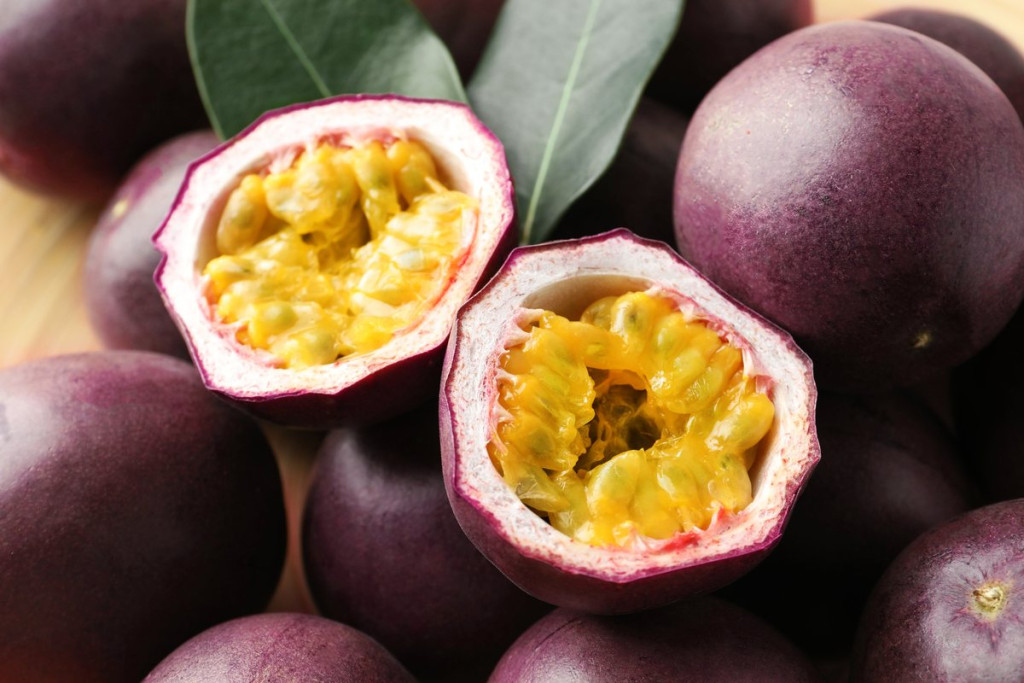
Missionaries gave it the name "Passion Flower": In the blossom they saw the crown of thorns, nails and wounds of the Passion of Christ.
The plant originates from southern Brazil and the surrounding regions; its name, Maracujá, comes from the Tupí language. This climbing plant grows several meters high and bears magnificent white and purple flowers, which develop into egg-shaped fruits with a jelly-like, seed-filled interior. Today, it is cultivated throughout the tropics and subtropics, from Colombia and Kenya to Vietnam.
There are two main forms: The purple passion fruit (Passiflora edulis f. edulisIt is small, grows in cooler highlands, and tastes sweeter – it is usually sold as fresh fruit. yellow passion fruit (f. flavicarpa) is larger, more acidic, and is primarily processed into juice. Neither should be confused with the Sweet grenadilla (Passiflora ligularisThe passion fruit sold commercially as a "granadilla" has a smooth, hard, orange-yellow rind and mild, sweet flesh. Confusingly, the purple passion fruit is also often called a "granadilla" in English.
To useWhat passion fruit does for you
According to USDA data, 100 g of the fruit pulp of the purple passion fruit provides approximately 10 g of vitamin D. Dietary fiber, approximately 30 mg Vitamin C, approximately 740 µg Beta-carotene (Provitamin A) and about 350 mg of potassium – in just under 100 kcal. A large portion of the fiber is found in the seeds. Eating them provides significantly more fiber than consuming juice or nectar.
The quantities need to be viewed realistically: One purple fruit contains only about 18 g of edible content. Three fruits provide around 5 g of fiber and 15 mg of vitamin C – a nice contribution, but not a vitamin C powerhouse like guava or kiwi. Passion fruit is primarily a flavoring agent, which can be used to add a fruity flavor to yogurt, muesli, and desserts without adding much sugar.
The kernels contain polyphenols such as Piceatannol, a relative of resveratrol, and the peel contains other flavonoids. Laboratory, animal, and some small human studies exist on extracts from the seeds and peel, for example, on blood pressure and blood sugar. No medicinal effect can be derived from this for the fruit as we eat it. The calming effect of the passionflower also applies to the herb of . Passiflora incarnata, not for the passion fruit.
IngredientsThis is what's in the passion fruit
Passion fruit contains sugar, fruit acids (especially citric acid and malic acid), soluble fiber such as pectin in the pulp and insoluble fiber in the seeds, beta-carotene and other carotenoids, vitamin C, niacin, potassium, magnesium, phosphorus and iron, as well as polyphenols such as piceatannol and flavonoids, and numerous fruity flavorings (esters and terpenes).
The peel and unripe fruits also contain cyanogenic glycosides, from which hydrocyanic acid can be released. The amounts are small in ripe fruit pulp – the peel is not eaten.
Enhanced combinationsWhat makes passion fruit stronger
Passion fruit brings acidity and fragrance - it goes well with creamy foods and other tropical fruits.
Protein plus fruit, hardly any sugar needed.
Sweetness versus acidity.
Vitamin C helps the body absorb iron from grain.
For desserts and curries.
For lemonade without syrup.
The classic tropical trio.
What contradicts itselfIt's best to avoid these combinations.
Contains cyanogenic glycosides.
Very acidic, contains more hydrocyanic acid precursors.
Often lots of sugar and no seeds.
The acid causes them to flocculate.
This is the passionflower herb.
Cross-reactions are possible.
In the kitchenWhere she belongs
- Eaten straight from the spoonCut in half and scoop out the flesh.
- Passion fruit yogurtWith natural yogurt.
- PavlovaMeringue with cream and fruit.
- cheesecakeWith passion fruit mirror.
- Passion fruit mousseBrazilian Cream.
- Smoothie bowlWith banana and mango.
- SorbetMarrow, water, a little sugar.
- salad dressingWith oil, mustard, and salt.
- Passion fruit spritzerWith sparkling water.
- fruit saladServe it as a fruity sauce.
As a home remedyPassion fruit water instead of lemonade
Passion fruit water
- Halve 2 ripe passion fruits and spoon the pulp, including the seeds, into a carafe.
- Add the juice of half a lime and a few mint leaves.
- Fill with 1 liter of cold water or sparkling water and stir briefly.
- Sweeten to taste with a teaspoon of honey and drink chilled - the kernels can be eaten.
A refreshing thirst quencher for those who want to drink more and replace sugary sodas or juices. The aroma and acidity come almost entirely from the fruit.
Drink on the same day. If you have sensitive teeth, rinse with water afterwards and do not brush your teeth immediately.
Ayurveda & TCMWhat the old systems say
Ayurveda
Passion fruit is not described in classical Ayurveda. According to current classification, it is considered sweet and sour, moist, and rather cooling – balancing for Vata, but in moderation for Pitta due to its acidity.
Traditional Chinese Medicine
The fruit is not described in classical TCM. In Western TCM nutritional theory, it is considered sweet-sour and cooling; it is said to clear heat and promote the production of fluids.
Warning noticesWhen you should be careful
Please note
- Peel: Do not eat - it contains hydrocyanic acid precursors, as do unripe fruits.
- Latex allergy: Passion fruit is one of the fruits that can trigger symptoms in latex fruit syndrome.
- Confusion: The fruit is not a medicine - the herb of the passionflower has a calming effect, but only in a tested preparation.
- Teeth and stomach: The fruit acid can irritate sensitive teeth and an upset stomach.
- Juice: Passion fruit nectar often contains a lot of added sugar - read the ingredient list.
This page provides information and does not replace medical advice. If symptoms persist, please consult a doctor.
Related to the topicRead on and cook along!
Shop links lead to our product pages; it is indicated there if a partner is involved.
SourcesWhat is this based on?
- USDA FoodData Central: Passion fruit (granadilla), purple, raw.
- He X et al. Passiflora edulis: An Insight Into Current Researches on Phytochemistry and Pharmacology. Frontiers in Pharmacology 2020; 11:617.
- Chassagne D et al. Identification and Quantification of Passion Fruit Cyanogenic Glycosides. Journal of Agricultural and Food Chemistry 1996; 44: 3817ff.
- Wagner S, Breiteneder H. The latex-fruit syndrome. Biochemical Society Transactions 2002; 30(6): 935–940.
- EMA/HMPC: Community herbal monograph on Passiflora incarnata L., herba.


