Prickly pear (Opuntia ficus-indica)
OriginThe cactus in the coat of arms of Mexico
Mexico's flag features an eagle perched on a prickly pear cactus - the plant is called that there. nopal.
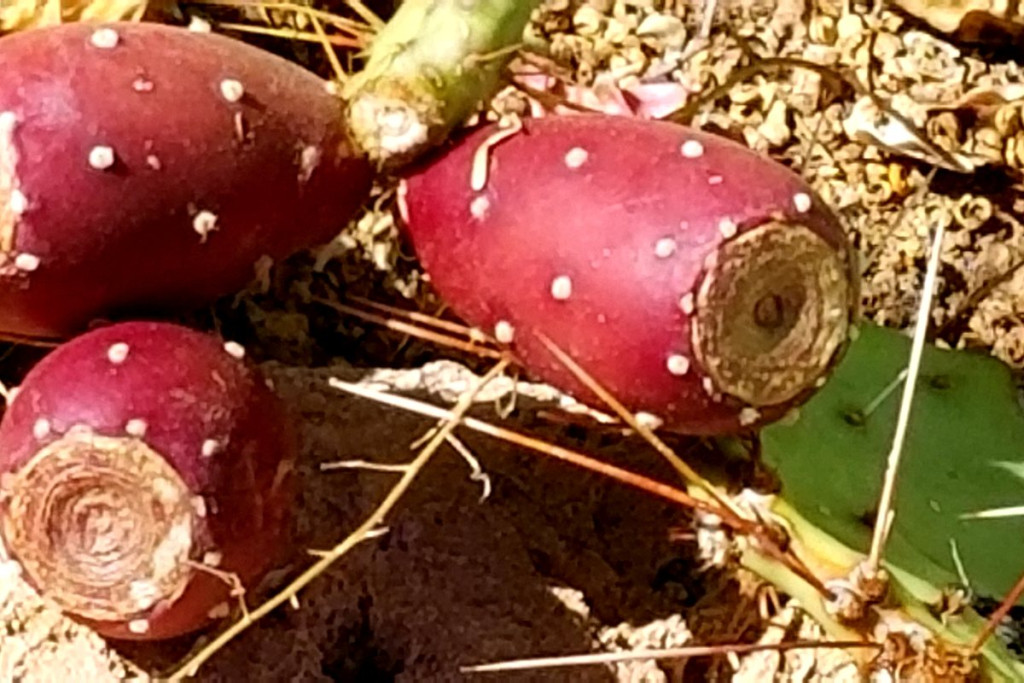
Opuntia ficus-indica originates from Mexico and has been used there for millennia: as a fruit, as a vegetable, and as a host plant for the cochineal insect, from which the red dye carmine is extracted. The ripe fruit is called [insert name of fruit there]. tuna, the flat shoot nopal; both are still present in every major market today.
The cactus arrived in the Mediterranean in the 16th century with Spanish ships. It required little water, thrived in barren volcanic soil, and spread rapidly. Today, it shapes the landscape in Sicily, Spain, North Africa, and Israel; Sicily is Europe's most important growing region. In arid regions, it serves both as animal fodder and as a living fence; in Australia and South Africa, it has become a problematic weed.
To useWhat the prickly pear can do for you
100g of fruit pulp provides only about 41 kcal, plus about 3.6g of... Dietary fiber, 14 mg Vitamin C, 220 mg Potassium, 56 mg Calcium and with approximately 85 mg magnesium An unusually high amount for a fruit - an apple contains about 6 mg.
The vibrant color comes from Betalainen - the same pigments that make beetroot red. In test tubes, they are good free radical scavengers; their effect in humans is unclear. A harmless side effect is particularly noticeable: in some people, urine and stool take on a reddish hue for one to two days.
Only small studies exist on its effects. A 2015 review summarized the controlled trials: body weight remained unchanged, body fat percentage, blood pressure, and total cholesterol decreased slightly—the effects were small and their practical significance questionable. A 2004 study, in which an extract administered before alcohol consumption alleviated some hangover symptoms but had little overall effect on the severity of the hangover, became well-known. The frequently cited blood sugar studies usually involve cooked shoots, not the fruit itself. In short: a fine fruit, not a medicine.
IngredientsThis is what's inside the prickly pear
The fruit consists of approximately 85% water and contains fructose and glucose, soluble and insoluble fiber including swelling mucilage, betalains such as red betanin and yellow indicaxanthin, vitamin C, vitamin E, carotenoids, flavonoids such as isorhamnetin, as well as magnesium, potassium, calcium and phosphorus.
The hard kernels contain a high-quality oil rich in linoleic acid and vitamin E – expensive, because around a ton of fruit is needed to produce just one liter. The young shoots, the nopales, are almost fat-free and consist mainly of water, mucilage, and fiber.
Enhanced combinationsWhat makes the prickly pear stronger
The flesh is mild and slightly earthy - it thrives on acidity, saltiness and spiciness.
It enhances the mild flesh.
Color and freshness in the glass.
Sweet meets salty.
This is how they eat them in Mexico.
Much more pleasant without the seeds.
It tastes best chilled.
What contradicts itselfIt's best to avoid these combinations.
Glochids are immediately embedded in the skin.
Rock hard - bad for your teeth.
The kernels can accumulate in the intestines.
Tough and full of barbs.
It does not ripen further.
The hairs are difficult to remove.
In the kitchenWhere she belongs
- Prickly pear sorbetPassed through and frozen.
- fruit saladWith melon and lime.
- SmoothieWith banana and orange juice.
- jamPassata, with lemon.
- Syrup for lemonadeBoiled down and filtered.
- Salad with fetaWith mint and olive oil.
- Nopales saladFrom young shoots, Mexican style.
- Tacos with nopalesGrilled, with onion and chili.
- Tuna waterMexican amniotic fluid.
- yogurt cupWith mashed potatoes and nuts.
As a home remedyPureed potatoes for gentle digestion
Prickly pear puree
- Brush two ripe prickly pears with gloves and rinse thoroughly under running water.
- Cut off both ends, score the peel lengthwise, open it up and remove the pulp.
- Strain the pulp through a fine sieve so that the hard seeds remain behind.
- Mix with a little lime juice, eat plain or in yogurt and drink a large glass of water with it.
As a mild fruit for sluggish days: Mucilage and fiber bind water and keep stools soft, similar to figs or prunes. This isn't scientifically proven, it's based on anecdotal evidence.
One to two pureed fruits a day, always with plenty of liquid.
Ayurveda & TCMWhat the old systems say
Ayurveda
The prickly pear is not described in classical Ayurveda – the plant only reached India with the Portuguese. According to modern classification, the ripe fruit is considered sweet, cooling, and moistening, and therefore balancing for Pitta; it is used sparingly for Kapha.
Traditional Chinese Medicine
It is not mentioned in classical TCM either. In Western TCM nutritional theory, it is classified as sweet and cooling and is considered a fruit that produces fluids, similar to melon.
Warning noticesWhen you should be careful
Please note
- Glochids Never touch with bare hands - the fine barbs are embedded in the skin and are almost impossible to pull out.
- Cores: Do not chew and do not eat in large quantities; in isolated cases, intestinal blockages have been described due to accumulated prickly pear seeds.
- Colon: If you have diverticula, intestinal narrowing or persistent constipation, eat only pureed fruit pulp.
- Coloring: Reddish urine or stool is harmless; if the discoloration persists for more than two days, please consult a doctor.
- Wild collection: Avoid fruit from roadsides and parks - dust, exhaust fumes and pesticides.
This page provides information and does not replace medical advice. If symptoms persist, please consult a doctor.
Related to the topicRead on and cook along!
Shop links lead to our product pages; it is indicated there if a partner is involved.
SourcesWhat is this based on?
- USDA FoodData Central: Prickly pears, raw.
- Consumer Advice Center Bavaria: How do you eat prickly pears?
- Onakpoya IJ, O'Sullivan J, Heneghan CJ. The effect of cactus pear (Opuntia ficus-indica) on body weight and cardiovascular risk factors: a systematic review and meta-analysis of randomized clinical trials. Nutrition 2015; 31(5): 640–646.
- Wiese J, McPherson S, Odden MC, Shlipak MG. Effect of Opuntia ficus indica on symptoms of the alcohol hangover. Archives of Internal Medicine 2004; 164(12): 1334–1340.
- Steinberg JM, Eitan A. Prickly pear fruit bezoar presenting as rectal perforation in an elderly patient. International Journal of Colorectal Disease 2003; 18(4): 365–367.
- Inglese P et al. (eds.): Crop Ecology, Cultivation and Uses of Cactus Pear. FAO and ICARDA, Rome 2017.