
OriginThe Flower of Passion
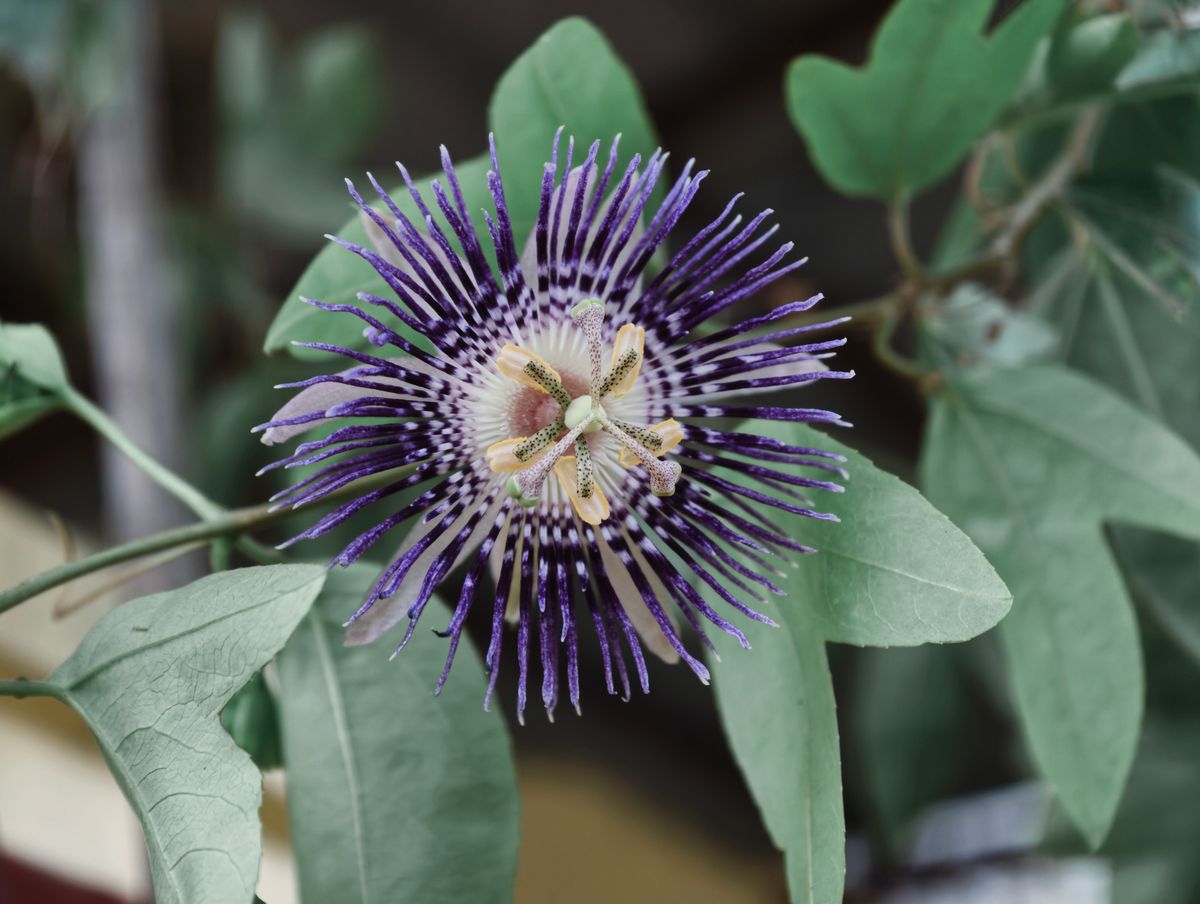
Spanish missionaries saw the Passion of Christ in the flower: the crown of thorns in the halo, the three nails in the styles, the five wounds in the stamens - hence the name.
The passionflower originates from the southeastern United States, where it grows as a climbing perennial on forest edges and fallow land. Native Americans used it as a sedative and ate the fruit that grows there. maypop It was brought to Europe in the 17th century by Spanish missionaries – initially as a botanical sensation, then as a garden plant, and its medicinal use only became established in the 19th and 20th centuries.
The naming of the flower is one of the most beautiful examples of Christian interpretation of plants. The missionaries saw the Passion of Christ depicted in the unusually structured flower: the thread-like corona as a crown of thorns, the three styles as nails, the five stamens as wounds, and the ten petals and sepals as the remaining apostles. From this came flos passionis - the passionflower. Botanically, all these parts naturally have concrete functions for pollination.
Care must be taken when buying and using it in the garden. It is used exclusively for medicinal purposes. Passiflora incarnata, the flesh-colored passionflower. The species that grows on house walls and fences in our area and has blue flowers is Passiflora caerulea - an ornamental plant that is not used medicinally. And the Passion fruit from the supermarket Passiflora edulis; its fruit is a foodstuff and has nothing to do with the medicinal drug.
To useWhat the passionflower can do for you
The European Medicines Agency lists passionflower herb as a traditional use for Relief of mild symptoms of mental tension and to Support for falling asleep; Commission E has given it a positive assessment for nervous restlessness. What makes it special on the herb shelf is a practical characteristic: it tends to work more relaxing rather than tiring. Valerian and hops are evening herbs; passionflower can also be used during the day when tension, inner restlessness or nervousness are bothersome, but one needs to function.
Regarding the available research: There are a few small controlled studies, including some involving people with anxiety symptoms and those preparing for surgery and dental procedures, in which passionflower preparations reduced tension more effectively than a placebo – sometimes comparable to a low-dose sedative, but without its sedative effect on attention. These studies are small and vary in methodological quality; this is insufficient for a strong conclusion. However, what can be said is that the general trend is consistent, and the safety profile is very good.
The mechanism of action is not fully understood. An influence on the GABA system—the same calming neurotransmitter that valerian also targets—is discussed, partly via the flavonoids, partly via other components. A single "active ingredient" has not yet been isolated; as with many calming plants, the interplay of components seems to be crucial, which is why standardized whole extracts are used.
One thing that was previously reported, but has turned out to be incorrect, was that passionflower species were thought to contain harman alkaloids that could interact dangerously with certain antidepressants. More recent analyses have found these substances in Passiflora incarnata At most, only in trace amounts. Caution when taking sedatives simultaneously remains advisable – not because of the alkaloids, but because the sedative effects can simply be additive.
IngredientsThat's what's in the weed
The most important group of substances are the C-Glycosylflavones - above all Vitexin, Isovitexin, orientin, and isoorientin, together comprising about 1.5 to 2.5 percent, are used to standardize extracts. They are thought to contribute to the calming effect, although their exact mechanism of action remains unclear.
In addition, the herb contains Maltol and ethyl maltol - substances with a pleasant caramel-like odor, for which dampening effects have been described in animal experiments -, as well as coumarin derivatives, phenolic acids and small amounts of cyanogenic glycosides, which do not play a role at the usual application amounts.
The previously much-discussed Harman alkaloids (Harman, harmin, harmaline) represent the most interesting chapter: In the laboratory, they inhibit the enzyme monoamine oxidase, which is why warnings about interactions with MAOIs were issued for a long time. However, careful analyses have shown that in Passiflora incarnata They are only detectable in trace amounts or not at all – the old findings were partly based on confusion with other species. In practical terms, this means: The warning has been eased, but general caution remains when combining it with sedatives.
Enhanced combinationsWhat makes the passionflower stronger
A mild herb that thrives on regularity and good company - and on a sufficient dose.
Unlike valerian, it doesn't make you feel heavy - ideal for hectic workdays.
The classic combination for nighttime - passionflower complements it for daytime rest.
When tension affects the stomach.
Two teaspoons per cup or a standardized extract - if the dose is too low, nothing will happen.
As with all mild nerve-stimulating herbs, the effect builds up over several days.
A cup at the same time has a double effect - on the plant and on the structure.
What contradicts itselfIt's best to avoid these combinations.
P. caerulea "From the garden fence" is not the medicinally used type.
Half a teaspoon per cup is the most common reason why nothing happens.
Sedative effects can be cumulative - consult with any prescribed sedatives.
The same consideration applies – the effects are amplified.
This limit applies to pharmaceutical use because data is lacking.
Persistent anxiety or insomnia have underlying causes that should be identified.
ApplicationHow it is used
- Passionflower teaTwo teaspoons per 250 ml, covered for ten minutes - two to three cups throughout the day.
- Standardized extractAvailable as a tablet or capsule, adjusted for flavonoid content.
- tinctureAlcoholic extract, added drop by drop to water - quick and easy to dose.
- Daytime tea for tensionThe strength of this plant: tranquility without diminishing attention.
- Evening mixWith valerian and hops, if falling asleep is the problem.
- Nerve teaWith lemon balm and lavender for stressful days.
- Before appointmentsTraditionally and in small studies, it has been investigated before dental and surgical appointments.
- Examination periodsAs support during times of high stress - for two to three weeks.
- Combination preparationsIt is found in many herbal sedatives available from pharmacies.
- garden plantThe decorative form is beautiful, but it's not the right type for medicinal purposes.
As a home remedyThe perfect tea for stressful days
Passionflower with lemon balm
- Mix two heaped teaspoons of passionflower herb and one teaspoon of lemon balm leaves.
- Pour 250 ml of boiling water over the mixture, cover, and let steep for ten minutes, then strain.
- Drink two to three cups throughout the day - one of them preferably in the morning, when tension is at its highest.
- Apply regularly for two to three weeks. Only then can you assess whether it's beneficial for you.
For inner restlessness, nervousness, tension before appointments, and the feeling of being unable to switch off – both during the day and in the evening. The advantage over valerian: at the usual dosage, it does not cause drowsiness, making it suitable for the workday. Small controlled studies on passionflower preparations for anxiety symptoms show positive results; its use is recognized by the EMA and Commission E, albeit on a traditional basis.
Two to three cups daily for two to three weeks. Do not combine with alcohol or prescribed sedatives and sleeping pills., Without denying it, the calming effects are cumulative. Not for children under twelve years of age, and not for use during pregnancy or breastfeeding due to a lack of data. If anxiety dominates daily life, panic attacks occur, or mood is low for weeks, this requires professional help – tea won't solve that.
Ayurveda & TCMWhat the old systems say
Ayurveda
The passionflower is an American plant and not used in Ayurveda. Based on its properties, it would be described as bitter, light, and cooling. Pitta and Vata Soothing. Ayurvedic plants with a comparable role are Brahmi and Jatamansi, Both are listed as Medhya herbs for a restless mind. A transmission based on principle, not a tradition.
Traditional Chinese Medicine
It is also absent from the Chinese Materia Medica. Based on its nature, it would be a cool, mild remedy that calms the mind - Shen - calms and soothes rising liver yang, in the vicinity of Suan Zao Ren (Jujube seeds) and He Huan Pi (Silk tree bark), which is used there for restlessness, irritability and difficulty falling asleep.
Warning noticesWhen you should be careful
Please note
- Combinations: Alcohol, sleeping pills and tranquilizers can have a cumulative sedative effect - consult your doctor beforehand.
- Fitness to drive: Fatigue is possible at higher doses - test the reaction on a day off first.
- Children: It is only prescribed for use from the age of twelve because reliable data for younger children is lacking.
- Pregnancy and breastfeeding: Do not apply due to insufficient data.
- Type: only Passiflora incarnata The medicinal drug is the blue ornamental variety, and the passion fruit is another type.
- Investigating the cause: Persistent anxiety, panic attacks, or a persistently low mood require professional treatment.
This page provides information and does not replace medical advice. If symptoms persist, please consult a doctor.
Related to the topicRead on and cook along!
Shop links lead to our product pages; it is indicated there if a partner is involved.
SourcesWhat is this based on?
- EMA/HMPC: European Union herbal monograph on Passiflora incarnata L., herba - traditional use for mild mental tension and to help with falling asleep.
- Commission E: Monograph Passiflorae herba (Passion flower herb), Federal Gazette 1985.
- Movafegh A et al. Preoperative oral Passiflora incarnata reduces anxiety in ambulatory surgery patients: a double-blind, placebo-controlled study. Anesthesia & Analgesia 2008; 106(6): 1728–1732.
- Miroddi M et al. Passiflora incarnata L.: ethnopharmacology, clinical application, safety and evaluation of clinical trials. Journal of Ethnopharmacology 2013; 150(3): 791–804.
- Blaschek W (ed.): Wichtl - Herbal drugs and phytopharmaceuticals. 6th edition 2016, monograph Passiflorae herba.


