
Brussels sprouts (Brassica oleracea var. gemmifera)
OriginFrom the gardens around Brussels
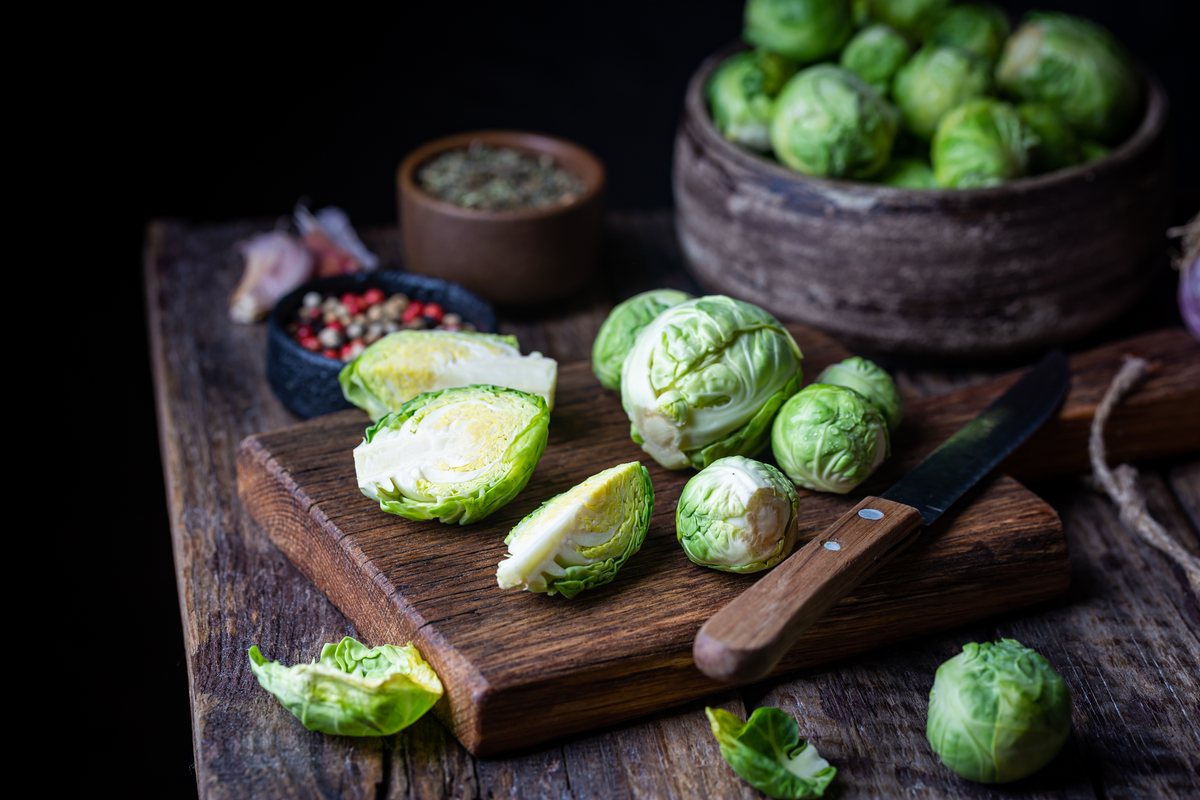
Brussels sprouts are the youngest form of cabbage - they only appeared in the vegetable gardens around Brussels in the 18th century.
Brussels sprouts, like all cabbages, are a cultivated variety of wild cabbage. They probably originated in Flanders between the 16th and 18th centuries; their presence is reliably documented from around 1750 in the Brussels area, hence the English name. Brussels sprouts. The plant forms a stem up to one meter high, on which small heads – actually buds – grow in the leaf axils.
Its bitterness made it the least favorite vegetable of many childhoods. In the 1990s, Dutch researchers discovered which glucosinolates were responsible for the bitter taste; breeders then crossed it with older, milder varieties. Modern Brussels sprouts therefore taste noticeably sweeter and nuttier than those of thirty years ago.
To useWhat Brussels sprouts do for you
Brussels sprouts are among the most nutrient-rich winter vegetables: around 85 mg of vitamin C per 100 g, very high in vitamin K, plus folate, potassium, fiber and protein - quite a lot for a vegetable, about 3.4 g per 100 g.
Among the cabbage varieties, he has one of the highest glucosinolate levels. When cut and chewed, cabbage produces isothiocyanates and indoles, which studies have shown stimulate liver detoxification enzymes. Observational studies suggest a slightly lower risk of colon and lung cancer with a high consumption of cruciferous vegetables; small interventional studies with Brussels sprouts showed less oxidative DNA damage. It's not a cure-all, but it's an excellent winter vegetable.
Important for people under Coumarin blood thinnersA single serving of Brussels sprouts provides several times the daily requirement of vitamin K. This doesn't mean you should avoid them altogether, but rather eat them regularly and in similar quantities to ensure a stable intake.
IngredientsThis is what's in Brussels sprouts
Brussels sprouts contain Vitamin C, Vitamin K, Folate, vitamin A (as beta-carotene), potassium, protein, and fiber. Among the Glucosinolates Sinigrin and progoitrin are responsible for the bitterness, while glucobrassicin provides indole-3-carbinol.
After frost, the plant converts starch into sugar to protect itself from freezing – that's why Brussels sprouts taste sweeter after the first frosty nights. Like all types of cabbage, they produce sulfurous odors when cooked for a long time.
Enhanced combinationsWhat makes Brussels sprouts stronger
Brussels sprouts need strong heat, fat and a touch of sweetness or acidity - then childhood trauma becomes a favorite vegetable.
Roast halved with the cut side facing down at 220 °C - the roasted aromas will mask any bitterness.
A touch of sweetness and acidity balances the slight bitterness.
The classic winter dish to accompany goose and roast meat.
Caraway seeds in the cooking water or sprinkled over roasted Brussels sprouts can help prevent bloating.
Raw, finely grated, as a salad with nuts, Parmesan cheese and lemon.
Halve and let stand for a few minutes - more isothiocyanates before cooking.
What contradicts itselfIt's best to avoid these combinations.
Overcooked Brussels sprouts become grey, mushy and smell of sulfur - steam or roast for a maximum of 8 minutes.
Eat plenty of vitamin K – regularly and consistently, monitor your INR.
Brussels sprouts cause bloating - small portions, well cooked, with caraway seeds.
Progoitrin can inhibit the thyroid gland in very large quantities - not a problem with a normal diet and iodized salt.
If bought on the stem, it lasts significantly longer.
The old cross-cut on the stem only lets water in - halving is better.
In the kitchenWhere he belongs
- Oven-baked Brussels sproutsHalved, olive oil, salt, 220 °C, 20 minutes.
- Brussels sprouts with chestnutsSautéed in butter, it goes well with goose and game.
- Brussels sprout saladRaw, finely grated with apple, walnut, and lemon.
- Brussels sprouts with baconBriefly blanched, then fried with bacon and onions.
- Brussels sprout gratinWith cream, nutmeg and cheese.
- Pasta with Brussels sproutsWith lemon, chili and Parmesan.
- Balsamic Brussels sproutsRoasted with balsamic reduction.
- Brussels sprout curryWith coconut milk and turmeric.
- Brussels sprout leavesRemoved individually and briefly tossed in butter.
- Brussels sprout stir-fryWith potatoes and caraway seeds.
As a home remedyThe cabbage roll
Cabbage wraps made from cabbage leaves
- Wash some leaves of white cabbage or savoy cabbage - close relatives of Brussels sprouts - and cut the thick central rib flat.
- Roll with a rolling pin until juice comes out.
- Place the leaves overlapping on the painful area and secure them with a cloth and a bandage.
- Leave to stand for several hours or overnight; replace wilted leaves.
Traditionally used for joint pain, swelling, and osteoarthritis, and for breast engorgement during breastfeeding. A small controlled study found pain relief in knee osteoarthritis similar to that provided by a pain-relieving ointment. The compress has a cooling effect, and the mustard oils from the leaves are mildly irritating to the skin.
Daily or overnight, as long as it feels good. Do not apply to open wounds. Remove if skin redness or itching occurs. Acute mastitis with fever requires consultation with a midwife or doctor.
Ayurveda & TCMWhat the old systems say
Ayurveda
Brussels sprouts are not a plant mentioned in classical texts. Modern practitioners classify them, like other types of cabbage, as cooling, drying, and gas-inducing: good for Pitta and Kapha, but for Vata only when cooked with cumin, ginger, and ghee.
Traditional Chinese Medicine
In Traditional Chinese Medicine (TCM), Brussels sprouts, like cabbage, are described as sweet and neutral. They are said to strengthen the spleen, clear heat, and relieve pain – serving as a fortifying vegetable in winter.
Warning noticesWhen you should be careful
Please note
- Blood thinners: Eat plenty of vitamin K – evenly while consuming coumarins.
- Flatulence: Small portions are recommended for irritable bowel syndrome.
- Thyroid: Only very large quantities of raw ingredients are problematic in cases of iodine deficiency.
- Cabbage wraps: Do not apply to open skin; remove if skin reaction occurs.
- Allergy: Rare; cross-reaction with mustard and other cruciferous plants is possible.
This page provides information and does not replace medical advice. If symptoms persist, please consult a doctor.
Related to the topicRead on and cook along!
Shop links lead to our product pages; it is indicated there if a partner is involved.
SourcesWhat is this based on?
- Verhoeven DT et al. Epidemiological studies on brassica vegetables and cancer risk. Cancer Epidemiology, Biomarkers & Prevention 1996; 5(9): 733–748.
- Higdon JV et al. Cruciferous vegetables and human cancer risk: epidemiological evidence and mechanistic basis. Pharmacological Research 2007; 55(3): 224–236.
- Lauche R et al. Efficacy of cabbage leaf wraps in the treatment of symptomatic osteoarthritis of the knee: a randomized controlled trial. Clinical Journal of Pain 2016; 32(11): 961–971.
- van Doorn HE et al. Glucosinolates as a factor in the bitterness of Brussels sprouts. Journal of the Science of Food and Agriculture 1998; 78(1): 30–38.
- USDA FoodData Central: Brussels sprouts, raw.


