OriginThe root that goes into the nose
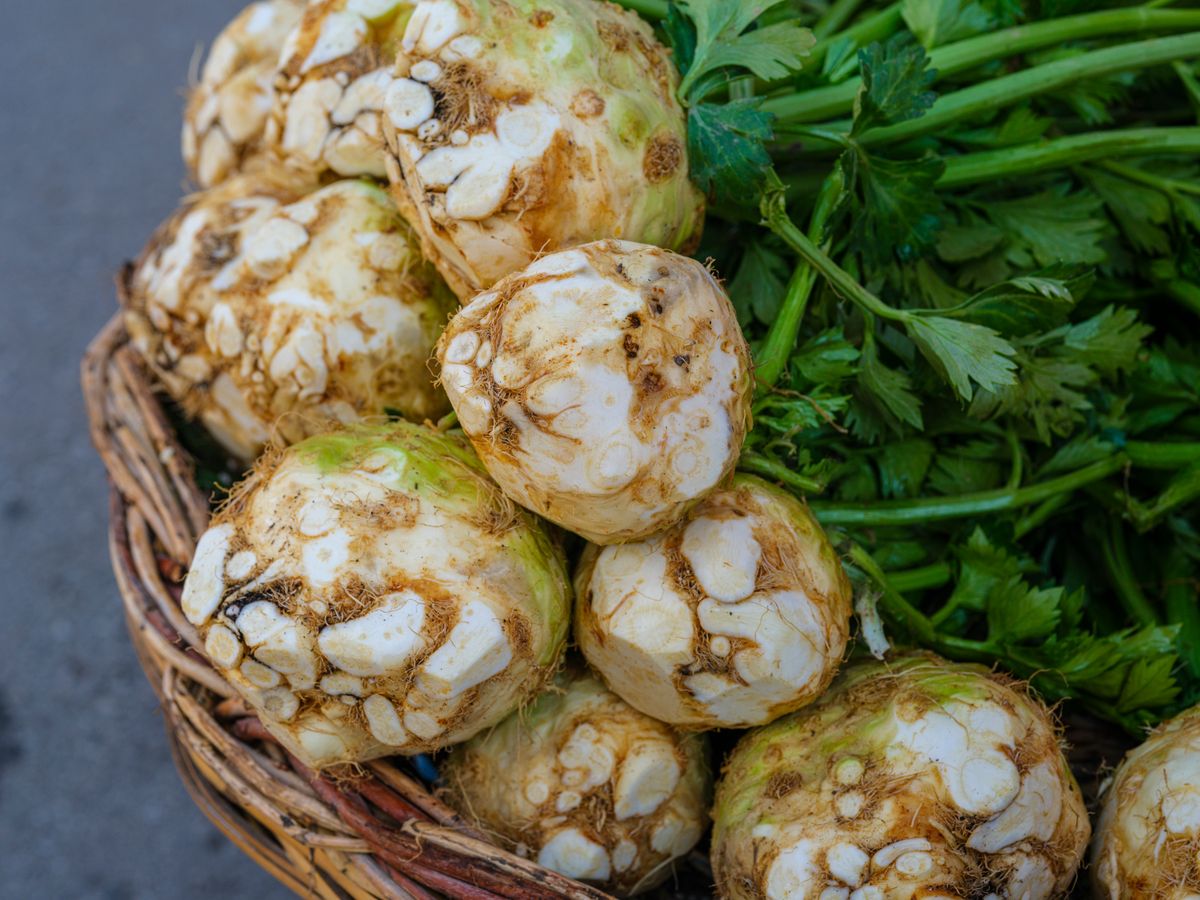
Horseradish is the only spice that you don't taste on your tongue, but feel in your nose - its spiciness consists of volatile mustard oils that rise upwards instead of burning.
Horseradish likely originated in Southeast Europe and West Asia and has been known since antiquity; the Greeks and Romans used it as medicine and as a spice. In Central Europe, it became a cultivated plant in the Middle Ages and has remained so to this day. It is grown as a root cutting, which is replanted every year and harvested in autumn – a labor-intensive crop that is primarily grown in Germany in the Spreewald and in Bavaria (Bavarian horseradish, which has been cultivated around Baiersdorf for generations) is at home in Austria in the Styria. Several of these origins are registered as protected geographical indications.
Linguistically, it is a special case: In southern Germany and in Austria, it is called Horseradish, a word of Slavic origin. The name "horseradish" probably has nothing to do with the sea, but rather with "mare" in the sense of horse - the large, coarse radish, quite similar to the English word. horseradish.
And one thing that surprises many: The green blob served with sushi in Europe is almost never real wasabi. The Japanese wasabi plant (Eutrema japonicum) is extremely complex to cultivate and correspondingly expensive; what is on the shelf instead is usually grated horseradish with green food coloring, sometimes with a small amount of real wasabi. Chemically, the two are indeed closely related – both use allyl isothiocyanate – but real wasabi is more delicate, sweeter, and significantly less harsh.
To useWhat horseradish does for you
Horseradish is one of the few culinary plants with a positive assessment by Commission EInternally, it is used for catarrh of the upper respiratory tract and as a supportive treatment for urinary tract infections; externally, it serves as a circulation-enhancing agent for minor muscle pain. Together with nasturtium herb, it is also an ingredient in an approved medicinal product for which clinical studies have been conducted on acute bronchitis, sinusitis, and urinary tract infections – an unusually solid foundation for a culinary herb.
The mechanism is the same as in mustard and nasturtium, only more powerful. The intact root contains the odorless storage glycoside. Sinigrin. When rubbed, the cells are destroyed, the enzyme myrosinase is released, and a substance is produced. Allyl mustard oil (Allyl isothiocyanate) – a volatile, highly pungent substance that exhibits broad antibacterial activity in the laboratory. Because it is volatile, it rises into the nasopharynx when ingested and acts directly there; because it is excreted via the kidneys and lungs after ingestion, it also reaches the urinary tract and bronchi.
What you need to know about this: The effect disappears as quickly as it appears. Grated horseradish loses much of its pungency within minutes to half an hour when exposed to air; heating destroys it completely. That's why cooked horseradish tastes mild, and why the jarred stuff from the refrigerated section is a poor imitation of freshly grated root. If you want the full effect, grate it fresh, use it immediately, and stabilize it with vinegar or lemon – the acid slows down further pungency.
IngredientsIt's in the root.
The crucial substance is Sinigrin, a mustard oil glycoside that is odorless and tasteless in the undamaged root – a whole horseradish root has no smell. It only comes into contact with the enzyme when grated. Myrosinase, and from this arises Allyl mustard oil. This substance is so volatile that it gets into the eyes when rubbed; anyone processing a larger quantity is better off working with an open window or rubbing the root under running cold water.
In addition, the root contains Vitamin C Horseradish contains a considerable amount of potassium, calcium, magnesium, iron, and peroxidases (freshly grated, significantly more than lemon, per 100 grams). The latter are so biochemically useful that horseradish peroxidase is used worldwide as a standard reagent in medical laboratory tests. A kitchen spice that also aids in diagnostics.
In practical terms, this means: Fresh, raw, cold, and sour. Store the root in a cool, dark place, ideally wrapped in a damp cloth in the refrigerator or in sand in the cellar; use quickly once cut. Always grate immediately before serving, mix instantly with a splash of vinegar or lemon juice, and never cook. Stirring it into cream or applesauce will help retain its spiciness a little longer, as the fat and acid bind it.
Enhanced combinationsWhat makes horseradish stronger
Everything about this root is about speed. What happens quickly and stays cold helps it; what waits or is heated takes everything away from it.
The spiciness is created at the moment of rubbing and begins to dissipate immediately - never rub in advance.
A splash of water immediately after rubbing slows down the degradation and maintains sharpness and bright color.
Creamed horseradish and apple horseradish tame the spiciness and make it suitable for everyday use - the classic accompaniment to boiled beef.
Half a teaspoon freshly grated with honey: The volatile mustard oils go directly into the nose and throat.
The tested combination - and liquid, so that the mustard oils reach the urinary tract.
The Eastern European Cwikla: grated horseradish with beetroot, vinegar and salt - color and spiciness at the same time.
What contradicts itselfIt's best to avoid these combinations.
Heat destroys the myrosinase and displaces the mustard oil - cooked horseradish is mild and almost ineffective.
After half an hour in the air, most of the sharpness is gone; the glass from the shelf is correspondingly weaker.
The mustard oils significantly irritate the mucous membrane - unsuitable for ulcers and acute gastritis.
Horseradish poultices cause blisters: a few minutes is the maximum, and not at all for children.
Do not use as a medicinal product in cases of impaired kidney function or kidney inflammation.
Mustard oil glycosides can affect iodine uptake in larger quantities.
To which courtWhere he belongs
- Tafelspitz with apple horseradishGrated with grated apple, vinegar and a pinch of sugar - the Austrian classic.
- Creamed horseradishFreshly grated into whipped cream, with lemon and salt - goes well with smoked fish and beef.
- CwiklaHorseradish with beetroot, vinegar and salt - Polish style, with sausage and egg.
- smoked fishRegarding trout, salmon and mackerel: The spiciness cuts through the fat of the smoked fish.
- Roast beef breadCold roast beef, horseradish cream, cress - the best leftover bread ever.
- Horseradish soupAs a foamy soup with potatoes - but the horseradish is added after cooking.
- potato saladAdd a spoonful of freshly grated horseradish to the salad instead of mustard.
- Horseradish sauce with fishButter, broth, cream, then off the heat and only then the horseradish.
- Wasabi substituteFreshly grated for sushi - more honest than the green-colored contents of a tube.
- Horseradish butterSoft butter with grated horseradish and lemon - perfect with steak and roasted vegetables.
As a home remedyThe sharp spoon
Horseradish with honey for a cold
- Peel a thumb-sized piece of fresh horseradish root and grate it on a fine grater - by an open window, the fumes are intense.
- Immediately mix in a teaspoon of honey and a few drops of lemon juice; the acid helps to stabilize the spiciness for longer.
- Let half to one teaspoon slowly dissolve in your mouth, do not gulp it down - the effect occurs in the nose and throat.
- Then drink a glass of water. Prepare fresh two to three times a day for a few days, if needed.
For a stuffy nose, sinus pressure, and the onset of a cold. You'll feel what reliably happens here immediately: the volatile mustard oils rise and clear your nose for a few minutes. Horseradish's antibacterial properties are well-documented in laboratory tests and have also been clinically investigated in combination preparations with nasturtium – this only applies to a limited extent to a spoonful from your own kitchen, as the quantity and concentration are not standardized.
Half to one teaspoon, two to three times daily, for a few days. Do not take on an empty stomach, and not if you have stomach or intestinal ulcers, kidney disease, or are under four years old. Consult a doctor if you experience fever, severe one-sided facial pain, or symptoms persist for more than ten days.
Ayurveda & TCMWhat the old systems say
Ayurveda
Horseradish is not a classic Ayurvedic plant. Based on its properties, it would be considered pungent (Katu), hot, and light: strongly reducing Kapha, moderately increasing Vata, and significantly increasing Pitta – a remedy for cold, damp, phlegmy conditions and sluggish digestion, but unsuitable for heat, inflammation, and burning stomach. This classification is based on principle, not tradition.
Traditional Chinese Medicine
Even in the Chinese Materia Medica, European horseradish is not represented; the role of the pungent, surface-opening root is taken over there by the radish (Lai Fu Zi (as seeds). Based on its nature, horseradish would be a sharp, warming remedy that opens the surface, disperses coldness, and transforms mucus – exactly what one is looking for in the case of an incipient cold with clear secretions.
Warning noticesWhen you should be careful
Please note
- Stomach and intestines: Do not use in cases of stomach or intestinal ulcers and acute gastritis - the mustard oils strongly irritate the mucous membrane.
- Kidneys: The drug is not suitable for use in cases of kidney inflammation or impaired kidney function.
- Children: For internal use only from the age of four; horseradish poultices on the skin should never be applied to children.
- Skin dressings: Blisters will appear after a few minutes - apply only briefly and remove immediately if it burns.
- Thyroid: Larger amounts of mustard oil glycosides can affect iodine uptake - caution advised in cases of thyroid disease.
- Pregnancy: It is safe to use as a spice, but avoid using it in medicinal quantities.
This page provides information and does not replace medical advice. If symptoms persist, please consult a doctor.
Related to the topicRead on and cook along!
Shop links lead to our product pages; it is indicated there if a partner is involved.
SourcesWhat is this based on?
- Commission E: Monograph Armoraciae rusticanae radix (horseradish root), Federal Gazette 1988 - Catarrh of the upper respiratory tract, supportive in infections of the urinary tract, externally hyperemic.
- Albrecht U, Goos KH, Schneider B. A randomized, double-blind, placebo-controlled trial of a herbal medicinal product containing Tropaeoli majoris herba and Armoraciae rusticanae radix. Current Medical Research and Opinion 2007; 23(10): 2415–2422.
- Blaschek W (ed.): Wichtl - Herbal drugs and phytopharmaceuticals. 6th edition 2016, monograph Armoraciae radix.
- Altmeyer's Encyclopedia, Phytotherapy Section: horseradish - Ingredients, uses and contraindications.
- USDA FoodData Central: Horseradish, prepared.