
OriginThe living fossil from the edge of the field
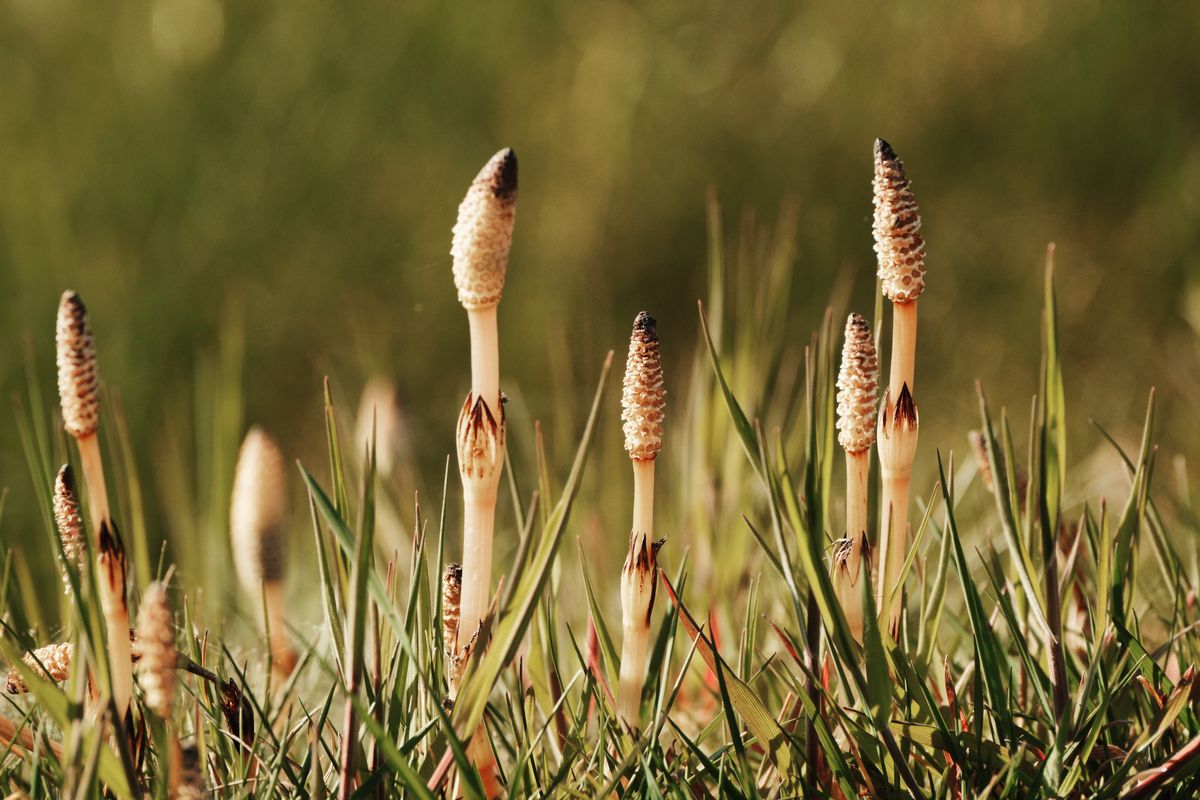
Horsetails grew as far back as 300 million years ago, then as tree-high forests - what now stands knee-high by the railway embankment is the remnant of one of the oldest plant groups on Earth.
Field horsetail is a spore-bearing plant without flowers, leaves, or seeds—a form dating back to the Paleozoic Era that has survived unchanged to this day. It sprouts twice a year from a deep, widely branching rhizome: in early spring, the inconspicuous brownish spore shoots, which serve only for propagation and quickly wither, and later the green, whorled, branched stems. Summer shoots, which look like tiny fir trees. Only these green, sterile shoots are collected.
In the garden, it has a bad reputation because its rhizome can reach up to two meters deep and is practically impossible to eradicate. In folk medicine, however, it was a standard remedy for centuries: it was called horsetail because its silica-rich shoots were used to polish pewterware, and cat's tail and horse's tail because of its shape. It can still be found in the archives under its second name, "pewterwort"—botanically, it's the same plant.
When collecting, a single point decides everything: the Distinguishing it from marsh horsetail (Equisetum palustreIt contains the alkaloid palustrine and is poisonous, especially to grazing animals. Two characteristics help to identify it: In the case of field horsetail, the lowermost link of each lateral branch longer The leaf sheath on the stem is shorter than the corresponding leaf sheath in marsh horsetail. Field horsetail has more grooves on its main stem (usually 6 to 19) than marsh horsetail (usually 4 to 8), whose stem appears thicker and softer. If you're unsure, buy from a pharmacy – tested products are definitely the better choice.
To useWhat horsetail can do for you
The European Medicines Agency lists horsetail herb as traditional application for two paths: internally to Flushing of the urinary tract For mild symptoms and to support the treatment of kidney stones, and externally for the supportive treatment of small, superficial wounds. Commission E has given it a correspondingly positive assessment. "Traditional use" here, as always, means that the application is based on long-standing experience, not on large clinical studies. This is honest, but not a criticism – the flushing therapy relies heavily on the amount of fluid, and tea is an excellent means of transporting it.
The substance for which horsetail is famous is the SilicaIt contains five to eight percent silicon, partly water-soluble, partly as a solid deposit in the cell walls – the latter makes the shoots so rough that they could be used to polish metal. Silicon is involved in the formation of connective tissue, cartilage, bones, hair, and nails, and this is how its reputation as a beauty herb developed. Let's be honest here: The claim that horsetail tea measurably makes hair thicker or nails stronger is not reliably proven. There are small studies on silicon-containing preparations that suggest this, but nothing on which one could base a promise. A laboratory finding is not a result.
What is certainly true, and practically important, is: The silica only dissolves after prolonged boiling. A simple infusion – pouring water over it and letting it steep for ten minutes – only extracts a fraction of the beneficial compounds. Horsetail requires a decoction: simmer gently for 20 to 30 minutes. This is the difference between a tea that contains something and greenish water. Externally, it is primarily the silica and tannins that are used for slow-healing, superficial skin lesions and as a bath additive.
IngredientsThat's what's in the horsetail
The key material is the Silica Horsetail contains five to eight percent of its dry mass, about one-tenth of which is water-soluble. It is embedded in the cell walls and gives the plant its hardness – the structure is so fine that horsetail is still occasionally used today for polishing wood and wind instruments. When cooked, some of it dissolves as orthosilicic acid, and only this form can be absorbed by the body.
In addition, the herb contains Flavonoids - primarily quercetin and kaempferol glycosides, to which the diuretic effect is attributed - potassium, organic acids, sterols, and traces of alkaloids. Of particular note is the Thiaminase, An enzyme that breaks down vitamin B1: In grazing animals that eat large quantities of fresh horsetail, this can lead to a real deficiency. In humans and with dried horsetail, this is practically irrelevant because the enzyme is destroyed during drying and cooking – but it is another reason not to consume the plant fresh in large quantities.
The following clear rule applies to the preparation: Boil, do not pour over.. Add two to three grams of chopped herb to 250 milliliters of cold water, bring to a boil, and simmer gently for 20 to 30 minutes, then strain. Some people soak the herb overnight in cold water and then boil it – this extracts even more flavor. For external applications and baths, boil the herb for a longer time and with a stronger brew.
Enhanced combinationsWhat makes horsetail stronger
With this plant, preparation is more important than any combination. Without cooking, little happens.
The one crucial step: simmer instead of scalding, otherwise the silica remains in the plant.
Flushing therapy works by the amount of fluid consumed - at least two liters of fluid per day, otherwise it is pointless.
The classic kidney tea blend: three plants that work in the same direction.
Strong decoction for compresses on poorly healing superficial skin areas and as a bath additive.
Pre-soak the cabbage in cold water, bring it to a boil in the morning - this extracts a little more flavor than boiling it directly.
The classic application in the organic garden: horsetail brew against fungal infestation on roses and tomatoes.
What contradicts itselfIt's best to avoid these combinations.
A ten-minute infusion only dissolves a fraction of the silica - this is the most common mistake.
The poisonous marsh horsetail often grows nearby; if in doubt, buy from a pharmacy.
Fresh herbs contain thiaminase, which breaks down vitamin B1 - this is not an issue when dried and cooked.
Flushing therapy with increased fluid intake is not suitable for patients with impaired heart or kidney function.
The connection via silicon is plausible, but not proven - a laboratory value, not a result.
Horsetail accumulates metals; it is collected away from railway tracks, roads and cultivated fields.
ApplicationHow it is used
- decoctionBoil two to three grams of herb in 250 ml of cold water, simmer for 20–30 minutes, then strain.
- Kidney teaWith goldenrod and nettle in equal parts - all three boiled together.
- Flushing treatmentTwo to three cups daily for one to two weeks, plus at least two liters of liquid.
- Skin wrapStrong decoction, let cool, soak cloth, apply to poorly healing superficial areas.
- Full bathBoil 100 grams of herbs in three liters of water for one hour, strain, and add to the bathwater.
- Sitz bathA smaller amount of the same decoction - traditionally used for complaints in the pelvic area.
- foot bathFor sweaty feet - tannins are particularly effective here.
- Hair conditionerApplying a cooled decoction to the hair after washing is an old practice without scientific evidence.
- Plant manureOne kilogram of fresh herbs to ten liters of water, steep for 24 hours, then boil - to prevent fungal infestation.
- Horsetail for polishingIts namesake use: dried shoots for grinding wood and metal.
As a home remedyThe flushing tea
Horsetail Goldenrod Nettle
- Place one teaspoon each of cut horsetail herb, goldenrod herb and nettle leaves into a small pot with 400 ml of cold water.
- Bring to a boil, then simmer gently for 20 to 25 minutes over low heat - covered, so that not too much evaporates.
- Strain and drink warm throughout the day.
- Important: drink at least two liters of water a day in addition, otherwise it's not a flushing, but just tea.
For flushing the urinary tract in cases of mild discomfort and for prevention in those prone to kidney stones. Horsetail provides silica and a mild diuretic effect; goldenrod and nettle work in the same way. Most of the effect simply comes from the amount of fluid – this isn't a problem, but it's good to be aware of.
Two to three cups daily for one to two weeks, then a break. Not suitable for patients with impaired heart or kidney function., Because increased fluid intake can then be harmful. Not recommended during pregnancy or breastfeeding due to a lack of data. Burning during urination accompanied by fever, flank pain, or blood in the urine requires immediate medical attention – this is not a case for tea.
Ayurveda & TCMWhat the old systems say
Ayurveda
The European horsetail is not a classic in Ayurveda, but it has an Indian relative: Equisetum debile, there as Ashwakhura Horsetail is used for urinary tract problems and bone healing. Based on its properties, field horsetail is described as sweet-bitter, cooling, and drying: reducing Pitta and Kapha, and in therapeutic doses, rather drying for Vata. Two related species, the same effect.
Traditional Chinese Medicine
In the Chinese Materia Medica, a type of horsetail is indeed firmly established: Equisetum hiemale as Mu Zei, Sweet-bitter and neutral, it is associated with the lung and liver meridians. Traditionally, it is used less for the urinary tract than for the eyes – for reddened and cloudy eyes – and also to clear wind-heat. A different type, a different focus, but the same plant family.
Warning noticesWhen you should be careful
Please note
- Confusion: the poisonous marsh horsetail (Equisetum palustreIt looks similar - determine with certainty or use pharmacy products.
- Heart and kidneys: Flushing therapy is not suitable for patients with impaired heart or kidney function.
- Fresh plant: Contains thiaminase, which breaks down vitamin B1 - do not consume fresh in large quantities.
- Location: Horsetail accumulates heavy metals; do not collect it on railway embankments, roadsides or treated fields.
- Pregnancy and breastfeeding: Do not apply due to insufficient data.
- No replacement: Burning during urination accompanied by fever, flank pain, or blood in the urine should be investigated by a doctor immediately.
This page provides information and does not replace medical advice. If symptoms persist, please consult a doctor.
Related to the topicRead on and cook along!
Shop links lead to our product pages; it is indicated there if a partner is involved.
SourcesWhat is this based on?
- EMA/HMPC: European Union herbal monograph on Equisetum arvense L., herba - traditional use for flushing the urinary tract and externally for small superficial wounds.
- Commission E: Monograph Equiseti herba (horsetail herb), Federal Gazette 1986.
- Blaschek W (ed.): Wichtl - Herbal drugs and phytopharmaceuticals. 6th edition 2016, monograph Equiseti herba.
- European Pharmacopoeia (Ph. Eur.): Monograph Equiseti herba - Minimum silica content and testing for adulteration with other Equisetum species.
- Federal Institute for Risk Assessment: Information on Equisetum palustre (Marsh horsetail) and palustrine as a risk to grazing animals.


