
Jerusalem artichoke (Helianthus tuberosus)
OriginThe American potato
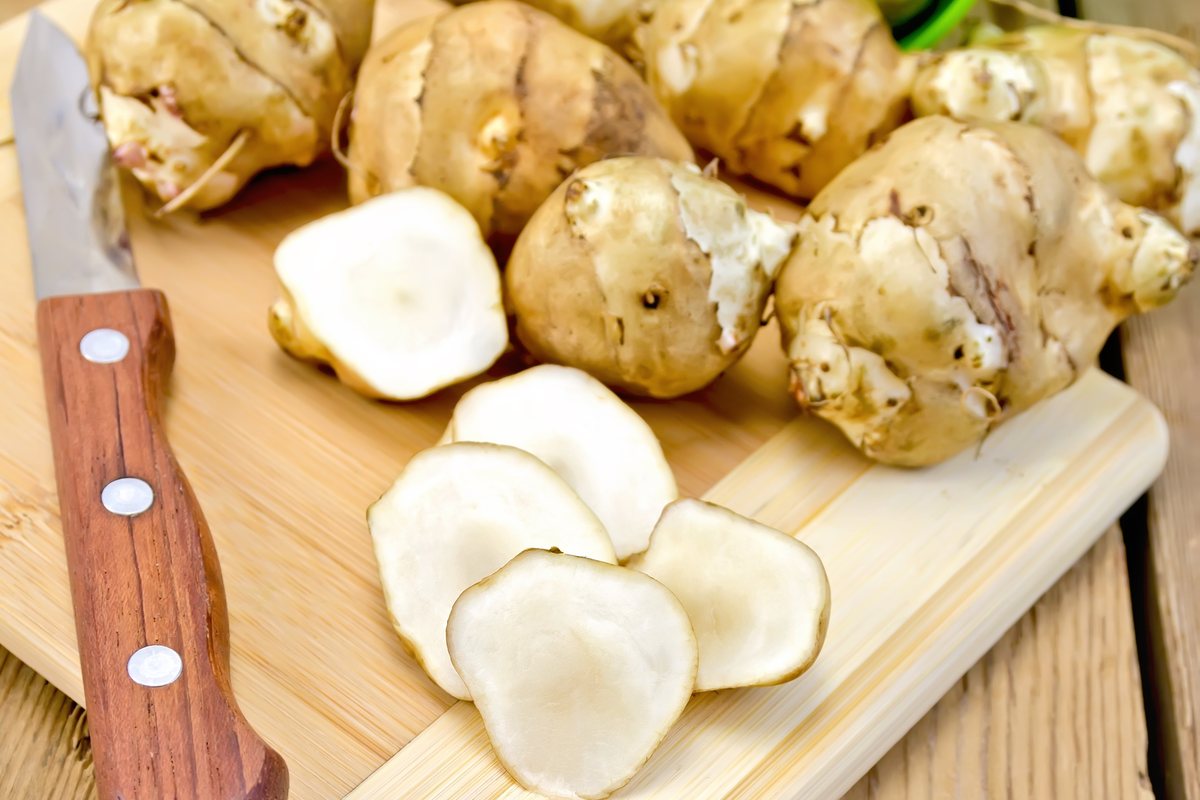
The name comes from the Brazilian Tupinambá, which were exhibited in Paris in the 17th century - they had nothing to do with the tuber.
Jerusalem artichokes originated in North America, where indigenous peoples used the tubers long before the arrival of Europeans. The plant arrived in France at the beginning of the 17th century and quickly spread throughout Europe. Before the potato became widespread, Jerusalem artichokes were an important winter vegetable in many places; afterwards, they were used as animal feed and for making schnapps.
In common parlance it is called Strawberry, earth artichoke, horse potato or Jerusalem artichoke. In Baden, the "Rossler" spirit is still distilled from it today. The plant is hardy, It grows over two meters tall, blooms yellow in autumn and is almost impossible to get rid of in the garden: Every forgotten tuber sprouts anew the following year.
To useWhat Jerusalem artichokes do for you
Fresh Jerusalem artichoke tubers consist of approximately 80 percent water. The majority of the dry mass is Inulin, a fructan made up of fructose building blocks that the small intestine cannot digest. Austrian nutritional tables list approximately 12 g of fiber, 2.4 g of protein, and almost 500 mg. potassium and approximately 3.5 mg iron per 100g. The USDA classifies inulin as a carbohydrate and therefore arrives at a higher calorie count.
In the large intestine, inulin serves as prebioticIn a study of baked goods containing Jerusalem artichoke or chicory inulin, the number of bifidobacteria in healthy adults increased significantly after three weeks. The EFSA has confirmed that 12 g of native chicory inulin per day increases stool frequency and thus contributes to normal bowel function. This cannot be directly extrapolated to the tuber, but it indicates the general trend.
Because inulin provides hardly any glucose, Jerusalem artichokes leave the Blood sugar They rise significantly less than potatoes – hence the old name "diabetic potato". However, hard evidence for better blood sugar control in humans is lacking. And: Intestinal bacteria ferment inulin into gases., Flatulence are almost certain with larger portions.
IngredientsThis is what's in Jerusalem artichokes
Jerusalem artichokes contain inulin and shorter fructooligosaccharides, protein, potassium, iron, magnesium, phosphorus, vitamins B1 and B3, some vitamin C, and phenolic acids such as chlorogenic acid. They contain virtually no starch.
The inulin content is highest in autumn. Over the course of the winter, some of it is converted into shorter sugar chains – late tubers therefore taste sweeter, but are often also somewhat more likely to cause bloating.
Enhanced combinationsWhat makes Jerusalem artichokes stronger
Jerusalem artichokes need seasoning that complements their nuttiness - and spices that ease digestion.
A classic remedy for bloating.
Brings out the aroma.
Keeps raw slices bright.
For oven-baked Jerusalem artichokes.
Enhances the flavor.
Half and half in the purée - better tolerated.
What contradicts itselfIt's best to avoid these combinations.
Increase the intensity slowly; the intestines will get used to it.
Fructans cause discomfort.
It shrinks in a few days.
It gets mushy quickly.
Thorough brushing is sufficient.
It turns brown when exposed to air.
In the kitchenWhere he belongs
- Jerusalem artichoke soupCreamy with hazelnut oil.
- Oven-baked Jerusalem artichokesWith thyme and garlic.
- Jerusalem artichoke chipsBaked paper-thin.
- Raw vegetable saladFinely grated with apple.
- pureeMixed with potatoes.
- GratinWith cream and nutmeg.
- Fried potato styleFried in slices.
- Winter vegetable stir-fryWith parsnip and carrot.
- Jerusalem artichoke röstiGrated with egg.
- CarpaccioRaw with lemon and herbs.
As a home remedyIntroduce Jerusalem artichokes carefully
The gentle introduction
- During the first week, eat only 2 to 3 slices raw or one small cooked tuber every other day.
- Season with caraway, fennel or coriander and chew well.
- From the second week onwards, gradually increase the amount if the stomach remains calm.
- Drink plenty of fluids, because inulin binds water in the intestines.
For anyone who wants to eat more fiber and nourish their gut flora with prebiotics without immediately experiencing bloating. The gut adapts, and gas production usually subsides after a few weeks.
As a side dish, 100 to 150 g per meal. Consult your doctor beforehand if you have irritable bowel syndrome, FODMAP intolerance, or have recently undergone bowel surgery.
Ayurveda & TCMWhat the old systems say
Ayurveda
Jerusalem artichokes are not described in classical Ayurveda. According to current classification, they are considered sweet, heavy, and gas-producing – suitable for Vata only when cooked and well-seasoned, balancing for Pitta, and in moderation for Kapha.
Traditional Chinese Medicine
Jerusalem artichoke is not a classic remedy in Traditional Chinese Medicine (TCM). In modern Chinese dietary theory, it is classified as sweet and cooling and is said to clear heat and moisten the intestines.
Warning noticesWhen you should be careful
Please note
- Flatulence: Inulin is fermented in the intestine - increase the amount slowly.
- Irritable bowel syndrome: Jerusalem artichokes are rich in fructans and unsuitable for a FODMAP diet.
- Fructose intolerance: Fructose is produced during breakdown; test carefully.
- Allergy: Rare; cross-reaction with other members of the Asteraceae family is possible.
- Diabetes: This is not a substitute for therapy - continue to measure blood sugar regularly.
This page provides information and does not replace medical advice. If symptoms persist, please consult a doctor.
Related to the topicRead on and cook along!
Shop links lead to our product pages; it is indicated there if a partner is involved.
SourcesWhat is this based on?
- Kleessen B et al. Jerusalem artichoke and chicory inulin in bakery products affect faecal microbiota of healthy volunteers. British Journal of Nutrition 2007; 98(3): 540–549.
- EFSA Panel on Dietetic Products, Nutrition and Allergies (NDA). Scientific Opinion on the substantiation of a health claim related to „native chicory inulin“ and maintenance of normal defecation by increasing stool frequency pursuant to Article 13.5 of Regulation (EC) No 1924/2006. EFSA Journal 2015; 13(1): 3951.
- Kays SJ, Nottingham SF. Biology and Chemistry of Jerusalem Artichoke: Helianthus tuberosus L. CRC Press, Boca Raton 2008.
- USDA FoodData Central: Jerusalem artichokes, raw.
- Public Health Portal of Austria (gesundheit.gv.at): Jerusalem artichoke.


