
Savoy cabbage (Brassica oleracea var. sabauda)
OriginThe cabbage from Savoy
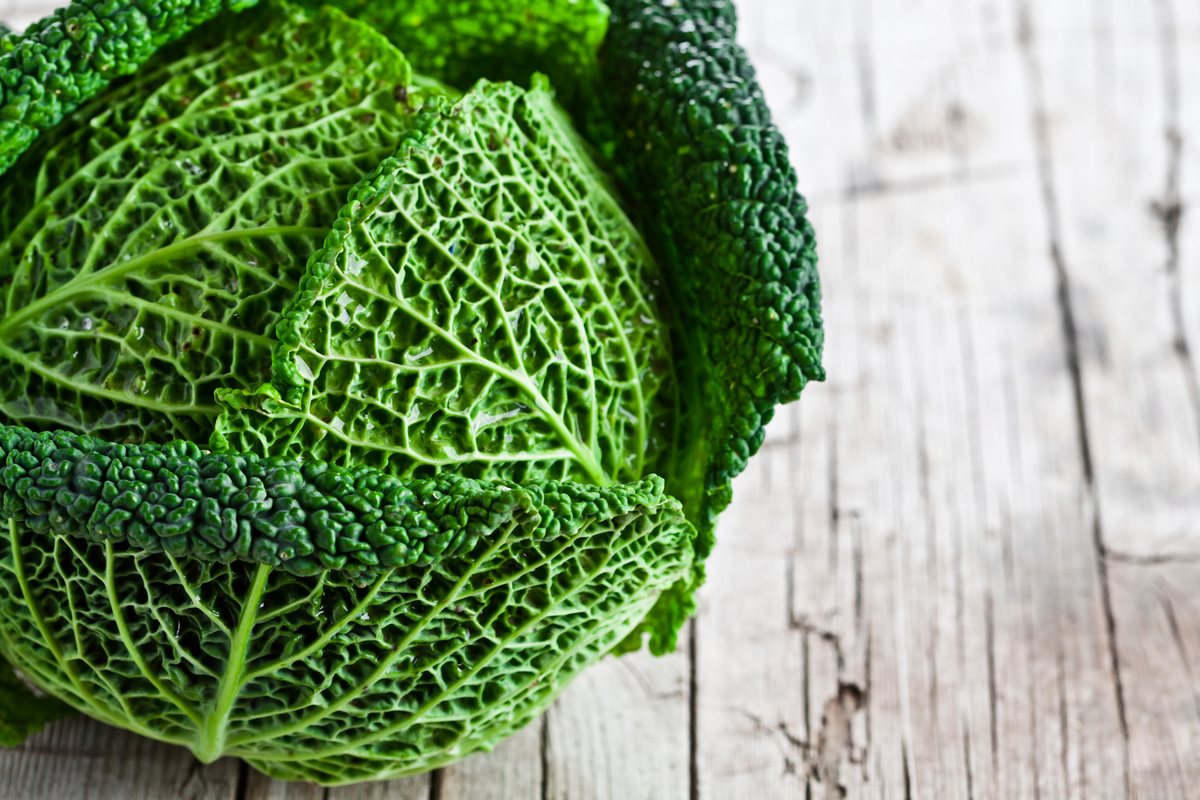
In English it's called Savoy cabbage, in Italian verza - and also its Latin name sabauda refers to Savoy.
Savoy cabbage probably originated in the Middle Ages in northern Italy and Savoy from the wild cabbage of the Mediterranean coast, like all cabbage varieties of the genus. Brassica oleracea. The word "savoy cabbage" came via Lombardy. verza into German.
In Germany, savoy cabbage is harvested almost year-round: early savoy cabbage with tender, light leaves from June onwards, and autumn and winter savoy cabbage with dark, firm leaves until spring. Winter savoy cabbage tolerates light frost and even becomes slightly sweeter as a result.
To useWhat savoy cabbage does for you
100g of raw savoy cabbage provides approximately 30mg Vitamin C, approximately 70 µg Vitamin K - approximately the daily requirement of an adult - and around 80 µg Folate. In addition, it contains fiber, potassium, and, in the dark green outer leaves, carotenoids such as lutein and beta-carotene. Some of the vitamin C is lost during cooking; brief steaming preserves it.
Like all cabbage varieties, savoy cabbage contains Glucosinolate, from which mustard oils (isothiocyanates) are produced when cut and chewed. Observational studies link a high consumption of cruciferous vegetables with a slightly lower risk of some types of cancer; whether this is due to the mustard oils is not certain.
Home remedies include Cabbage leaf wraps This is well known. A small study on knee osteoarthritis found pain relief similar to that achieved with a pain-relieving gel, but no better than standard treatment. Many women find cool cabbage leaves soothing for breast swelling during breastfeeding; however, the research on this is weak.
IngredientsThis is what's in savoy cabbage
Savoy cabbage contains vitamin C, vitamin K, folate, vitamin B6, vitamin A (as carotenoids), potassium, calcium, magnesium, and fiber. It also contains glucosinolates such as sinigrin and glucobrassicin, flavonoids such as kaempferol and quercetin, and chlorophyll in the dark leaves.
The outer leaves are more nutrient-rich than the paler interior. Wilted or damaged leaves should be removed, but the green leaves underneath should be eaten.
Enhanced combinationsWhat makes savoy cabbage stronger
Savoy cabbage loves fat, spices and short cooking times.
The classic remedy for flatulence.
For vitamin K and carotenoids.
Classically served in creamed savoy cabbage.
In the stew.
Wait 10 minutes before cooking.
For cabbage rolls.
What contradicts itselfIt's best to avoid these combinations.
Vitamins and mustard oils are lost.
Vitamin K affects coagulation values.
Cabbage causes bloating.
Store in a cool place, warm up once.
Safe when cooked.
It doesn't keep as long as white cabbage.
In the kitchenWhere he belongs
- Creamed savoy cabbageWith nutmeg.
- Savoy cabbage rollsWith lentil or meat filling.
- Savoy cabbage stewWith potatoes and carrots.
- Savoy cabbage pastaWith garlic and Parmesan cheese.
- Savoy cabbage stir-fryBriefly fried with onions.
- MinestroneWith beans.
- Savoy cabbage quicheWith cheese.
- Savoy cabbage saladFinely sliced and marinated.
- Savoy cabbage chipsLeaves baked in the oven.
- Cabbage soupWith caraway seeds.
As a home remedyCabbage poultice for joint pain
Cabbage leaf wrap
- Wash 2 to 3 large savoy cabbage or white cabbage leaves and cut out the thick central rib.
- Roll the leaves with a rolling pin or a bottle until some juice comes out.
- Place on the painful joint and loosely secure with a cloth or gauze bandage.
- Leave on for several hours or overnight, then wash off the skin.
Traditionally used for painful, swollen joints, such as those caused by knee osteoarthritis. During breastfeeding, cooled, rolled leaves are applied for 20 minutes to relieve milk stasis or breast engorgement. If fever, redness, or a general feeling of illness (suspected mastitis) occurs, a midwife or doctor should be consulted – a compress is not a substitute for medical treatment.
Once daily, for several days if needed. Do not apply to open wounds; discontinue use if skin irritation occurs.
Ayurveda & TCMWhat the old systems say
Ayurveda
In Ayurveda, cabbage is considered cooling, dry, and difficult to digest. It is said to balance Pitta and Kapha; for Vata, it should only be well-cooked and seasoned with warming spices such as cumin or ginger.
Traditional Chinese Medicine
In Traditional Chinese Medicine (TCM), cabbage is considered neutral to slightly cooling and sweet. It is said to strengthen the stomach and relieve upper abdominal pain; its juice is traditionally used for stomach ailments.
Warning noticesWhen you should be careful
Please note
- Anticoagulants: Those taking Marcumar or Phenprocoumon do not need to avoid savoy cabbage, but should eat regular amounts and discuss any major changes with their doctor.
- Flatulence: Cabbage can cause bloating - season with caraway and increase gradually, be careful if you have irritable bowel syndrome.
- Cabbage wraps: Do not apply to open skin; if breast inflammation is suspected with fever, consult a doctor.
- Thyroid: Large quantities of raw cabbage can strain the thyroid gland in cases of iodine deficiency; cooked and in normal quantities, it is safe.
- Storage: Cool cooked savoy cabbage quickly and store in the refrigerator.
This page provides information and does not replace medical advice. If symptoms persist, please consult a doctor.
Related to the topicRead on and cook along!
Shop links lead to our product pages; it is indicated there if a partner is involved.
SourcesWhat is this based on?
- USDA FoodData Central: Cabbage, Savoy, raw.
- Lauche R et al. Efficacy of cabbage leaf wraps in the treatment of symptomatic osteoarthritis of the knee: a randomized controlled trial. Clinical Journal of Pain 2016; 32(11): 961–971.
- Mangesi L, Zakarija-Grkovic I. Treatments for breast engorgement during lactation. Cochrane Database of Systematic Reviews 2016; (6): CD006946.
- Traka M, Mithen R. Glucosinolates, isothiocyanates and human health. Phytochemistry Reviews 2009; 8:269–282.
- German Nutrition Society (DGE): Reference values for nutrient intake - Vitamin K.


